CRISC: the full course
All five domains in study order. Arrow keys or space to move, F for full screen, or jump to a domain or topic below.
Certified in Risk and Information Systems Control
Domain 1: Governance · Domain 2: IT Risk Assessment · Domain 3: Risk Response and Reporting · Domain 4: Information Technology and Security
CRISCGovernance
Exam technique · Organisational governance · Policies and assets · Risk governance · Appetite and profile · Legal and compliance
Exam Technique: Thinking Like a Risk Practitioner
How CRISC questions are built, why two answers often look right, and a method for choosing the answer a risk practitioner would give: assess before acting, compare with appetite and let the owner decide.
The exam in numbers
| Item | Detail |
|---|---|
| Questions | 150 multiple choice, one best answer |
| Time | 4 hours |
| Scoring | Scaled 200-800; 450 passes |
| Weights (from Nov 2025) | Governance 26%, Assessment 22%, Response and Reporting 32%, IT and Security 20% |
| Experience to certify | 3 years in IT risk and IS control, across at least 2 domains |
Two answers look right
Most CRISC questions have two or three plausible options. A security engineer, an auditor and a risk practitioner would each pick differently. The exam wants the risk practitioner's answer: understand and assess the risk, then help the owner choose a response.
A method for every question
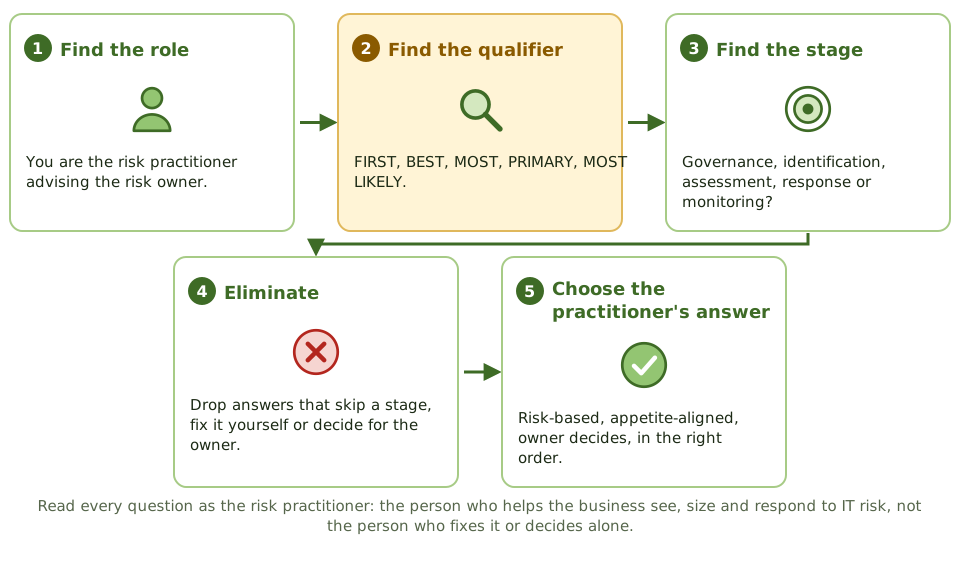
The practitioner's mindset
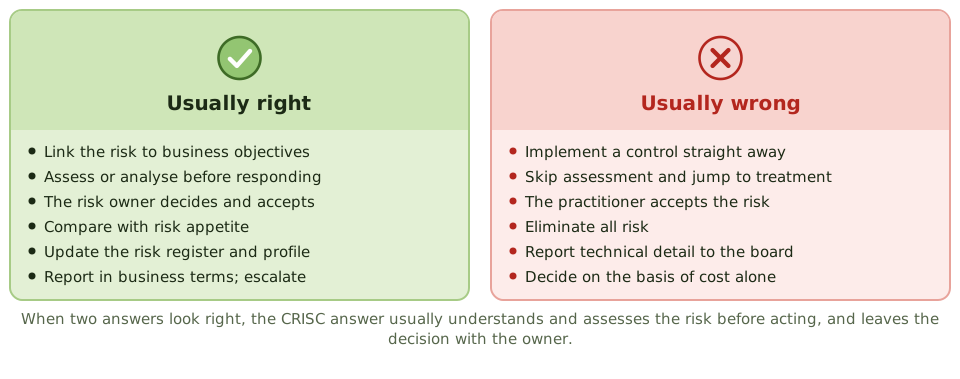
Reading the qualifiers
| Qualifier | What it's really asking |
|---|---|
| FIRST | Which step of the risk process comes before the others? |
| BEST / MOST effective | The option that best keeps risk within appetite for the business |
| PRIMARY / MAIN | The fundamental purpose, not a side benefit |
| MOST LIKELY | The probable cause or result, not the worst case |
| GREATEST concern / risk | What would hurt business objectives most |
Preparing well
- 1Learn the risk life cycle; most questions sit at one stage of it.
- 2For wrong answers, ask: which stage did that option skip?
- 3Study by weight: Domain 3 alone is 32% of the exam.
- 4Time: about 1.5 minutes per question; flag and return.
- 5Answer every question; there's no penalty for guessing.
Key takeaways
- ✓The CRISC exam has 150 multiple-choice questions in 4 hours; scores are scaled from 200 to 800 and 450 passes.
- ✓Every question is answered from the risk practitioner's viewpoint: identifying, assessing, responding to and reporting IT risk so the business can decide.
- ✓Read the qualifier: FIRST, BEST, MOST, PRIMARY and MOST LIKELY change which answer is right.
- ✓FIRST questions are about the risk process in order: context, identification, analysis, evaluation, response, monitoring.
- ✓The risk owner decides and accepts risk; the practitioner advises, facilitates and reports.
- ✓Answers that link risk to business objectives and appetite are usually right; answers that jump to a control are usually wrong.
Exam traps
- !Choosing to implement a control before the risk has been assessed.
- !Letting the risk practitioner, the CISO or IT accept a business risk.
- !Picking 'eliminate the risk'; the aim is risk within appetite.
- !Choosing the most technical answer instead of the risk-process answer.
- !Reporting technical detail to the board instead of business impact.
Aligning IT Risk Management with Business Strategy
Why IT risk management starts from the organisation's strategy and objectives, and how the risk practitioner links each IT risk to the business goal it threatens.
Why strategy comes first
IT risk is the risk that technology stops the business reaching its goals. A risk practitioner who doesn't know the goals can't tell which IT risks matter. That's why understanding strategy and objectives is the first step in every IT risk activity.
From goal to risk to control
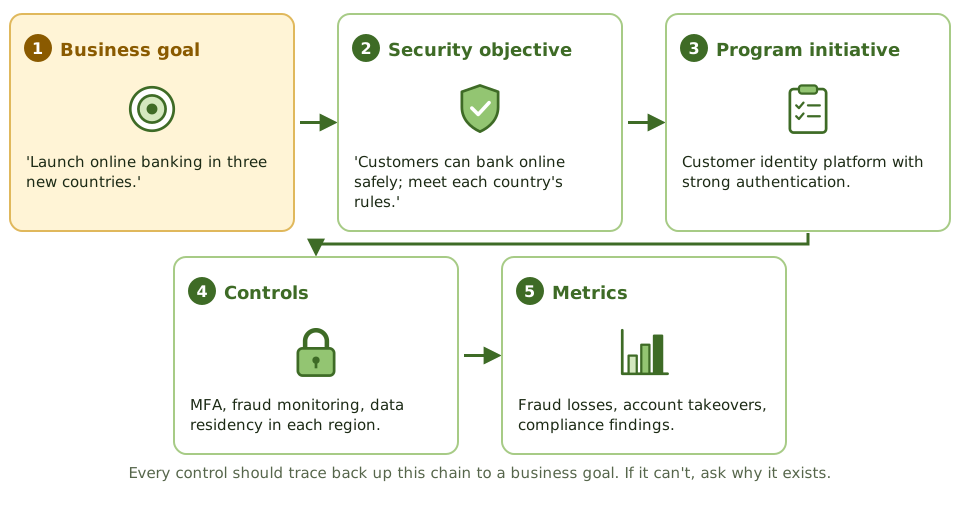
Risk supports strategy both ways
Speak the business's language
| Technical statement | Business statement |
|---|---|
| Unpatched web server | Possible theft of 2 million customer records and regulatory fines |
| Single database server | Online sales stop if it fails; about 40,000 an hour lost |
| Weak vendor access control | A supplier compromise could halt production |
When strategy changes
- 1Revisit the risk profile and top risks.
- 2Check whether risk appetite still fits.
- 3Reprioritise risk responses and resources.
- 4Update risk scenarios for new products, markets or technology.
How the exam asks about it
| If the question asks… | The answer is usually… |
|---|---|
| FIRST step in an IT risk assessment | Understand business objectives and context |
| MOST important when prioritising IT risks | Impact on business objectives |
| BEST way to get management attention | Express risk in business terms |
| After a major strategy change | Reassess the risk profile |
Key takeaways
- ✓IT risk matters only because it can stop the business achieving its objectives; every risk should trace back to one.
- ✓Understanding business strategy and objectives is the first step in any IT risk activity.
- ✓Risk management supports strategy in both directions: it protects existing goals and informs decisions about new ones.
- ✓Risks expressed in business terms get attention and funding; risks expressed in technical terms don't.
- ✓When strategy changes, the risk profile, priorities and appetite need to be revisited.
Exam traps
- !Starting a risk assessment with a vulnerability scan instead of the business objectives.
- !Treating IT risk as an IT problem rather than a business risk.
- !Assuming a technically severe issue is automatically a high business risk.
- !Leaving the risk program unchanged after a major change in strategy.
Organisational Structure, Roles and Decision Rights
Who does what in IT risk management, from the board to control owners, and why clear decision rights stop risks from falling between teams.
Who does what
| Role | Main responsibility in IT risk |
|---|---|
| Board / risk committee | Sets appetite; oversees the risk profile |
| Senior management | Owns risk management; sets policy and resources |
| Risk owners | Decide and act on specific risks |
| Risk practitioner / risk function | Facilitates, analyses, challenges, reports |
| Control owners | Design and run controls |
| Internal audit | Independent assurance |
Decision rights
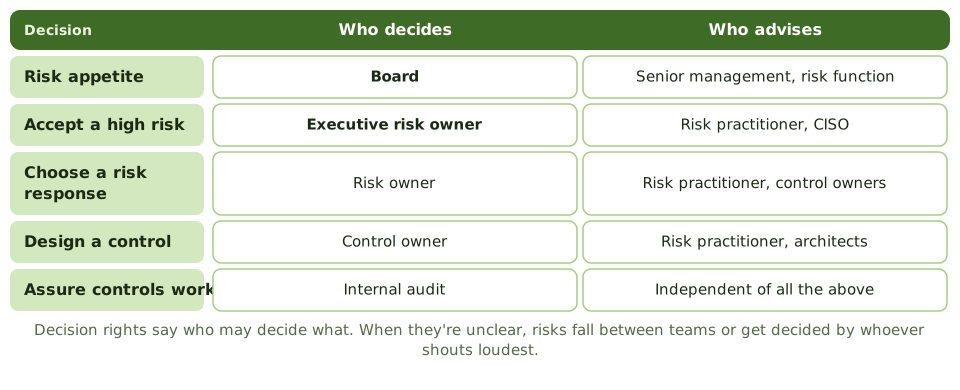
Committees
Structure creates or removes risk
- 1Unclear reporting lines: risks escalate to nobody.
- 2Overlapping roles: everyone assumes someone else owns it.
- 3Conflicts of interest: risk reports filtered by those affected.
- 4Fix with a RACI, named owners and an independent risk function.
How the exam asks about it
| If the question asks… | The answer is usually… |
|---|---|
| Who should accept an IT-related business risk | The business risk owner, at the right level |
| Role of the risk practitioner | Facilitate, analyse, advise and report |
| Who sets risk appetite | The board |
| Why define decision rights | So risks are owned and decided at the right level |
Key takeaways
- ✓The board sets direction and risk appetite; senior management owns and runs risk management; the risk function facilitates and challenges.
- ✓Decision rights define who may decide what: accept risk, choose a response, design a control or give assurance.
- ✓Risk owners are business managers with the authority and budget to act on the risk.
- ✓The risk practitioner advises, facilitates and reports; they don't own business risks.
- ✓Committees such as a risk committee or IT steering committee coordinate decisions across business units.
- ✓Organisational structure affects risk: unclear reporting lines and overlapping roles create gaps.
Exam traps
- !Making the risk practitioner or the CISO the owner of business risks.
- !Assuming IT owns all IT-related risk.
- !Letting internal audit design or approve the controls it will later assess.
- !Accepting high risks at a level without the authority to do so.
Risk Ownership and Accountability
What a risk owner is, how to choose one, and how accountability is made real through named owners, records, review and consequences.
What a risk owner is
The risk owner is the person accountable for managing a risk, with the authority and budget to act on it. It's usually the business manager whose process or objectives the risk threatens, not the person who runs the technology.
Choosing the owner
| Risk | Owner | Not the owner |
|---|---|---|
| Payment fraud in the finance system | CFO | Finance system administrator |
| Customer portal outage | Head of digital sales | Hosting team |
| Supplier data breach | Business owner of the service | Procurement clerk |
What owners do
- 1Understand the risk and its impact on their objectives.
- 2Choose a response from the options offered.
- 3Accept residual risk within their authority.
- 4Fund and track treatment plans.
- 5Report status and escalate when needed.
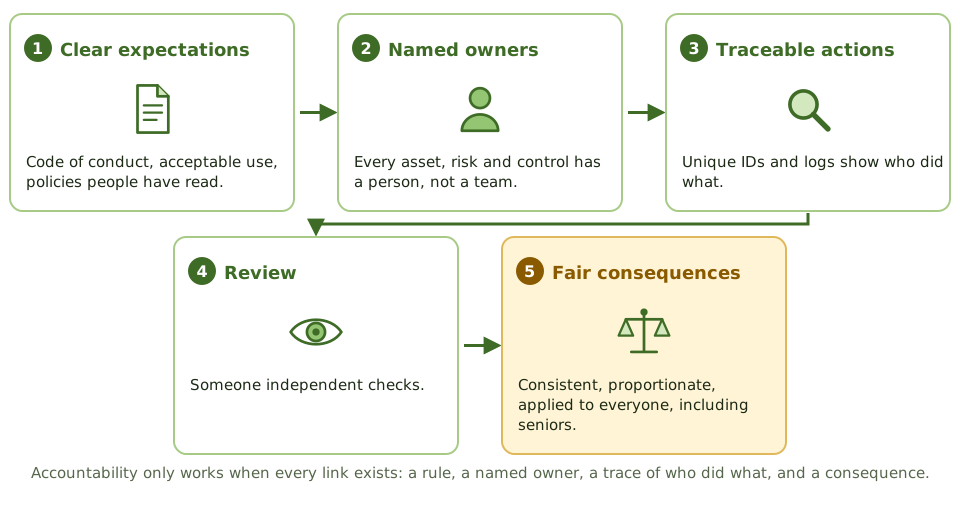
Making accountability real
How the exam asks about it
| If the question asks… | The answer is usually… |
|---|---|
| Who should own an IT-related risk | The business manager accountable for the affected process |
| MOST important attribute of a risk owner | Authority and accountability to act |
| Who accepts residual risk | The risk owner, within their authority |
| Role of the risk practitioner | Help owners understand and manage their risks |
Key takeaways
- ✓A risk owner is the person with the accountability and authority to manage a risk, usually the business manager whose objectives it threatens.
- ✓Every risk in the register needs one named owner, a person rather than a team.
- ✓Owners decide the response, accept residual risk within their authority and report on progress.
- ✓Accountability needs clear expectations, named owners, traceable actions, review and fair consequences.
- ✓The risk practitioner helps owners understand their risks but never takes ownership from them.
Exam traps
- !Assigning ownership to IT because the risk involves a system.
- !Assigning a committee or department as owner instead of a person.
- !Treating the person who found the risk as its owner.
- !Allowing an owner to accept a risk above their authority.
Segregation of Duties
Why separating key duties reduces the risk of error and fraud, the combinations that matter most in IT, and what to do when a small team can't separate them.
What SoD prevents
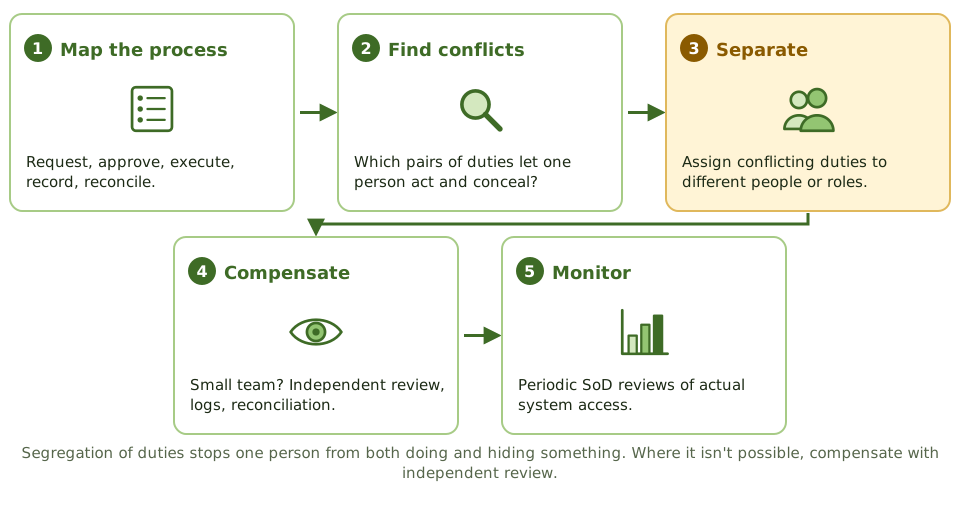
Segregation of duties splits a task so that no single person can both carry it out and hide a mistake or fraud. It's one of the oldest and most effective controls against insider risk.
Separating duties step by step
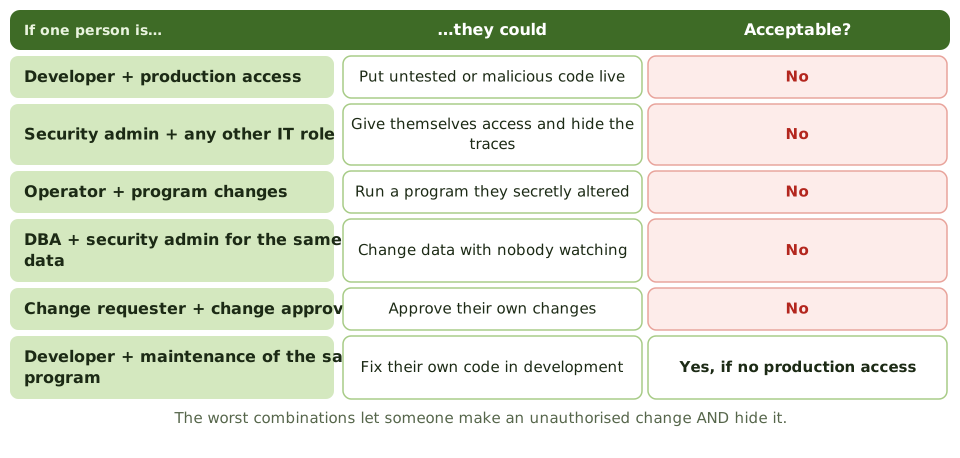
IT conflicts that matter
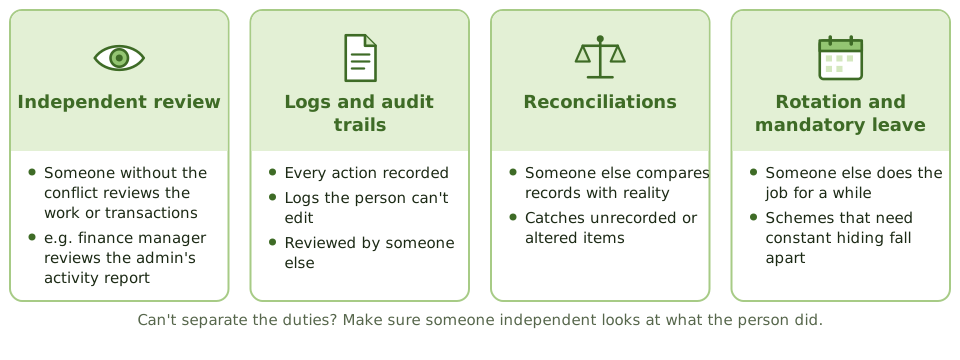
When you can't separate
How the exam asks about it
| If the question asks… | The answer is usually… |
|---|---|
| BEST evidence of SoD | Actual system access compared with an SoD rule set |
| Small team can't separate duties | Compensating controls by someone independent |
| GREATEST SoD risk in IT | A developer or admin who can change production and hide it |
| Purpose of SoD | Prevent one person committing and concealing errors or fraud |
Key takeaways
- ✓Segregation of duties (SoD) means no single person can both carry out and conceal an error or fraud.
- ✓Classic duties to separate are authorising, recording, custody of assets and reconciling.
- ✓In IT, the worst conflicts let someone change systems or access and also hide it.
- ✓Where SoD isn't practical, compensating controls such as independent review, logging and reconciliation reduce the risk.
- ✓SoD must be checked against actual system access, not job descriptions.
Exam traps
- !Relying on job descriptions or org charts to prove segregation.
- !Choosing 'hire more staff' as the answer for a small team; compensating controls are expected.
- !Accepting compensating controls performed by the same person who holds the conflict.
- !Forgetting that privileged IT users can often bypass application-level SoD.
Risk Culture and Tone at the Top
What risk culture is, how leaders shape it, how to recognise a healthy one, and how a risk awareness program helps people raise risks early.
What risk culture is
Risk culture is how people actually treat risk when no rule tells them what to do: whether they raise problems, take shortcuts or ask before acting. It decides whether policies work in practice.
Where culture comes from
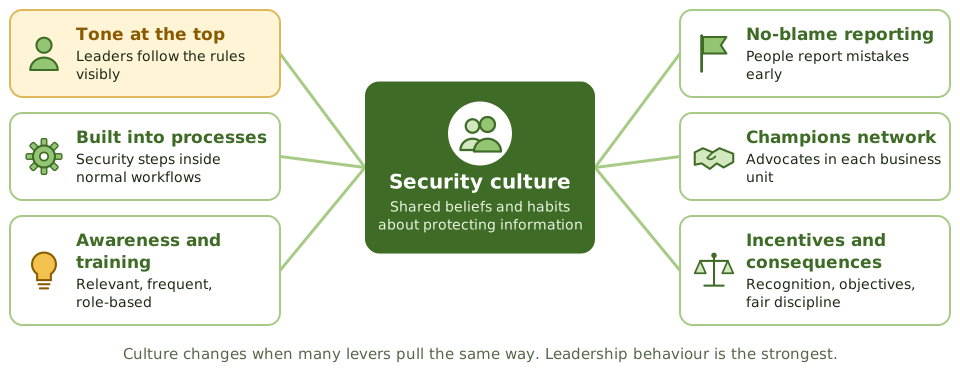
Healthy versus weak
| Healthy risk culture | Weak risk culture |
|---|---|
| Risks raised early by the business | Risks found only by audit |
| Bad news travels up quickly | Incidents hidden or downplayed |
| Leaders follow the rules | Exceptions for senior staff |
| Mistakes treated as learning | Blame and fear |
Risk awareness program
- 1Explain what IT risk means in each role.
- 2Show how to report risks and incidents, simply.
- 3Use real examples from the organisation and its sector.
- 4Repeat regularly; measure behaviour, not attendance.
How the exam asks about it
| If the question asks… | The answer is usually… |
|---|---|
| GREATEST influence on risk culture | Tone at the top: leaders' behaviour |
| Sign of a healthy culture | Risks raised openly by the business |
| BEST way to improve reporting | No-blame reporting, easy channels |
| Purpose of risk awareness | Everyone recognises and reports risk in their work |
Key takeaways
- ✓Risk culture is the shared values, attitudes and behaviours that decide how people treat risk when no rule tells them what to do.
- ✓Tone at the top is the strongest influence: people copy what leaders do and reward, not what policies say.
- ✓Healthy cultures raise risks early, discuss them openly and don't punish honest reporting.
- ✓Signs of a weak culture include hidden incidents, routine workarounds and risks discovered only by audit.
- ✓A risk awareness program helps everyone recognise and report risk in their own work.
Exam traps
- !Trying to fix culture with stricter policies or penalties alone.
- !Treating awareness as a once-a-year training event.
- !Assuming a culture is healthy because few incidents are reported.
- !Measuring culture by training completion rather than behaviour.
Ethics and Professional Conduct
The ISACA Code of Professional Ethics, why ethics matters in risk work, and how a risk practitioner handles pressure to soften, hide or misreport risk.
Why ethics matters in risk work
Risk reports guide decisions worth millions. If ratings are softened to please someone, or risks quietly dropped, the board decides on false information. The value of the risk function depends on its honesty.
ISACA Code of Ethics
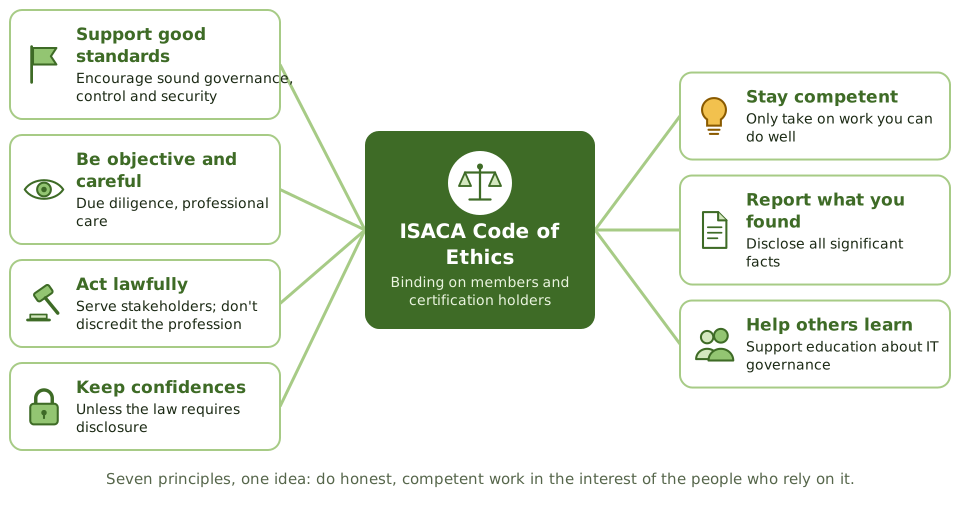
Pressure to change a rating
- 1 Ask for new evidence
- 2 Re-assess objectively
- 3 Document both views
- 4 Escalate if unresolved
Other ethical duties
- 1Protect confidential information; don't use it for gain.
- 2Declare conflicts of interest; step back if needed.
- 3Take on only work you're competent to do.
- 4Decline gifts that could affect objectivity.
How the exam asks about it
| If the question asks… | The answer is usually… |
|---|---|
| Manager asks to lower a rating | Keep it unless evidence changes; escalate |
| Practitioner has a conflict of interest | Disclose it and step back |
| Internal escalation fails on a legal issue | Seek legal advice on reporting duties |
| Purpose of the code of ethics | Objective, competent, honest professional work |
Key takeaways
- ✓CRISC holders must follow ISACA's Code of Professional Ethics; breaches can lead to disciplinary action.
- ✓Ethical risk work means reporting risks objectively and completely, even when the news is unwelcome.
- ✓Pressure to downgrade a risk rating or leave a risk out of a report must be resisted and, if needed, escalated.
- ✓Confidential information gained in risk work must be protected and not used for personal benefit.
- ✓Practitioners take on only work they're competent to do, and declare conflicts of interest.
Exam traps
- !Lowering a risk rating because a senior manager asks, without new evidence.
- !Going straight to the media or regulator before using internal escalation.
- !Using confidential information for personal gain.
- !Accepting gifts or favours from those whose risks you assess.
Policies, Standards, Procedures and Guidelines
How the policy framework turns management intent into specific requirements and steps, and why it's one of the main ways risk appetite becomes day-to-day behaviour.
The hierarchy
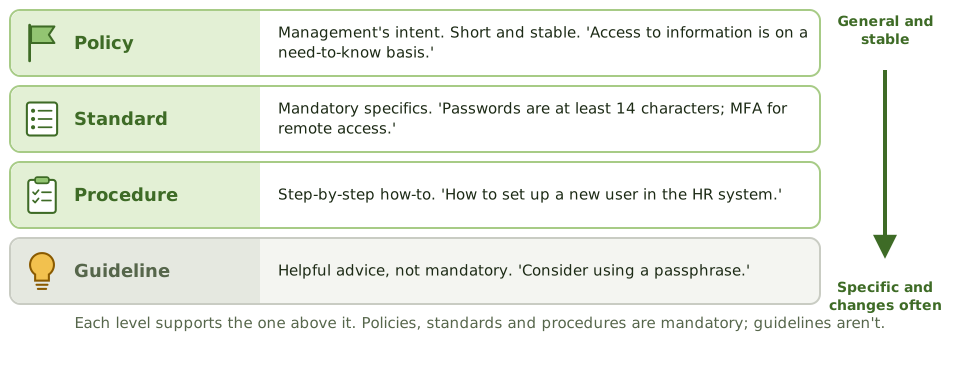
What goes where
| Document | Example | Mandatory? |
|---|---|---|
| Policy | Access is granted on a need-to-know basis | Yes |
| Standard | MFA for all remote access; 14-character passwords | Yes |
| Procedure | How to request and approve access in the HR system | Yes |
| Guideline | Consider a password manager | No |
Policies carry risk appetite
When the board says it has a low appetite for data loss, the policy framework is how that becomes real: a data protection policy, encryption standards and handling procedures. Without it, appetite stays a statement on paper.
What makes a good policy
- 1Approved by senior management.
- 2Short, clear and technology-neutral.
- 3A named owner and a review date.
- 4Realistic: people can actually follow it.
- 5Supported by standards, procedures and an exception process.
How the exam asks about it
| If the question asks… | The answer is usually… |
|---|---|
| Who approves policy | Senior management or the board |
| Where specific technical requirements belong | Standards |
| Which document is advisory | Guidelines |
| Why keep policies high level | So they stay stable as technology changes |
Key takeaways
- ✓Policies state management's intent and are approved by senior management; standards, procedures and guidelines support them.
- ✓Policies, standards and procedures are mandatory; guidelines are advice.
- ✓Policies should be high level and stable; technology-specific detail belongs in standards.
- ✓The policy framework is how risk appetite and control requirements reach everyday work.
- ✓Policies need owners, review dates and an exception process to stay useful.
Exam traps
- !Putting technical settings in the policy, so it needs constant re-approval.
- !Treating guidelines as mandatory.
- !Having policies approved by IT staff instead of senior management.
- !Writing policies that can't realistically be followed.
Policy Lifecycle, Exceptions and Enforcement
How policies are drafted, approved, communicated, enforced and reviewed, and how exceptions are handled so that departures from policy stay visible, owned and time-limited.
The life cycle
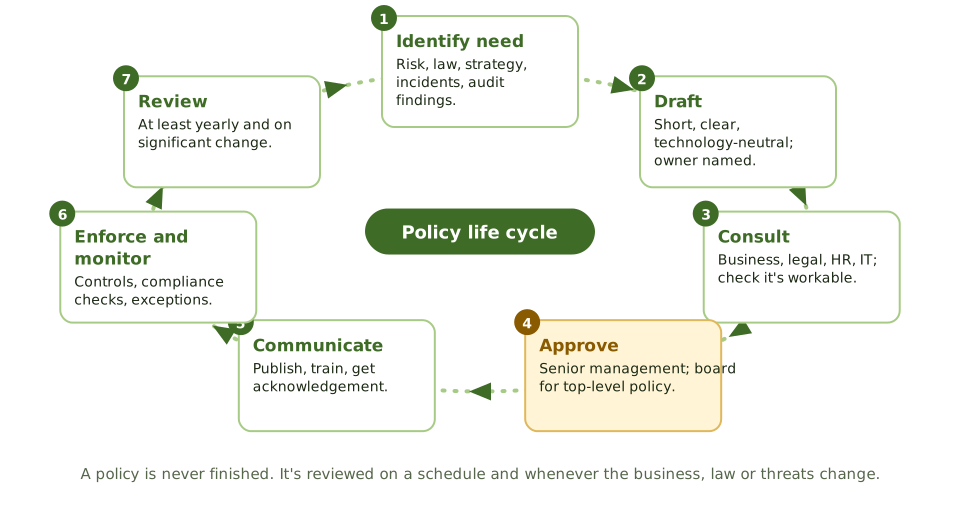
Exceptions
Sometimes a system or process can't meet a policy, for a good reason. An exception lets that happen safely: the risk is assessed, compensating controls are added, the owner accepts what's left, and it expires on a set date.
What an exception record holds
| Field | Why it matters |
|---|---|
| Requirement not met | So everyone knows the gap |
| Reason and business need | Shows it's justified |
| Risk rating and compensating controls | Keeps risk visible and reduced |
| Owner and approver | Accountability at the right level |
| Expiry date | Forces a review instead of permanence |
Enforcement
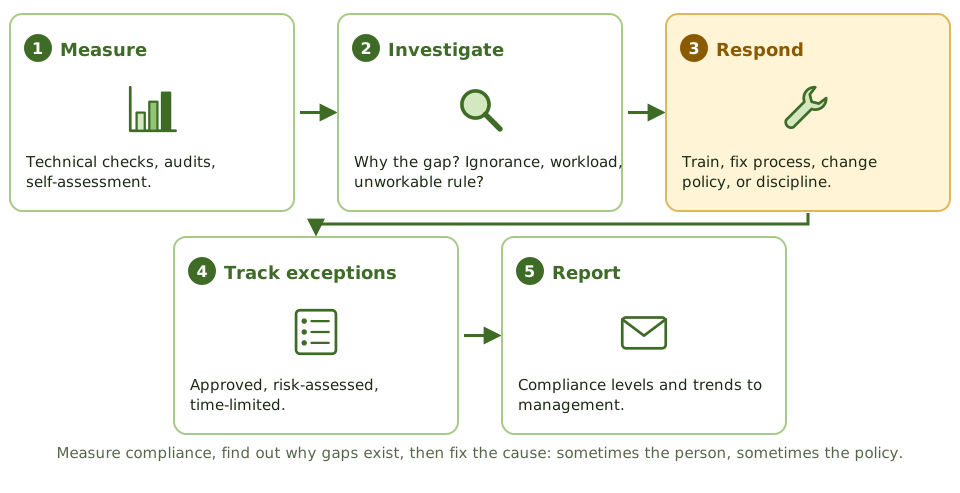
How the exam asks about it
| If the question asks… | The answer is usually… |
|---|---|
| System can't meet policy | Formal exception with compensating controls and expiry |
| Widespread non-compliance | Find out why before enforcing |
| When to review policy | At least yearly and on significant change |
| Who approves an exception | The risk owner with suitable authority |
Key takeaways
- ✓Policies follow a life cycle: identify need, draft, consult, approve, communicate, enforce and review.
- ✓Review policies at least yearly and when the business, law or threats change.
- ✓An exception is a formally approved, risk-assessed and time-limited departure from policy.
- ✓Every exception needs an owner, compensating controls where possible, and an expiry date.
- ✓When many people break a policy, find out why: the policy may be unworkable.
Exam traps
- !Approving exceptions by email with no record or expiry.
- !Rewriting the policy to remove a requirement just because one system can't meet it.
- !Disciplining everyone when widespread non-compliance points to a bad policy.
- !Letting exceptions renew automatically without review.
Business Process Review: Ownership and Criticality
How reviewing business processes shows where IT risk really matters: which processes are critical, who owns them and which systems, data, people and suppliers they depend on.
Why processes come first
A server failing only matters because of what stops when it fails. Business process review links IT assets to the work they support, so the risk practitioner can judge impact in business terms rather than technical ones.
The review step by step
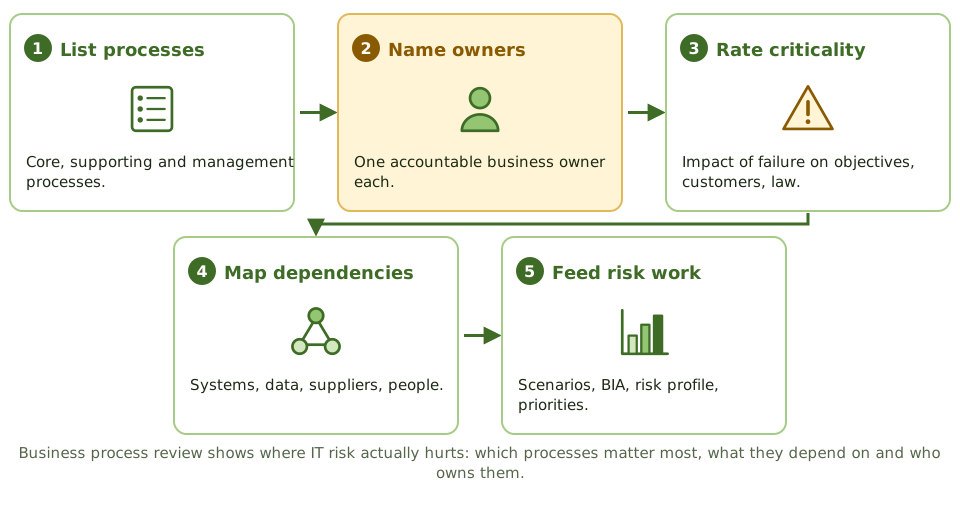
Rating criticality
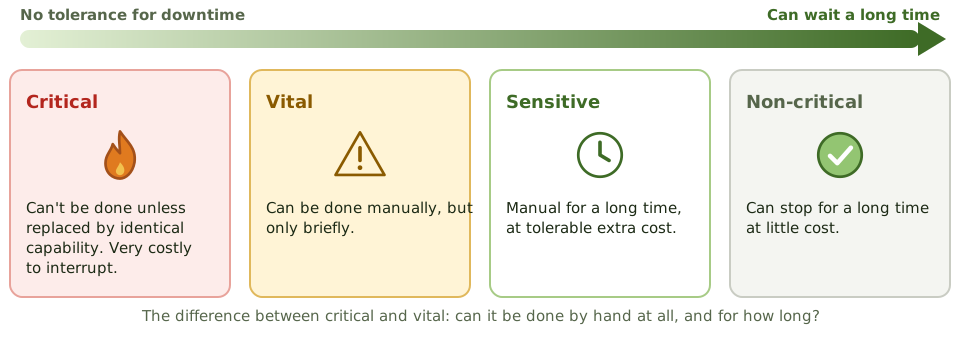
Hidden dependencies
- 1End-user spreadsheets in critical calculations.
- 2A single expert who knows how a system works.
- 3Suppliers and cloud services in the chain.
- 4Shared infrastructure such as identity and DNS.
How the exam asks about it
| If the question asks… | The answer is usually… |
|---|---|
| BEST basis for rating IT asset importance | Criticality of the business processes it supports |
| Who owns a business process | A named business manager |
| Purpose of mapping dependencies | Find what each process relies on, including hidden items |
| Output used for | Scenarios, BIA, continuity and the risk profile |
Key takeaways
- ✓IT risk is felt through business processes, so understanding processes comes before assessing IT risk.
- ✓Every key process needs one accountable business owner.
- ✓Criticality depends on the impact of the process failing on objectives, customers, finances and legal duties.
- ✓Mapping dependencies shows which systems, data, suppliers and people each process relies on.
- ✓Process reviews feed risk scenarios, the BIA, continuity planning and the risk profile.
Exam traps
- !Rating systems by technical importance instead of the processes they support.
- !Assuming IT owns the process because it runs the system.
- !Missing hidden dependencies such as spreadsheets, suppliers or key individuals.
- !Reviewing processes once and never updating after change.
Identifying and Valuing Organisational Assets
Which assets matter for IT risk (information, systems, people, suppliers and intangibles), how to find them and how to value them by business impact rather than purchase price.
What counts as an asset
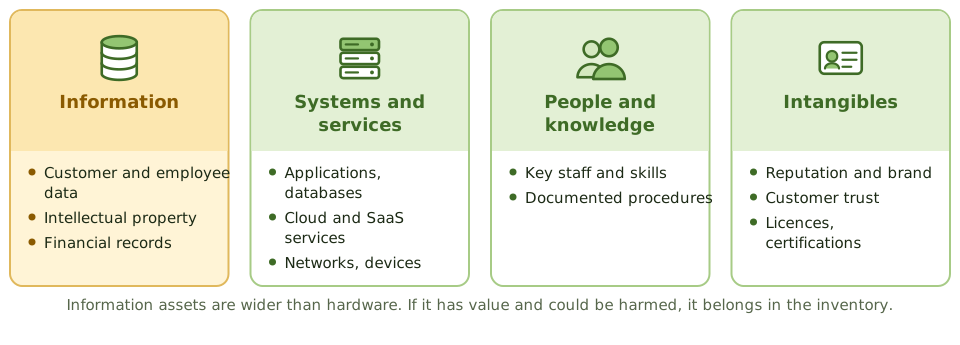
Finding assets
- 1Automated discovery on networks and cloud accounts.
- 2Business process reviews and interviews.
- 3Procurement and contract records.
- 4Data discovery for sensitive information.
Valuing assets
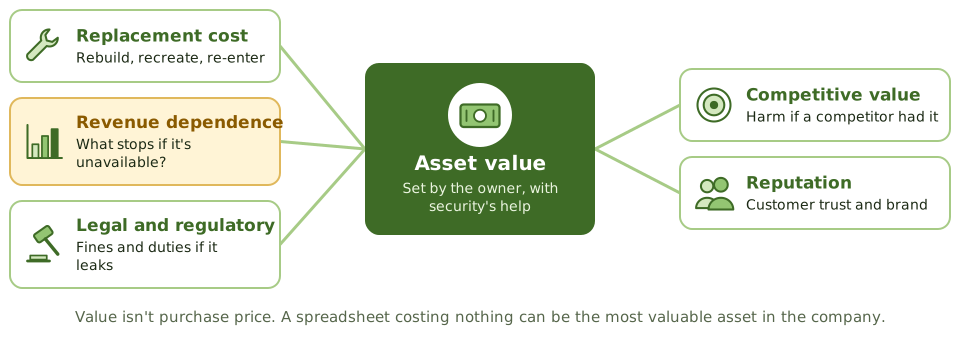
Who values them
| Role | Contribution |
|---|---|
| Asset owner (business) | Sets value and classification |
| Risk practitioner | Provides method and criteria; challenges |
| IT / custodian | Provides technical facts and dependencies |
How the exam asks about it
| If the question asks… | The answer is usually… |
|---|---|
| BEST basis for asset value | Business impact of losing it |
| Who sets asset value | The business owner |
| FIRST step before assessing risk to assets | Identify and inventory them |
| MOST complete inventory method | Automated discovery reconciled with business input |
Key takeaways
- ✓Assets include information, systems, infrastructure, people, suppliers and intangibles such as reputation.
- ✓Identifying assets is an early step in risk assessment; you can't assess risk to something you don't know about.
- ✓Value comes from business impact if confidentiality, integrity or availability is lost, not from purchase price.
- ✓The asset owner, a business manager, sets value and classification with the practitioner's help.
- ✓Automated discovery plus business input gives the most complete inventory.
Exam traps
- !Valuing information by the cost of the server that stores it.
- !Listing only hardware and software, missing data, people and suppliers.
- !Building the inventory from purchase records alone.
- !Letting IT set the value of business information.
Embedding Asset Management into Risk Governance
How keeping the asset inventory accurate through its life cycle supports every other risk activity, and the risks that appear when assets are unknown, unowned or untracked.
Why it matters
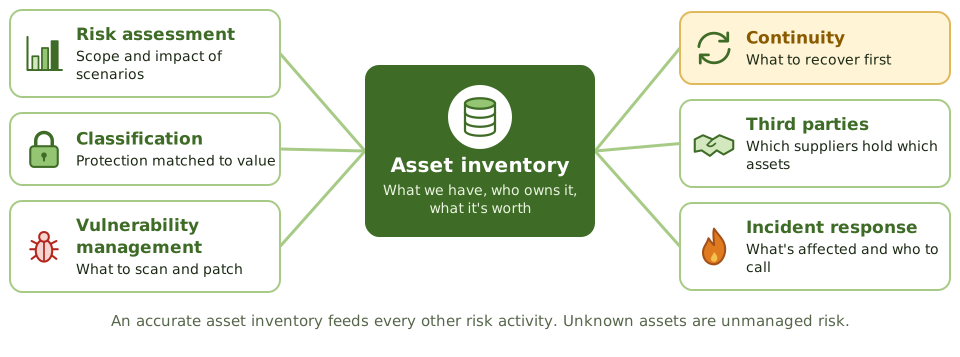
Tracking the life cycle
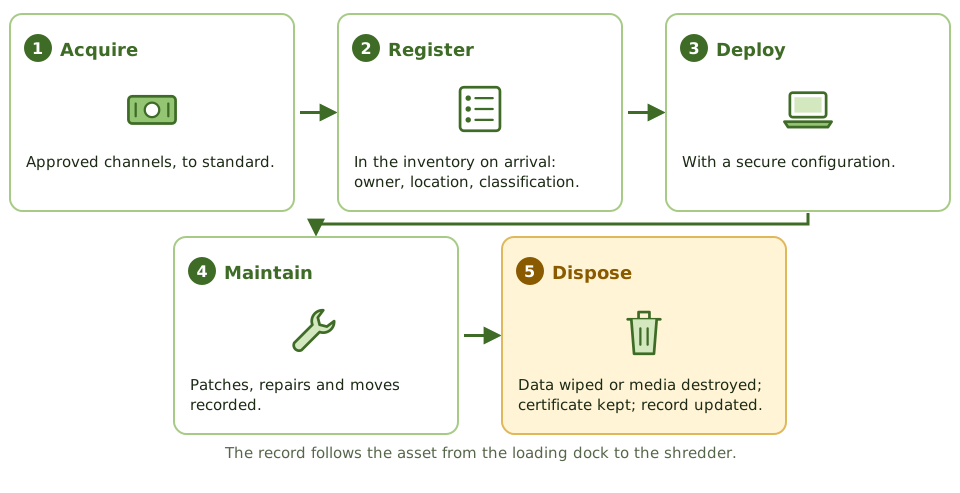
Risks from poor asset management
| Gap | Resulting risk |
|---|---|
| Unknown devices or cloud services | Unpatched, unmonitored, unprotected |
| No owner | Nobody decides on risk or retirement |
| Inventory not updated on change | Wrong impact analysis in incidents |
| Poor disposal | Data leaks from retired equipment |
Keeping it accurate
- 1Link the inventory to change management and procurement.
- 2Reconcile automated discovery regularly.
- 3Require owners to confirm their assets periodically.
- 4Track disposals with certificates of destruction.
How the exam asks about it
| If the question asks… | The answer is usually… |
|---|---|
| GREATEST risk of an incomplete inventory | Unknown assets aren't protected |
| BEST way to keep inventory current | Link to change management and automated discovery |
| Asset with no owner | Assign an owner before assessing or treating |
| Disposal control | Secure wiping or destruction with evidence |
Key takeaways
- ✓An accurate asset inventory feeds risk assessment, classification, vulnerability management, continuity and incident response.
- ✓Assets must be tracked through their whole life cycle, from acquisition to disposal.
- ✓Every asset needs an owner; ownerless assets are rarely patched, reviewed or retired.
- ✓Unknown assets, including shadow IT, are unmanaged risk.
- ✓Change management should update the inventory so it doesn't drift from reality.
Exam traps
- !Treating the inventory as a one-off project rather than a continuous process.
- !Forgetting disposal: data left on retired equipment.
- !Allowing cloud services bought on credit cards to stay off the inventory.
- !Accepting an inventory without owners as complete.
Enterprise Risk Management: Purpose and Principles
What enterprise risk management is, the principles that make it work, and how IT risk fits into the enterprise view so the board can compare it with every other risk.
What ERM is
Enterprise risk management looks at all the organisation's risks together, strategic, financial, operational, compliance and technology, and manages them in line with strategy and the board's appetite. Its aim is to help the organisation achieve its objectives, not just avoid losses.
Principles that make it work
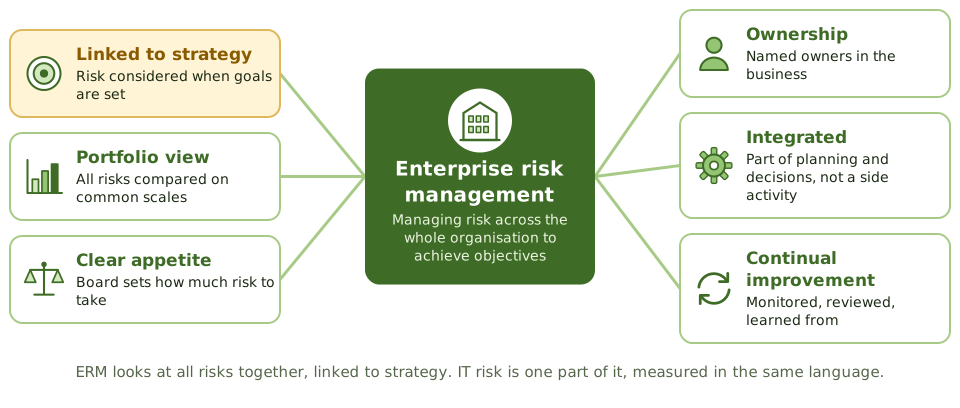
Where IT risk fits
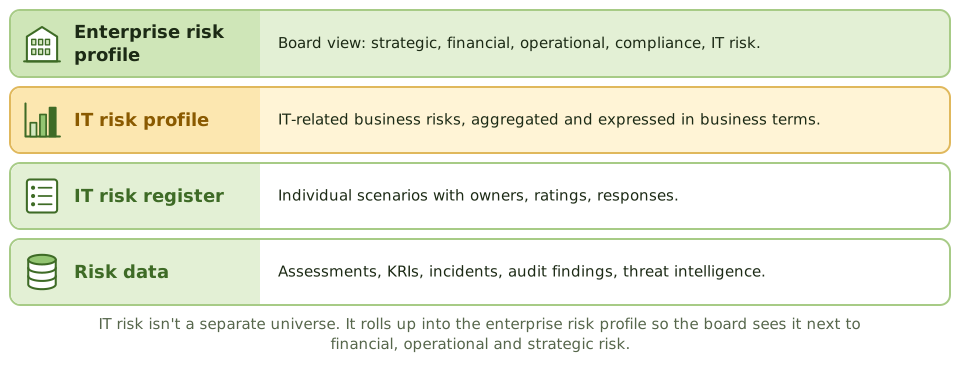
Why integration matters
- 1One risk language and common scales.
- 2IT risks compete fairly for attention and funding.
- 3Concentrations across categories become visible.
- 4Decisions weigh technology risk alongside other risks.
How the exam asks about it
| If the question asks… | The answer is usually… |
|---|---|
| BEST way to manage IT risk at enterprise level | Integrate it into ERM with common scales |
| PRIMARY purpose of ERM | Help achieve objectives within appetite |
| Benefit of a portfolio view | Compare and prioritise all risks together |
| IT risk is… | A category of business risk |
Key takeaways
- ✓ERM manages all of an organisation's risks together, linked to strategy and objectives.
- ✓IT risk is a category of business risk and should be managed within ERM, not separately.
- ✓A portfolio view on common scales lets the board compare and prioritise risks of all kinds.
- ✓ERM works when it's integrated into planning and decisions, with clear appetite and named owners.
- ✓Risk management aims to support value creation, not just avoid losses.
Exam traps
- !Running IT risk in a silo with its own scales and register.
- !Treating ERM as a compliance exercise disconnected from decisions.
- !Assuming ERM's goal is to minimise all risk.
- !Reporting IT risk to the board in technical terms that can't be compared with other risks.
The Risk Practitioner's Role in ERM
What the CRISC-certified risk practitioner actually does inside enterprise risk management, and the line between advising on risk and owning it.
What the practitioner does
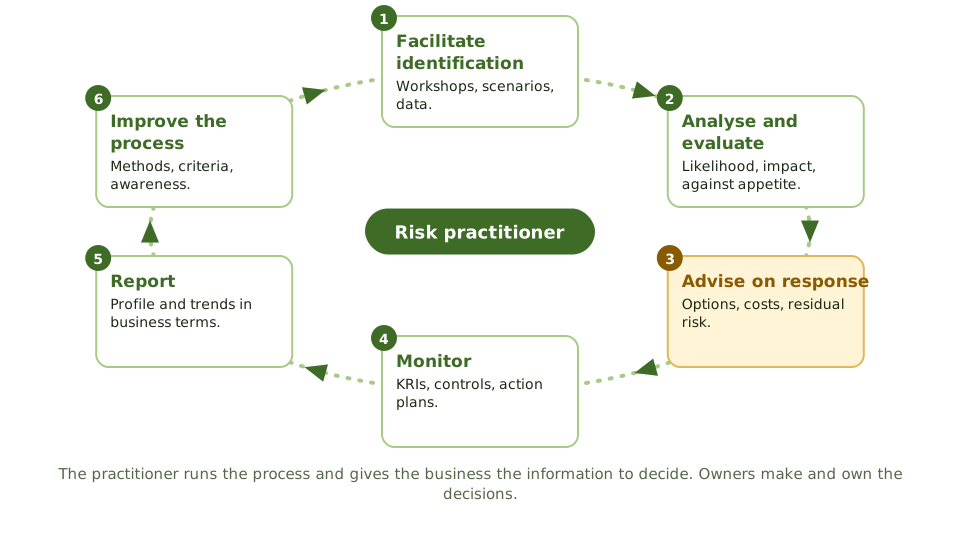
Advise, don't own
| Practitioner | Risk owner |
|---|---|
| Identifies and analyses the risk | Understands its impact on objectives |
| Presents response options and costs | Chooses the response |
| Checks residual risk against appetite | Accepts residual risk |
| Monitors and reports | Delivers the treatment plan |
The translator
IT talks about vulnerabilities and outages; the board talks about revenue, customers and regulators. The practitioner translates technical findings into business impact, and business priorities into risk criteria IT can work with.
Constructive challenge
- 1Question ratings that don't match evidence.
- 2Ask what assumptions sit behind an estimate.
- 3Compare with incidents, industry data and peer experience.
- 4Escalate material disagreements; don't silently accept them.
How the exam asks about it
| If the question asks… | The answer is usually… |
|---|---|
| PRIMARY role of the risk practitioner | Help the business make informed risk decisions |
| Owner rates a risk too low | Challenge with evidence; escalate if material |
| Who implements the control | The control owner, not the practitioner |
| Practitioner's line of defence | Usually the second line |
Key takeaways
- ✓The risk practitioner facilitates identification, analyses and evaluates risk, advises on responses, monitors and reports.
- ✓Owners decide and accept; the practitioner makes sure decisions are informed and recorded.
- ✓The practitioner translates between IT and the business, in both directions.
- ✓Challenging optimistic or incomplete risk assessments is part of the job.
- ✓The practitioner improves the risk process itself: methods, criteria, tools and awareness.
Exam traps
- !The practitioner accepting or owning a business risk.
- !The practitioner implementing controls instead of advising on them.
- !Accepting the business's risk rating without challenge.
- !Acting as an auditor rather than a second-line adviser.
The Three Lines Model and Risk Oversight
How the Three Lines Model divides responsibility for owning risk, overseeing it and giving independent assurance, and where the risk practitioner and IT sit.
The three lines
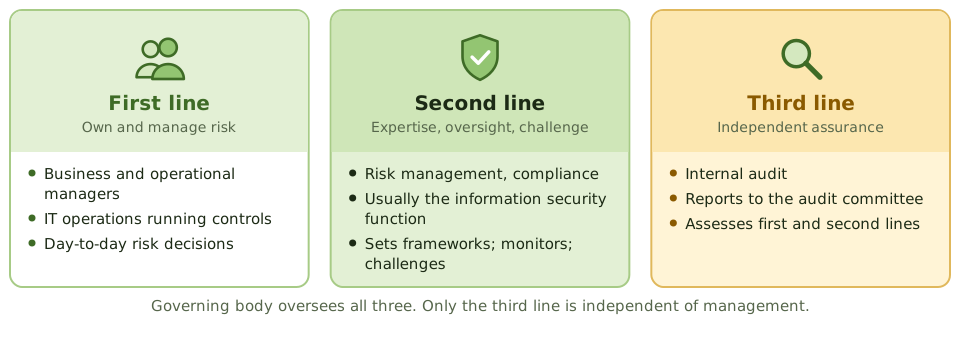
Where IT roles sit
| Role | Usual line |
|---|---|
| Business process owners | First |
| IT operations and development | First |
| IT risk function, risk practitioner | Second |
| Compliance, often information security | Second |
| Internal audit | Third |
Keeping the lines clean
- 1First line owns risk and runs controls.
- 2Second line sets method, monitors and challenges, but doesn't own.
- 3Third line stays independent; it doesn't design or run controls.
- 4All coordinate so effort isn't duplicated and gaps don't appear.
How the exam asks about it
| If the question asks… | The answer is usually… |
|---|---|
| Who provides independent assurance | Internal audit (third line) |
| Who owns IT operational risk | First-line management |
| Role of the risk function | Second line: frameworks, monitoring, challenge |
| Who oversees all three | The governing body |
Key takeaways
- ✓The first line owns and manages risk: business and operational management, including IT operations.
- ✓The second line provides expertise, frameworks, monitoring and challenge: risk management, compliance and often security.
- ✓The third line, internal audit, provides independent assurance to the governing body.
- ✓The governing body oversees all three and is accountable for risk governance.
- ✓Each line must keep its role: the second line advises rather than owns, and audit stays independent.
Exam traps
- !Placing internal audit in the first or second line.
- !Making the second line the owner of first-line risks.
- !Letting internal audit design controls it will later assess.
- !Assuming the lines can't cooperate; they should coordinate without merging roles.
Risk Management Frameworks: ISO 31000, COSO ERM, NIST and COBIT
The main risk management frameworks and standards a CRISC candidate should recognise, what each is best for, and how to choose one for the organisation.
Why use a framework
A framework gives everyone the same method, the same words and the same scales. That's what lets risks from different parts of the organisation be compared, and lets results be repeated next year.
The main frameworks
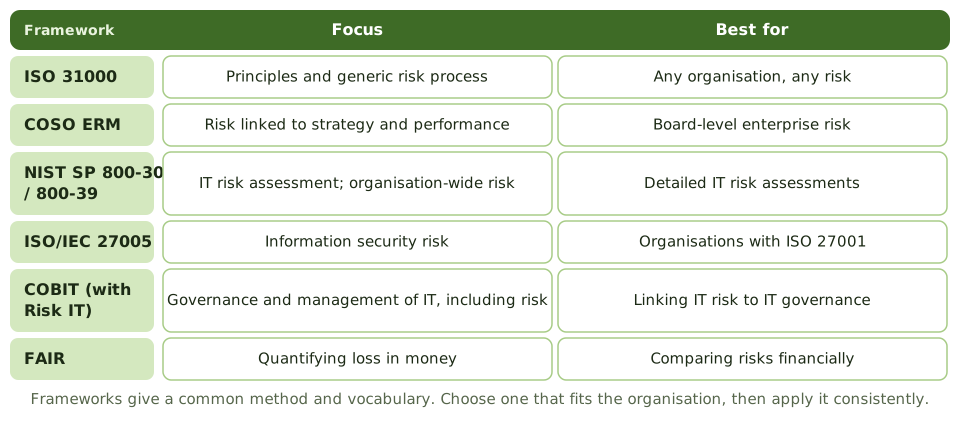
Framework or catalogue?
Choosing one
- 1Fit with regulation and customer expectations.
- 2Size and maturity of the organisation.
- 3Alignment with existing ERM and IT governance.
- 4Ability to apply it consistently.
How the exam asks about it
| If the question asks… | The answer is usually… |
|---|---|
| MOST important when selecting a framework | Fit with the organisation's needs and obligations |
| Benefit of a common framework | Consistent, comparable, repeatable risk results |
| Framework for quantifying risk in money | FAIR |
| Guidance on conducting IT risk assessments | NIST SP 800-30 |
Key takeaways
- ✓Frameworks give a consistent method, vocabulary and set of roles for managing risk.
- ✓ISO 31000 offers principles and a generic process for any risk; COSO ERM links risk to strategy and performance.
- ✓NIST SP 800-30 guides IT risk assessment; ISO/IEC 27005 supports information security risk under ISO 27001.
- ✓COBIT, with ISACA's risk guidance, links IT risk to IT governance and management.
- ✓FAIR quantifies risk in money; it complements rather than replaces a framework.
- ✓Choose a framework that fits the organisation's size, sector and obligations, then apply it consistently.
Exam traps
- !Thinking any one framework is mandatory for every organisation.
- !Mixing frameworks so that scales and terms are inconsistent.
- !Adopting a framework's full detail when the organisation is small.
- !Confusing a risk framework with a control catalogue.
Applying a Framework: the Risk Management Life Cycle
The risk management life cycle that every framework shares, from establishing context through identification, analysis, evaluation, response and monitoring, and why the order matters on the exam.
The shared cycle
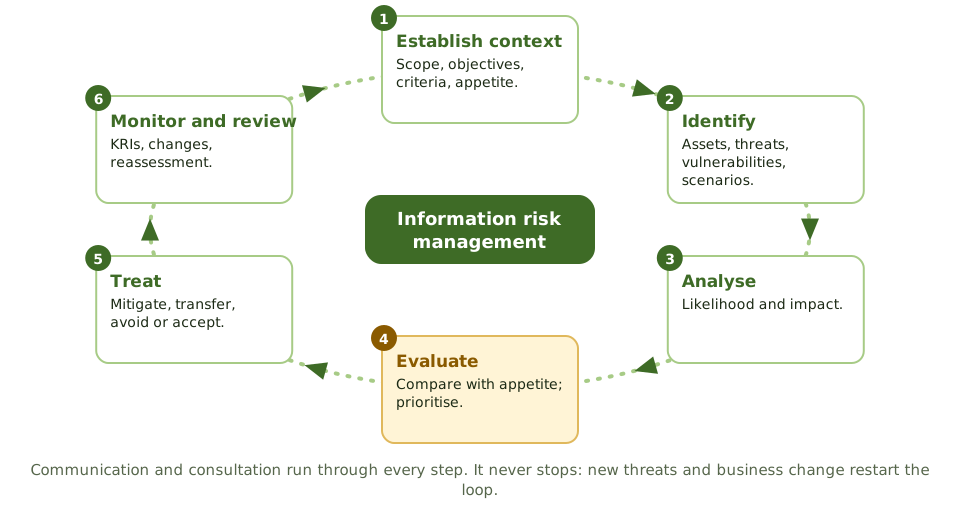
What each stage produces
| Stage | Output |
|---|---|
| Establish context | Objectives, scope, criteria, appetite |
| Identify | Risk scenarios: what could happen and why |
| Analyse | Likelihood and impact of each scenario |
| Evaluate | Priorities compared with appetite |
| Respond | Chosen responses and action plans |
| Monitor and review | KRIs, control results, updated profile |
Order matters
Most CRISC 'FIRST' and 'NEXT' questions are about this sequence. You can't evaluate a risk you haven't analysed, or choose a response before you know whether the risk exceeds appetite.
Keeping the cycle running
- 1Reassess on significant change: new systems, suppliers, regulations.
- 2Feed incidents and audit findings back into identification.
- 3Monitor KRIs between formal assessments.
- 4Communicate results to owners and stakeholders throughout.
How the exam asks about it
| If the question asks… | The answer is usually… |
|---|---|
| FIRST step in risk management | Establish context and objectives |
| After analysis | Evaluate against appetite |
| After a response is implemented | Monitor whether it's effective |
| How often to assess | Periodically and when significant change occurs |
Key takeaways
- ✓Every framework follows the same basic cycle: context, identify, analyse, evaluate, respond, monitor and review.
- ✓Communication and consultation with stakeholders run through every stage.
- ✓Establishing context comes first: objectives, scope, criteria and appetite.
- ✓Evaluation compares analysed risk with appetite to decide which risks need a response.
- ✓The cycle never ends; change, incidents and new threats restart it.
- ✓Many exam questions test which stage comes FIRST or NEXT.
Exam traps
- !Selecting controls before risks have been analysed and evaluated.
- !Treating risk assessment as a once-a-year event.
- !Skipping context, so assessments use inconsistent criteria.
- !Forgetting to monitor whether responses actually worked.
Risk Appetite, Tolerance and Capacity
The difference between risk capacity, appetite and tolerance, who sets each, and how to turn the board's appetite into measurable tolerances and thresholds that guide everyday risk decisions.
Three different ideas
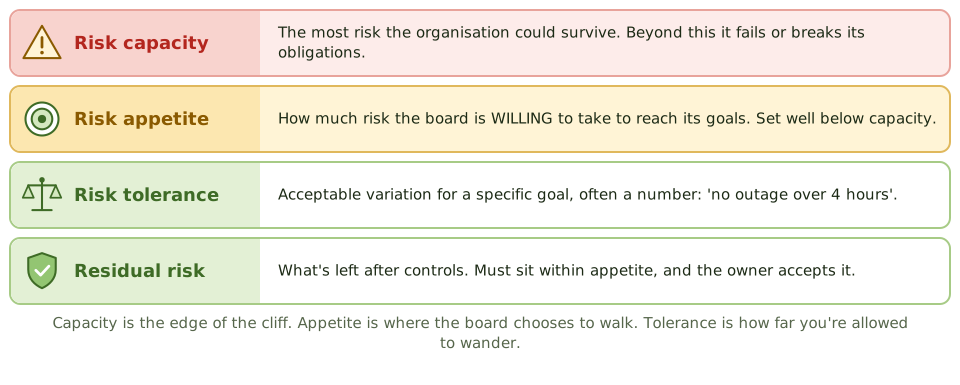
Who sets what
| Concept | Set by | Example |
|---|---|---|
| Capacity | Determined by finances and obligations | Losses above 50 million would threaten solvency |
| Appetite | Board | Low appetite for customer data loss |
| Tolerance | Senior management, within appetite | No more than 4 hours' outage of online banking |
From words to numbers
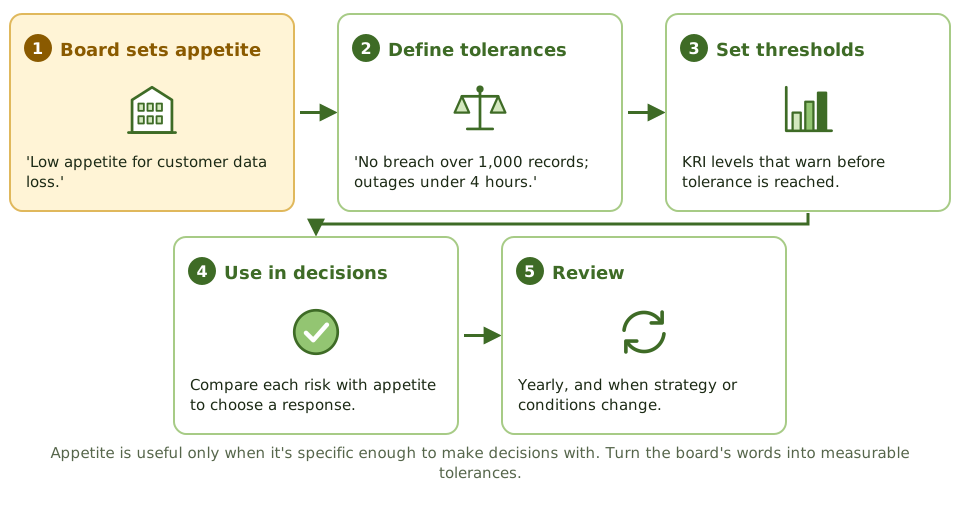
Using appetite
- 1Evaluate each risk: within, near or beyond appetite?
- 2Choose responses that bring risk within appetite.
- 3Escalate risks beyond appetite to the right level.
- 4Report the risk profile against appetite to the board.
How the exam asks about it
| If the question asks… | The answer is usually… |
|---|---|
| Who sets risk appetite | The board |
| Difference between appetite and tolerance | Overall willingness versus acceptable variation for a specific goal |
| Risk exceeds appetite | Respond further or escalate for formal acceptance |
| MOST useful appetite statement | Specific and measurable |
Key takeaways
- ✓Risk capacity is the most risk the organisation could absorb; appetite is how much it's willing to take; tolerance is the acceptable variation for a specific objective.
- ✓The board sets risk appetite, normally well below capacity.
- ✓Appetite must be turned into specific, measurable tolerances to be useful.
- ✓KRI thresholds should warn before a tolerance is breached.
- ✓Every risk response decision compares residual risk with appetite.
- ✓Appetite is reviewed when strategy, conditions or capacity change.
Exam traps
- !Confusing appetite (willingness) with capacity (ability).
- !Letting IT or the risk function set the organisation's appetite.
- !Writing appetite statements too vague to support decisions.
- !Treating appetite as fixed forever.
Establishing and Maintaining the IT Risk Profile
What the IT risk profile is, how it differs from the risk register, how it's built and kept current, and why it's the main tool for showing senior management the overall state of IT risk.
Register versus profile
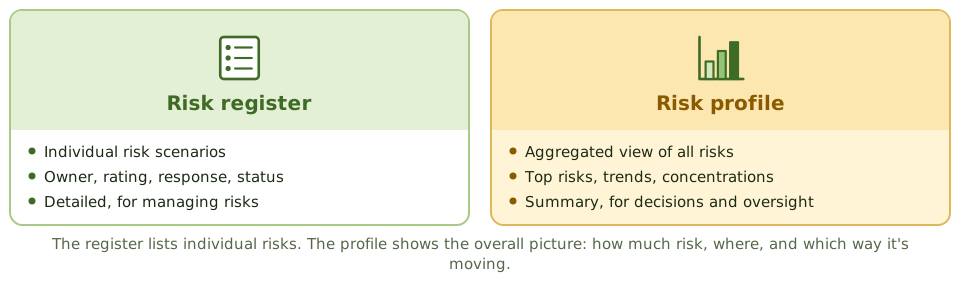
Building the profile
- 1 Collect risks from the register
- 2 Group by category and business area
- 3 Aggregate and look for concentrations
- 4 Compare with appetite
- 5 Show trends and top risks
Keeping it current
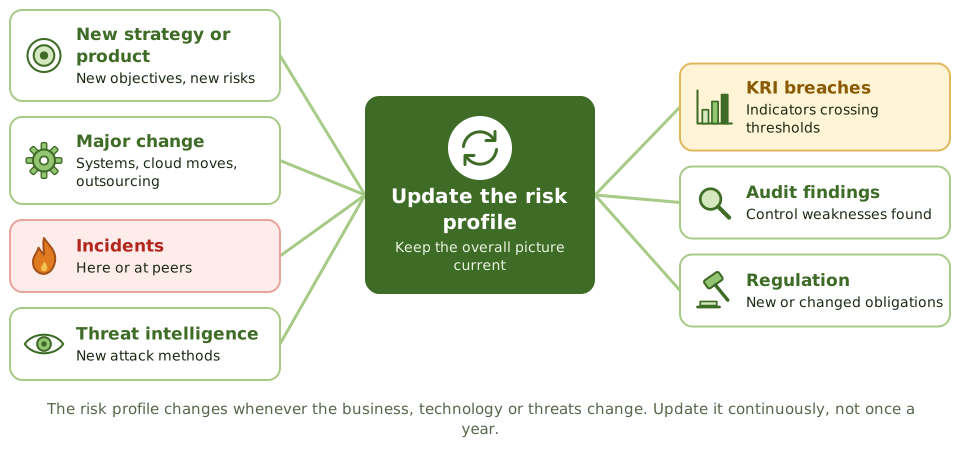
Aggregation matters
Ten 'low' risks on the same customer platform may add up to one significant exposure. Looking at the profile by system, process or supplier shows concentrations that a list of individual risks hides.
How the exam asks about it
| If the question asks… | The answer is usually… |
|---|---|
| PRIMARY purpose of the risk profile | Show the overall risk position against appetite |
| When to update it | Continuously, and on significant change |
| BEST way to show the board IT risk | The profile in business terms, with trends |
| Several small related risks | Consider their aggregated effect |
Key takeaways
- ✓The risk profile is the aggregated picture of all risks: how much risk, where it sits and which way it's moving.
- ✓The register lists individual risks; the profile summarises them for oversight and decisions.
- ✓The profile is compared with risk appetite to show whether the organisation is within its limits.
- ✓It must be updated continuously as the business, technology and threats change.
- ✓Aggregation can reveal concentrations that individual risks hide.
Exam traps
- !Treating the risk register as if it were the risk profile.
- !Updating the profile only once a year.
- !Presenting the profile in technical terms the board can't use.
- !Missing aggregated risk because each item looks small on its own.
Making Risk-Based Business Decisions
How the risk practitioner helps leaders weigh opportunity against risk, using appetite, options and residual risk, so that decisions are informed, made at the right level and recorded.
Risk and reward
Every opportunity carries risk. Refusing all risk means missing opportunities; taking risk blindly means unexpected losses. Risk-based decisions sit in between: deliberate risk-taking, within the appetite the board set.
The decision step by step
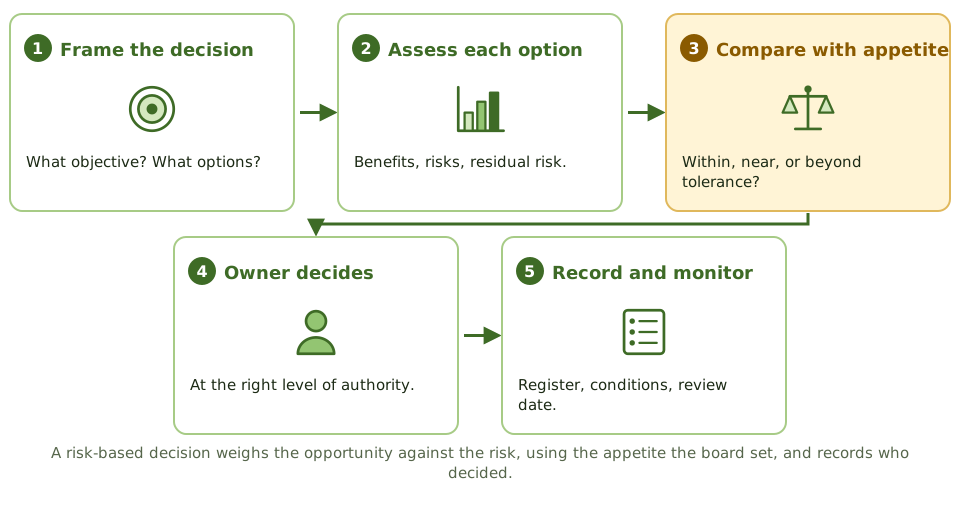
What the decision-maker needs
- 1The options, including doing nothing.
- 2Benefits and costs of each.
- 3Residual risk of each, compared with appetite.
- 4Who has authority to decide.
Right level, on the record
| Residual risk | Decided by |
|---|---|
| Low, within appetite | Process or asset owner |
| Medium, near tolerance | Business unit head |
| High or beyond appetite | Executive or board risk committee |
How the exam asks about it
| If the question asks… | The answer is usually… |
|---|---|
| Practitioner's role in a business decision | Provide risk information and options |
| BEST basis for a risk decision | Comparison with appetite and tolerance |
| Project wants to accept a high risk | Escalate to the authority level that can accept it |
| After the decision | Record it and monitor the risk |
Key takeaways
- ✓Risk-based decisions weigh the benefit of an opportunity against its risks, using the board's appetite.
- ✓The practitioner provides options, residual risk and costs; the owner decides.
- ✓Taking risk is normal; the goal is informed, deliberate risk-taking within appetite.
- ✓Decisions should be made at the level of authority that matches the size of the risk.
- ✓Every significant risk decision should be recorded with its conditions and review date.
Exam traps
- !Assuming the safest option is always the best.
- !Deciding without comparing options with appetite.
- !Letting a project team accept risk beyond its authority to meet a deadline.
- !Failing to record the decision and who made it.
Legal, Regulatory and Contractual Requirements
Where IT-related obligations come from, how the risk practitioner turns them into risks and controls, and why compliance risk is assessed like any other risk.
Where obligations come from
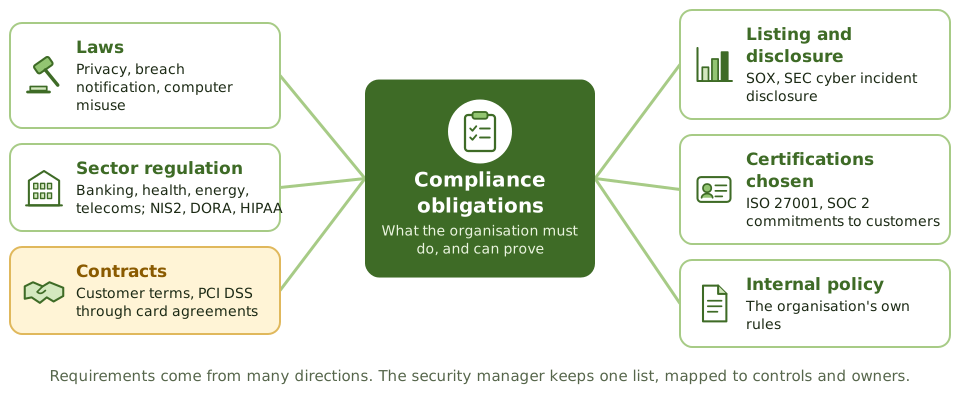
From obligation to control
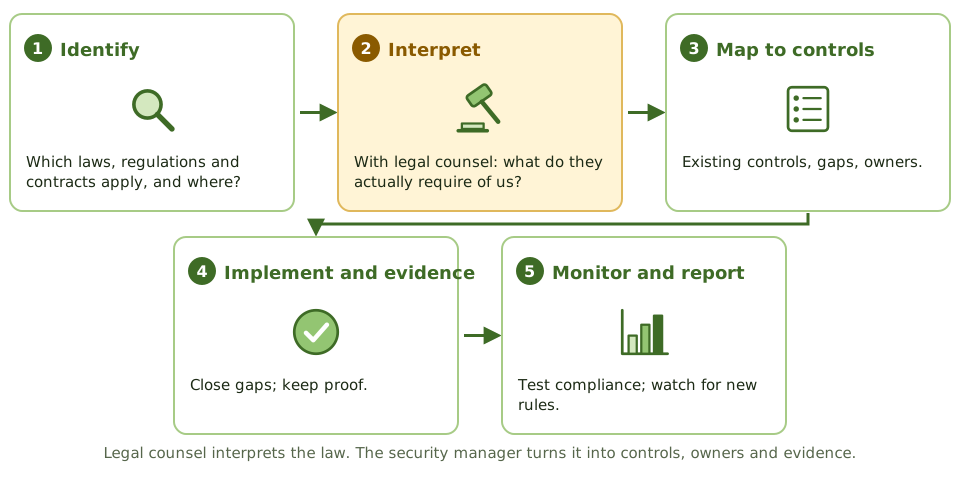
Compliance risk is a risk
Non-compliance has a likelihood and an impact: fines, lost licences, lost contracts and reputational damage. It goes in the register and is assessed, prioritised and treated like any other risk, compared with the organisation's appetite.
Working across borders
- 1Identify which laws apply where data and customers are.
- 2Build a common control baseline that meets shared requirements.
- 3Add local controls where laws are stricter.
- 4Get legal advice where rules conflict.
How the exam asks about it
| If the question asks… | The answer is usually… |
|---|---|
| FIRST step with a new regulation | Determine with legal counsel how it applies |
| Who interprets the law | Legal counsel |
| How to manage many obligations | A register mapped to controls and owners |
| Compliance versus risk | Compliance is a minimum; risk management goes further |
Key takeaways
- ✓Obligations come from laws, sector regulation, contracts, listing rules, certifications and internal policy.
- ✓Legal counsel interprets the law; the risk practitioner turns obligations into risks, controls and owners.
- ✓Non-compliance is a risk with likelihood and impact (fines, lost licences, lost customers, reputation).
- ✓Keep a register of obligations mapped to controls and owners, and review it as rules change.
- ✓Multinationals face overlapping and sometimes conflicting rules; map them and use a common baseline with local additions.
Exam traps
- !Treating compliance as the whole of risk management.
- !Interpreting the law without legal counsel.
- !Following only the headquarters country's laws.
- !Waiting for an audit finding to discover a new requirement.
Connecting Governance to Risk Outcomes
How to show that governance activities (strategy, structure, policy and oversight) actually change IT risk, and which measures tell the board whether risk governance is working.
From direction to outcome
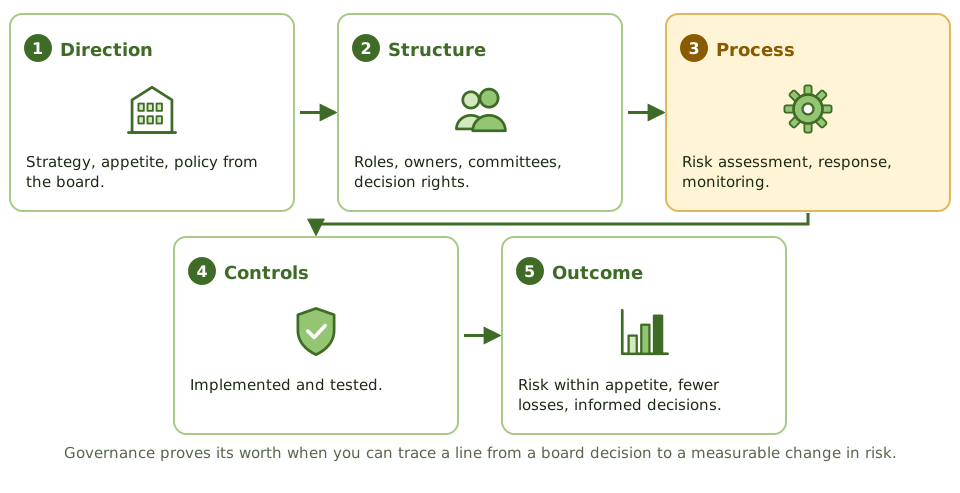
Outcome versus activity measures
| Shows governance works | Only shows activity |
|---|---|
| Share of top risks within appetite | Number of policies published |
| Overdue treatment plans, trend | Number of committee meetings |
| Time to decide on escalated risks | Training hours delivered |
| Losses from IT-related incidents | Number of risks in the register |
Where the chain breaks
- 1Appetite too vague to guide decisions.
- 2Risks without named owners.
- 3Policies not enforced or monitored.
- 4Controls designed but never tested.
The governance outcomes
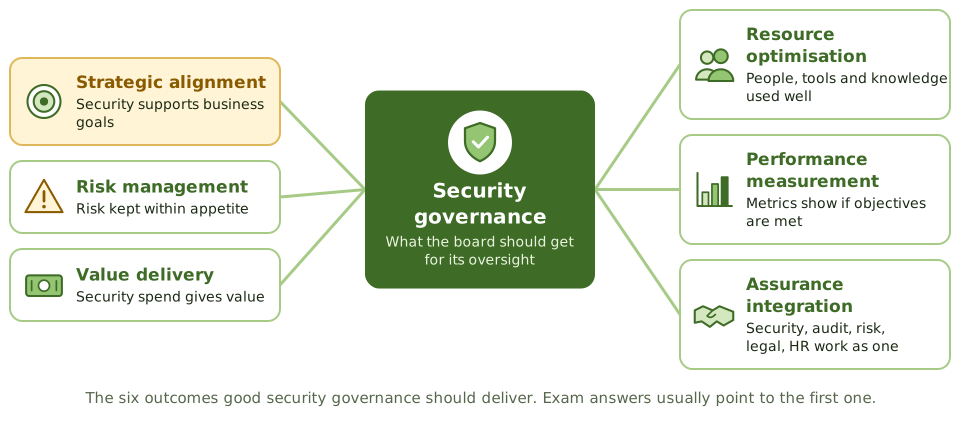
How the exam asks about it
| If the question asks… | The answer is usually… |
|---|---|
| BEST evidence governance is effective | Risk kept within appetite, with timely decisions |
| Weakness of activity metrics | They don't show changes in risk |
| Primary governance outcome | Strategic alignment |
| Many overdue treatment plans | Governance or ownership weakness to escalate |
Key takeaways
- ✓Governance is worthwhile only if it changes outcomes: risk within appetite, fewer losses, better decisions.
- ✓Trace each governance activity through structure, process and controls to a measurable outcome.
- ✓Good governance measures focus on risk against appetite and the timeliness of decisions and treatment.
- ✓Activity measures (meetings held, policies written) don't prove governance works.
- ✓Weak links in the chain, such as missing owners or untested controls, break the connection.
Exam traps
- !Reporting the number of policies or meetings as evidence of effective governance.
- !Assuming governance works because no incidents were reported.
- !Measuring governance only through audit results.
- !Ignoring overdue treatment plans when judging governance.
IT Risk Assessment
Risk events and threats · Vulnerabilities and risk factors · Risk scenarios · Assessment methods · Analysis and evaluation · Risk register
IT Risk Events, Loss Types and Business Outcomes
What an IT risk event is, the common families of events, the types of loss they cause and how to trace each event through to the business outcome it threatens.
From cause to outcome
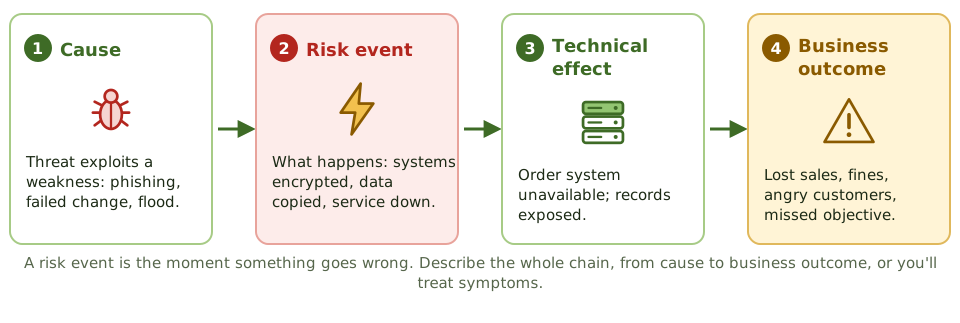
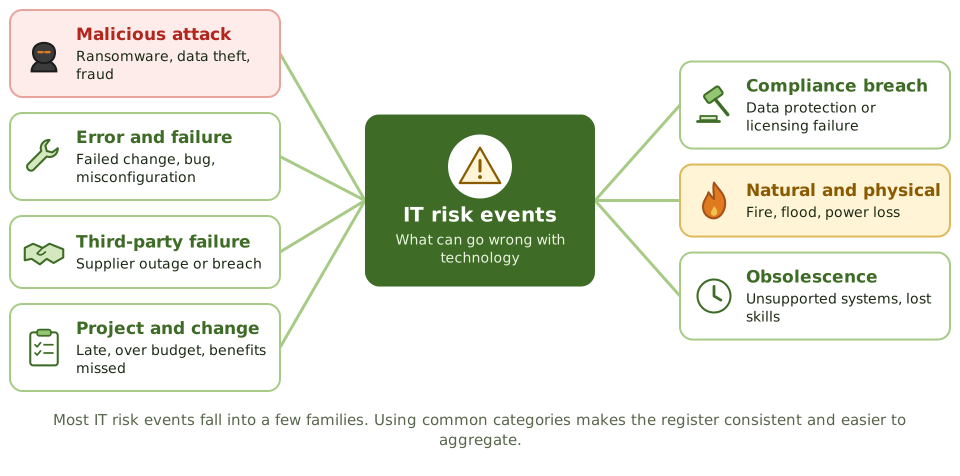
Families of IT risk events
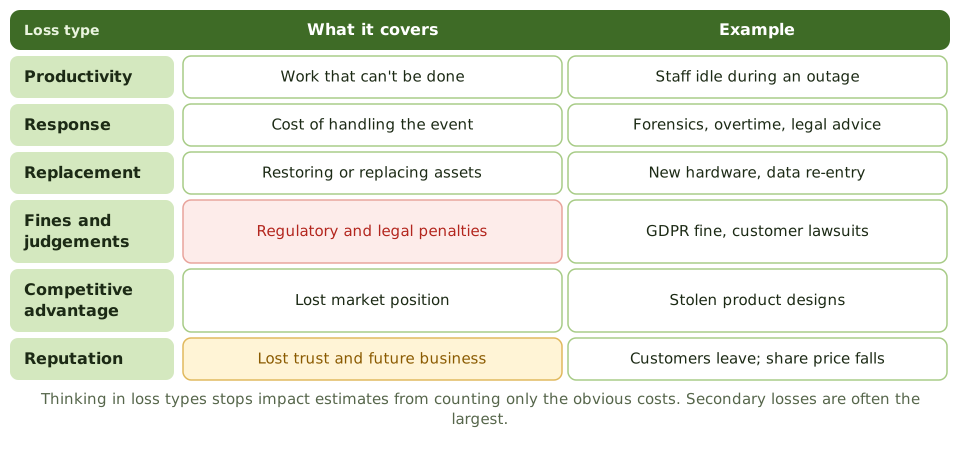
Types of loss
IT risk is broader than security
- 1Benefit risk: IT investments that don't deliver value.
- 2Delivery risk: projects late, over budget or failing.
- 3Operations risk: outages, errors, performance.
- 4Security and compliance risk: breaches, fines.
How the exam asks about it
| If the question asks… | The answer is usually… |
|---|---|
| Loss MOST often underestimated | Secondary losses: fines, reputation, lost customers |
| BEST way to describe a risk event | Cause, event and business consequence |
| Benefit of standard event categories | Consistent register and aggregation |
| Is a failed IT project an IT risk? | Yes: delivery and benefit risk |
Key takeaways
- ✓A risk event is the moment something goes wrong; describe the chain from cause to event to business outcome.
- ✓IT risk events include attacks, errors and failures, supplier failures, project failures, compliance breaches, physical events and obsolescence.
- ✓Using common event categories makes the register consistent and easier to aggregate.
- ✓Losses include productivity, response, replacement, fines, competitive advantage and reputation.
- ✓Secondary losses such as fines and lost customers are often larger than the direct costs.
- ✓IT risk includes missed opportunities and failed projects, not just security incidents.
Exam traps
- !Counting only the direct technical cost of an event.
- !Treating IT risk as only security risk.
- !Describing the cause (a vulnerability) as if it were the event.
- !Stopping the analysis at the technical effect instead of the business outcome.
Threat Sources, Actors and Motivations
The sources of threat to IT (adversarial, accidental, structural and environmental), the main threat actors and why their motivation and capability shape likelihood.
Four sources of threat
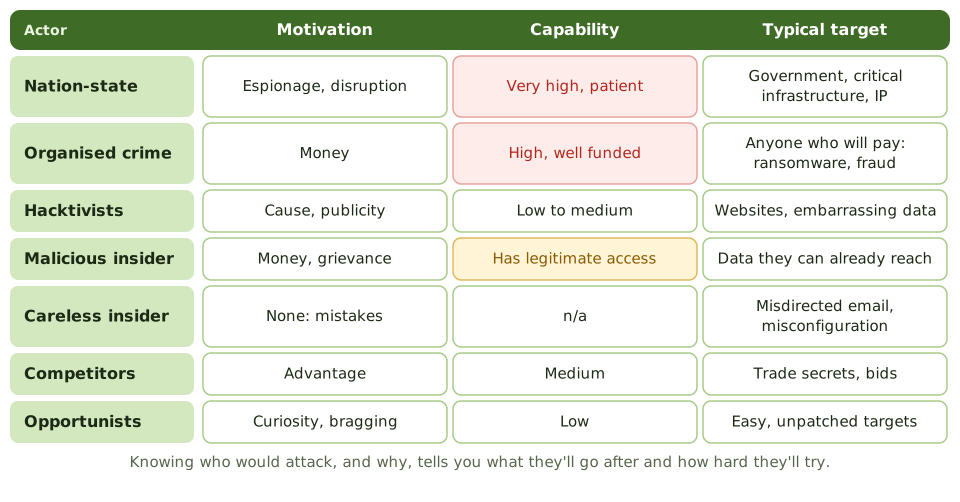
Who attacks, and why
Motivation drives likelihood
A threat is more likely when an actor has both the motive and the capability. A hospital is attractive to ransomware gangs because it can't tolerate downtime; a defence contractor attracts nation-states because of its secrets.
Don't forget the insider
- 1Already has access and knowledge.
- 2Bypasses perimeter controls.
- 3Can be malicious or simply careless.
- 4Controls: least privilege, SoD, monitoring, leaver process.
How the exam asks about it
| If the question asks… | The answer is usually… |
|---|---|
| Why consider threat actor motivation | It affects likelihood and targets |
| Threat that bypasses perimeter controls | Insider |
| MOST common cause of many incidents | Human error and failures, not only attacks |
| Small organisation thinks it's not a target | Opportunistic and criminal actors still target it |
Key takeaways
- ✓Threat sources are adversarial (people with intent), accidental (mistakes), structural (failures) and environmental (natural and physical events).
- ✓Adversarial actors include nation-states, organised crime, hacktivists, insiders, competitors and opportunists.
- ✓Motivation and capability decide what an actor targets and how hard they try.
- ✓Insiders matter because they already have legitimate access.
- ✓Accidental and structural threats cause many incidents and are often underweighted.
Exam traps
- !Focusing only on external hackers and ignoring errors, failures and insiders.
- !Rating likelihood without considering who would want to attack and why.
- !Assuming the organisation is too small to be targeted.
- !Treating every actor as equally capable.
The Changing Threat Landscape and Threat Modelling
How the risk practitioner keeps up with changing threats through threat intelligence, and uses threat modelling to find threats to a system before it's built.
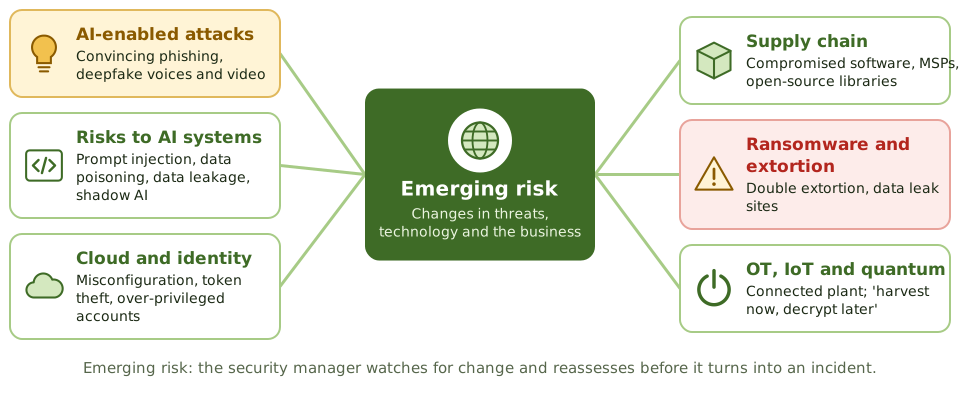
Threats keep changing
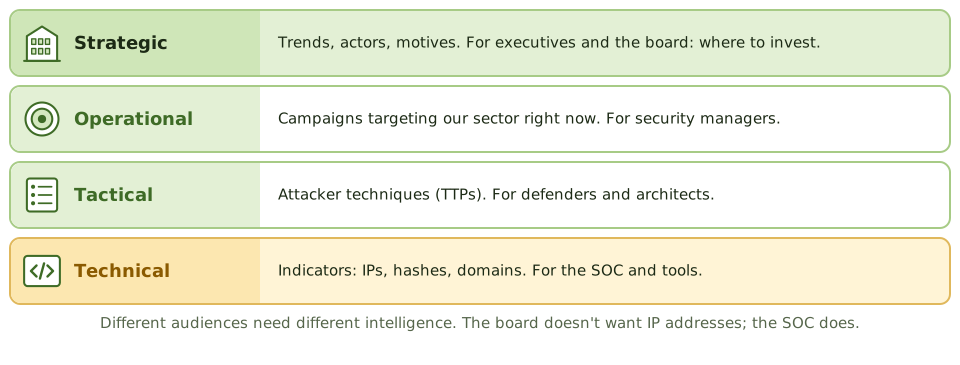
Using threat intelligence
How attacks unfold
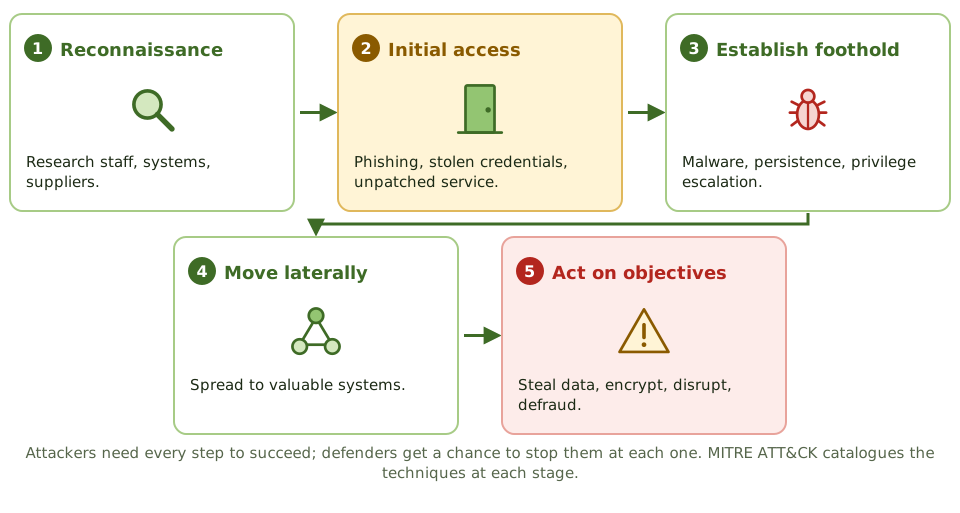
Threat modelling
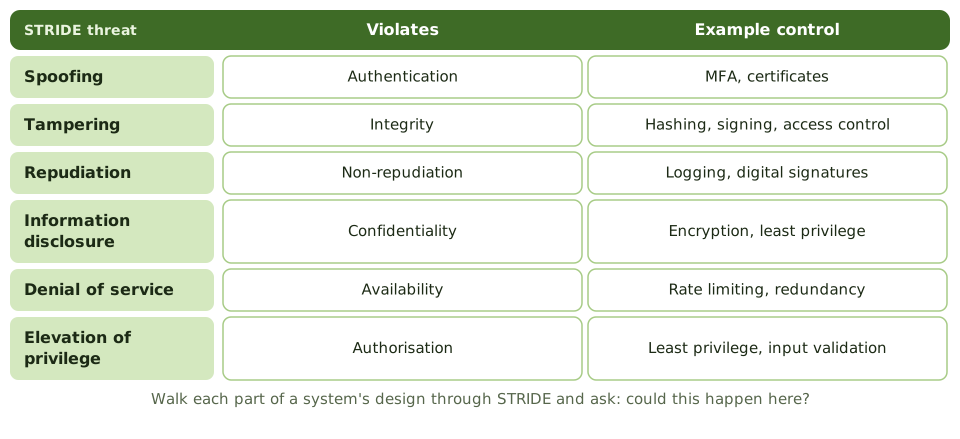
How the exam asks about it
| If the question asks… | The answer is usually… |
|---|---|
| BEST time for threat modelling | During design |
| Most useful threat intelligence | Filtered for relevance to the organisation |
| Major new threat in the sector | Reassess affected risk scenarios now |
| Intelligence for the board | Strategic trends and business implications |
Key takeaways
- ✓The threat landscape changes constantly; risk assessments must be updated when it does.
- ✓Threat intelligence is useful only when filtered for relevance to the organisation's sector, geography and technology.
- ✓Different audiences need different levels of intelligence: strategic, operational, tactical and technical.
- ✓Threat modelling finds threats to a system during design, when fixes are cheapest.
- ✓Frameworks such as STRIDE and MITRE ATT&CK structure threat modelling and analysis.
Exam traps
- !Collecting large volumes of threat feeds without filtering or using them.
- !Threat modelling after go-live instead of during design.
- !Waiting for the annual assessment to react to a major new threat.
- !Giving the board technical indicators instead of strategic trends.
Vulnerabilities, Control Deficiencies and Risk Conditions
The kinds of weakness that let threats cause harm, from technical flaws to process and people gaps, how control deficiencies are classified and how to prioritise vulnerabilities by risk.
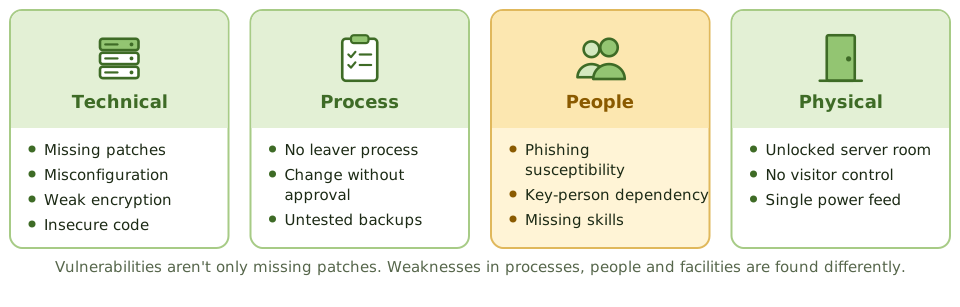
Where weaknesses hide
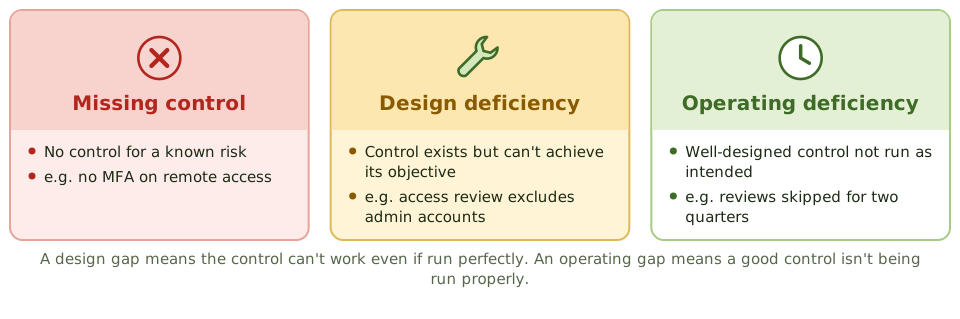
Control deficiencies
Finding them
- 1Vulnerability scans and penetration tests.
- 2Audit findings and control testing.
- 3Incident and near-miss reviews.
- 4Control self-assessments and process walkthroughs.
- 5Supplier assurance reports.
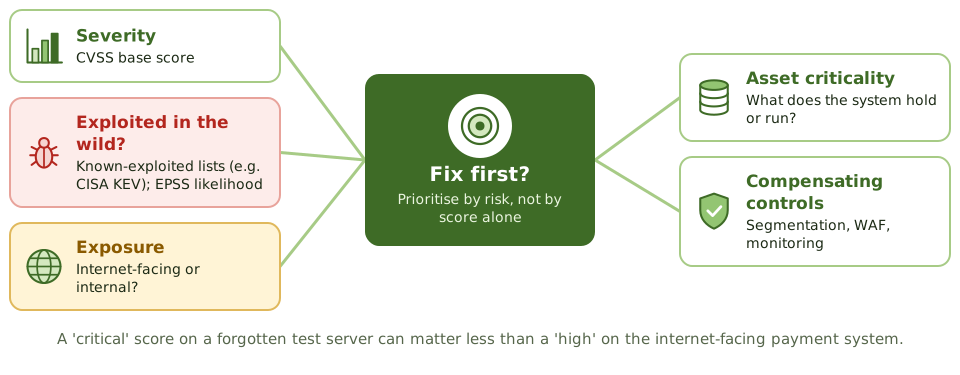
Prioritising by risk
How the exam asks about it
| If the question asks… | The answer is usually… |
|---|---|
| BEST basis for prioritising vulnerabilities | Risk to the business, not score alone |
| Control exists but can't achieve its objective | Design deficiency |
| Good control not performed | Operating deficiency |
| Vulnerability with no realistic threat | Low risk; monitor |
Key takeaways
- ✓Vulnerabilities are weaknesses in technology, processes, people or facilities that a threat could exploit.
- ✓Control deficiencies are missing controls, design deficiencies or operating deficiencies.
- ✓Sources include scans, penetration tests, audits, incidents, control testing and self-assessments.
- ✓Prioritise vulnerabilities by risk: exploitability, exposure, asset criticality and compensating controls, not severity score alone.
- ✓A vulnerability with no realistic threat is low risk, but should be monitored as threats change.
Exam traps
- !Treating every scanner finding as high risk because of its CVSS score.
- !Looking only for technical vulnerabilities.
- !Confusing a design deficiency (control can't work) with an operating deficiency (control not run).
- !Ignoring vulnerabilities in third-party systems the organisation relies on.
Identifying Internal and External Risk Factors
The internal and external conditions that make IT risk events more likely or more damaging, and how the risk practitioner uses them to keep scenarios and ratings realistic.
What risk factors are
Risk factors are conditions that make an event more likely or more damaging. They aren't events themselves. High staff turnover in IT doesn't cause an outage, but it makes one more likely and slower to fix.
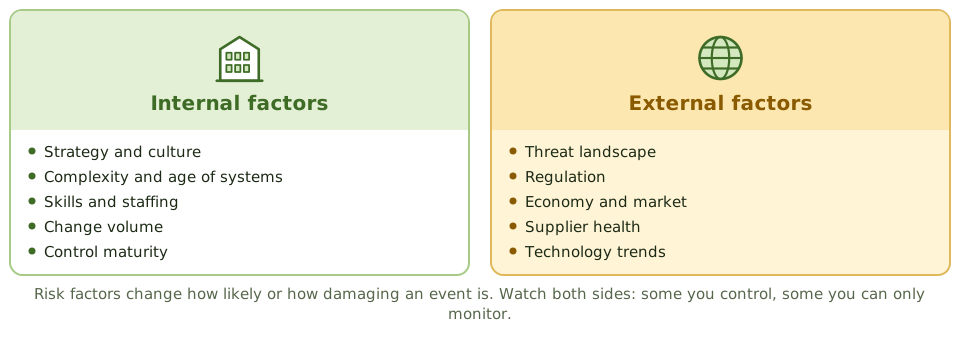
Internal and external
Using risk factors
- 1Adjust likelihood and impact estimates.
- 2Spot when ratings need review.
- 3Choose leading key risk indicators.
- 4Explain why a risk is rising or falling.
Factor versus event
| Risk factor | Related risk event |
|---|---|
| Ageing, unsupported systems | System failure or exploited vulnerability |
| New data protection law | Regulatory breach and fine |
| Rapid growth in change volume | Failed change causes outage |
| Key supplier in financial trouble | Supplier stops delivering service |
How the exam asks about it
| If the question asks… | The answer is usually… |
|---|---|
| Purpose of identifying risk factors | Make likelihood and impact estimates realistic |
| Significant change in a risk factor | Review the related risk ratings |
| Good source of leading KRIs | Risk factors |
| External factors you can't control | Still monitor and include in assessment |
Key takeaways
- ✓Risk factors are conditions that change the likelihood or impact of risk events.
- ✓Internal factors include strategy, culture, system complexity, skills, change volume and control maturity.
- ✓External factors include the threat landscape, regulation, the economy, supplier health and technology trends.
- ✓Changes in risk factors are early signals that risk ratings need reviewing.
- ✓Many risk factors make good key risk indicators.
Exam traps
- !Rating risk only on technical facts and ignoring organisational factors like skills or culture.
- !Ignoring external factors because the organisation can't control them.
- !Leaving ratings unchanged after a major change in risk factors.
- !Confusing a risk factor with a risk event.
Building IT Risk Scenarios
How to write risk scenarios that the business recognises and can rate, using top-down and bottom-up approaches, and why scenarios are the core of IT risk assessment.
Why scenarios
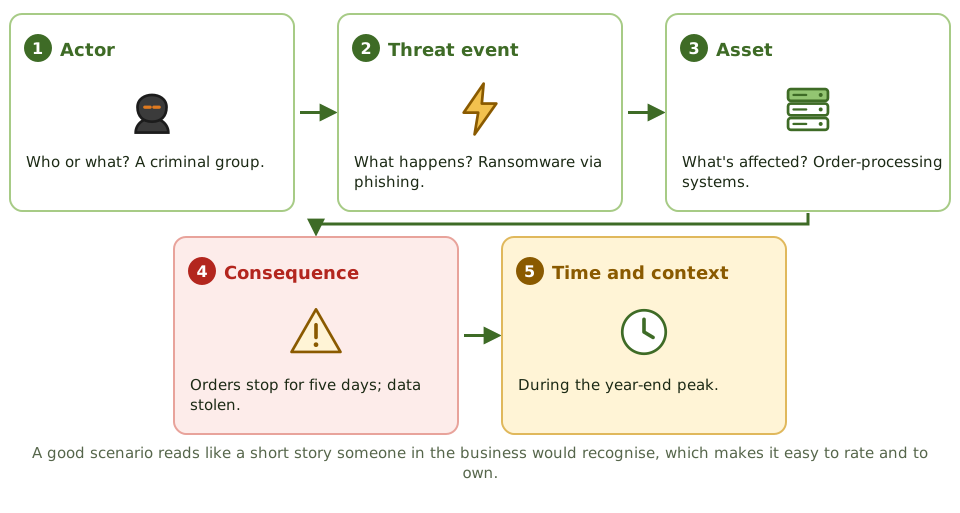
'Cyber risk' can't be rated or owned. 'A criminal group phishes finance staff and diverts a 500,000 payment' can. Scenarios make risk concrete enough for the business to judge likelihood and impact and decide what to do.
Anatomy of a scenario
Top-down and bottom-up
Building them well
- 1Involve business owners and technical experts together.
- 2Use generic scenario libraries only as a starting point.
- 3Keep the number manageable: focus on what matters.
- 4Link each scenario to an objective and an owner.
How the exam asks about it
| If the question asks… | The answer is usually… |
|---|---|
| PRIMARY benefit of risk scenarios | Make risk concrete for business decisions |
| BEST way to build scenarios | Workshops with business and technical stakeholders |
| Top-down approach starts with | Business objectives |
| Using another firm's scenario list | Tailor it to this organisation |
Key takeaways
- ✓A risk scenario describes an actor, a threat event, the asset affected, the consequence and the timing or context.
- ✓Scenarios turn abstract risk into concrete stories that owners can recognise, rate and own.
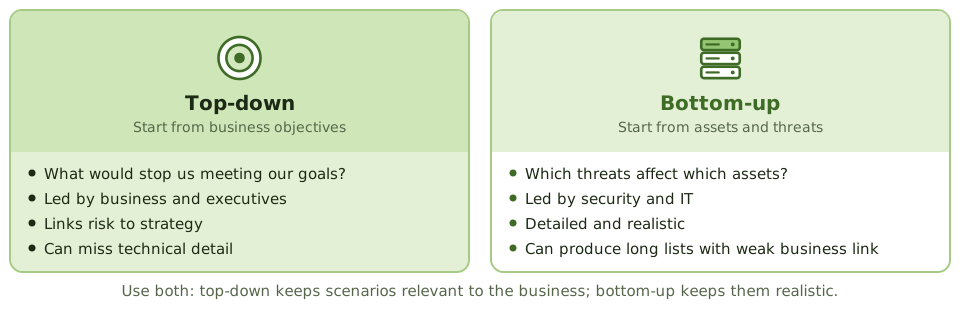
- ✓Top-down scenarios start from business objectives; bottom-up scenarios start from assets and threats.
- ✓Use both approaches: top-down for relevance, bottom-up for realism.
- ✓Build scenarios with business and technical stakeholders together.
- ✓Generic risk lists from other organisations are a starting point, not a substitute.
Exam traps
- !Writing one-word scenarios such as 'hackers' or 'cyber'.
- !Building scenarios only with the IT team.
- !Copying another organisation's scenario list without tailoring.
- !Producing hundreds of technical scenarios with no business link.
Evaluating Scenarios for Completeness and Relevance
How to check that each risk scenario is realistic, specific, business-linked and owned, and that the set as a whole covers the organisation's key assets, processes and threats.
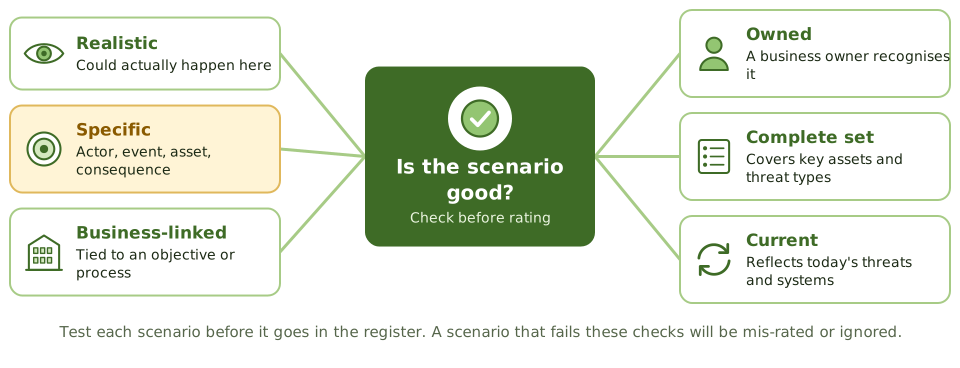
Checking each scenario
Checking the whole set
| Coverage question | If the answer is no |
|---|---|
| Are all critical processes covered? | Add scenarios for the gaps |
| Are all event types represented? | Add errors, failures, supplier events |
| Are key third parties included? | Add supplier and outsourcing scenarios |
| Do recent incidents map to a scenario? | The set is missing something |
Validating with the business
A scenario is ready when its owner reads it and says 'yes, that could happen to us, and here's what it would cost'. If the owner doesn't recognise it, it will be mis-rated or ignored.
How the exam asks about it
| If the question asks… | The answer is usually… |
|---|---|
| BEST way to validate scenarios | Review with business owners |
| Test of scenario completeness | Compare with incidents, assets and processes |
| When to update scenarios | On significant business, technology or threat change |
| Scenario no owner recognises | Rework it before rating |
Key takeaways
- ✓Check each scenario before rating: realistic, specific, business-linked, owned and current.
- ✓Check the set as a whole: does it cover key processes, assets, threat types and third parties?
- ✓Validate scenarios with the business owners who will own them.
- ✓Compare the set with incidents, audit findings and industry data to find gaps.
- ✓Review scenarios when the business, technology or threat landscape changes.
Exam traps
- !Rating scenarios before checking whether they're realistic and complete.
- !Covering only cyberattacks and missing errors, failures and supplier events.
- !Keeping scenarios that no longer match current systems.
- !Accepting scenarios no business owner recognises.
Common Risk Scenario Errors
The mistakes that make risk scenarios useless (too vague, too technical, too extreme, too many or out of date) and how to fix each before rating.
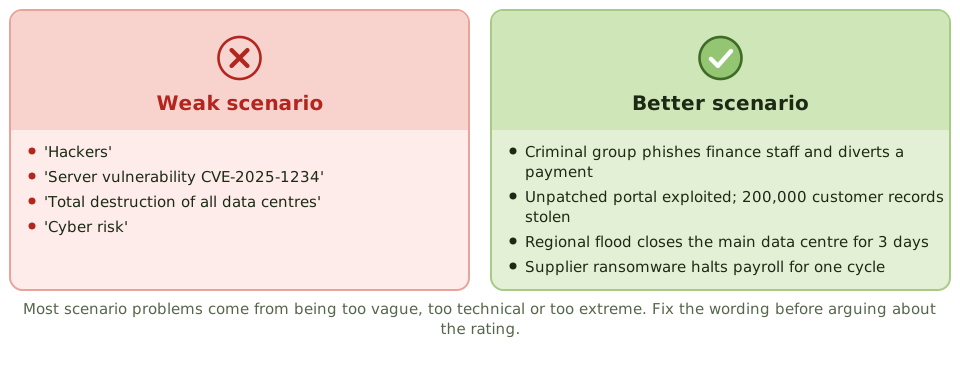
Weak versus better
The five common errors
| Error | Fix |
|---|---|
| Too vague | Add actor, event, asset and consequence |
| Too technical | State the business outcome |
| Only worst case | Add a realistic severe case |
| Too many, overlapping | Group similar scenarios |
| Several events in one | Split into separate scenarios |
Realistic versus worst case
If every scenario is 'total loss of all systems', everything rates critical and nothing can be prioritised. Assess the realistic severe case alongside the extreme, so ratings reflect what's actually likely.
How the exam asks about it
| If the question asks… | The answer is usually… |
|---|---|
| Scenario reads 'cyber risk' | Too vague; make it specific |
| Scenario is a CVE number | It's a vulnerability; describe the business event |
| All scenarios rate critical | Scenarios are too extreme; use realistic cases |
| Scenario covers several events | Split it |
Key takeaways
- ✓Vague scenarios such as 'cyber risk' can't be rated or owned.
- ✓Purely technical scenarios (a CVE number) describe a cause, not a business risk.
- ✓Worst-case-only scenarios exaggerate; use realistic severe cases as well.
- ✓Too many scenarios dilute attention; group and focus on what matters.
- ✓Scenarios must be refreshed when systems and threats change.
Exam traps
- !Arguing about a rating when the real problem is the scenario wording.
- !Including only catastrophic scenarios, which makes everything look critical.
- !Writing scenarios as vulnerabilities rather than events with consequences.
- !Combining several different events into one scenario.
Risk Assessment Concepts and Standards
The building blocks of IT risk assessment (assets, threats, vulnerabilities, likelihood and impact), the standard process steps and the main standards that describe them.
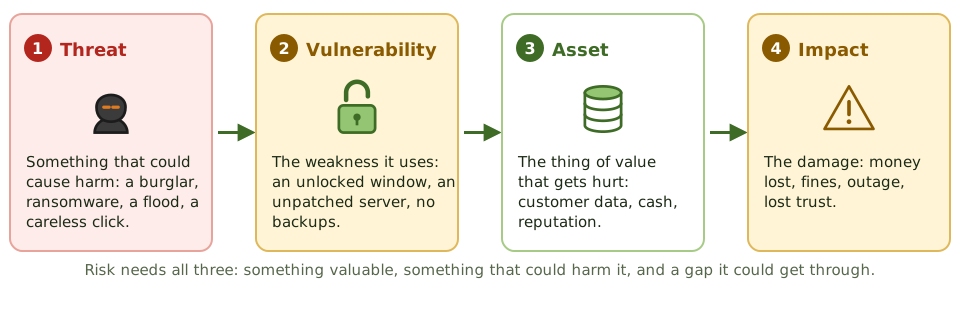
The ingredients of risk
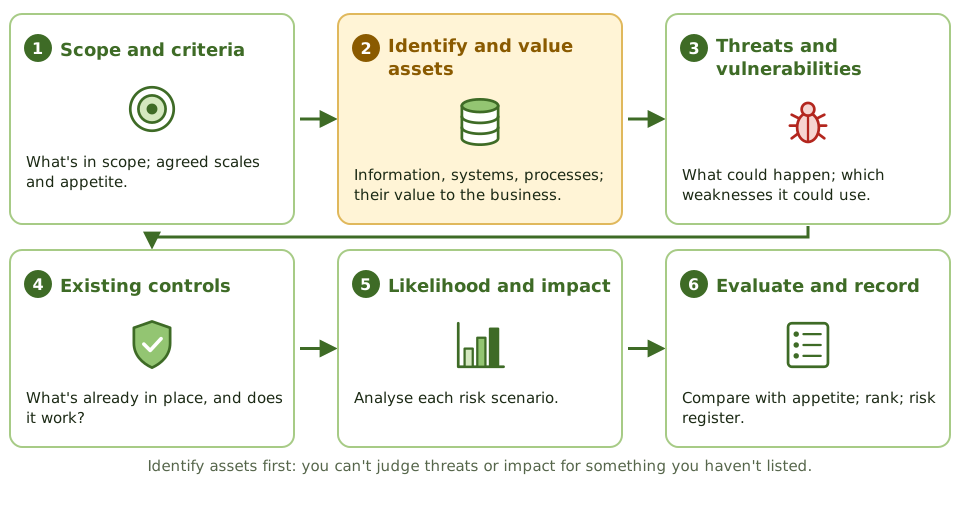
The standard steps
Standards that describe it
| Standard | What it offers |
|---|---|
| NIST SP 800-30 | How to prepare, conduct and maintain IT risk assessments |
| ISO/IEC 27005 | Information security risk management for ISO 27001 |
| ISO 31000 / IEC 31010 | Generic risk process and assessment techniques |
Assessment is not a scan
A vulnerability scan lists technical weaknesses. A risk assessment asks which threats could use them, against which assets, how likely that is and what it would cost the business. Scans are one input, not the assessment.
How the exam asks about it
| If the question asks… | The answer is usually… |
|---|---|
| FIRST step after setting scope | Identify and value assets |
| Before estimating residual risk | Evaluate existing controls |
| Difference between scan and assessment | Assessment considers threats, likelihood and business impact |
| Standard for IT risk assessment | NIST SP 800-30 |
Key takeaways
- ✓Risk combines the likelihood of a threat exploiting a vulnerability and the impact on an asset.
- ✓The standard steps are scope and criteria, assets, threats and vulnerabilities, existing controls, likelihood and impact, then evaluate and record.
- ✓Existing controls must be considered, and tested where possible, before estimating residual risk.
- ✓NIST SP 800-30 and ISO/IEC 27005 describe IT and information security risk assessment.
- ✓Risk assessment is repeated periodically and when significant change occurs.
Exam traps
- !Starting with threats before identifying the assets at risk.
- !Assuming existing controls work without checking.
- !Treating a vulnerability scan as a risk assessment.
- !Running a one-off assessment and never updating it.
Qualitative, Semi-Quantitative and Quantitative Analysis
The three ways to analyse risk, what each is good and bad at, and how to choose the right approach for the decision and the data available.
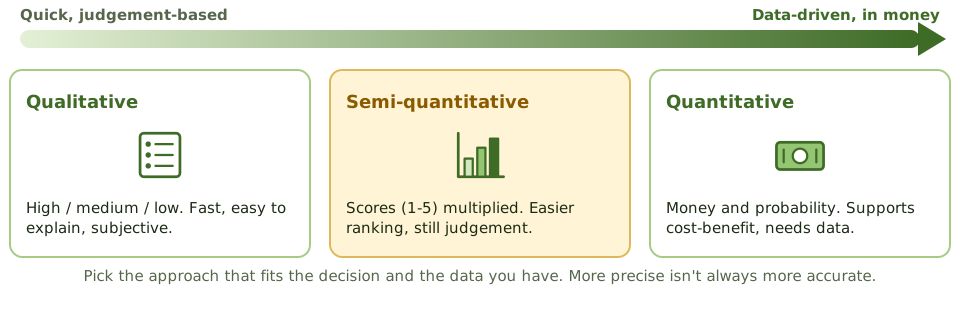
Three approaches
Strengths and weaknesses
| Approach | Strength | Weakness |
|---|---|---|
| Qualitative | Fast, easy to explain, no data needed | Subjective; hard to compare costs |
| Semi-quantitative | Easier ranking and aggregation | Scores look precise but aren't |
| Quantitative | Money terms; supports cost-benefit | Needs data; time-consuming |
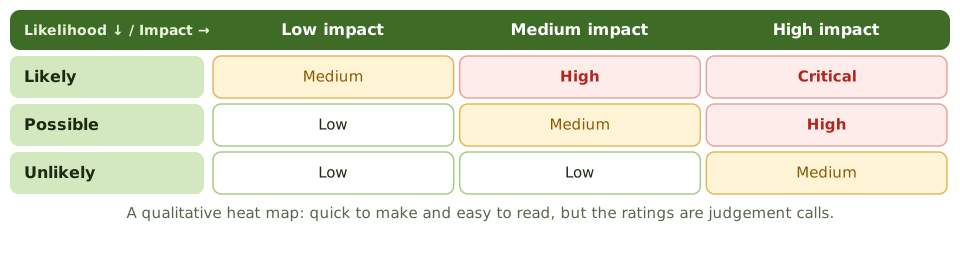
The heat map
Choosing an approach
- 1What decision will the result support?
- 2Is reliable loss and frequency data available?
- 3How much time and expertise do we have?
- 4Does it fit the enterprise risk method?
How the exam asks about it
| If the question asks… | The answer is usually… |
|---|---|
| Advantage of qualitative analysis | Quick, needs little data |
| Advantage of quantitative analysis | Supports cost-benefit in money |
| Main weakness of quantitative | Depends on reliable data |
| MOST important when choosing | Fit with the decision and available data, applied consistently |
Key takeaways
- ✓Qualitative analysis uses descriptive scales such as high, medium and low; it's fast but subjective.
- ✓Semi-quantitative analysis assigns numbers to scales and combines them; it ranks more easily but is still judgement-based.
- ✓Quantitative analysis uses money and probabilities; it supports cost-benefit decisions but needs reliable data.
- ✓Choose the approach that fits the decision and the data available, and apply it consistently.
- ✓Precise-looking numbers based on weak data can mislead.
Exam traps
- !Assuming quantitative analysis is always more accurate.
- !Treating semi-quantitative scores as if they were real measurements.
- !Mixing approaches so that ratings can't be compared.
- !Using qualitative ratings to justify detailed investment cases.
Quantitative Methods: ALE, FAIR and Monte Carlo
How to express IT risk in money, from the classic SLE and ALE formulas to FAIR and Monte Carlo simulation, and how to use the results in cost-benefit decisions.
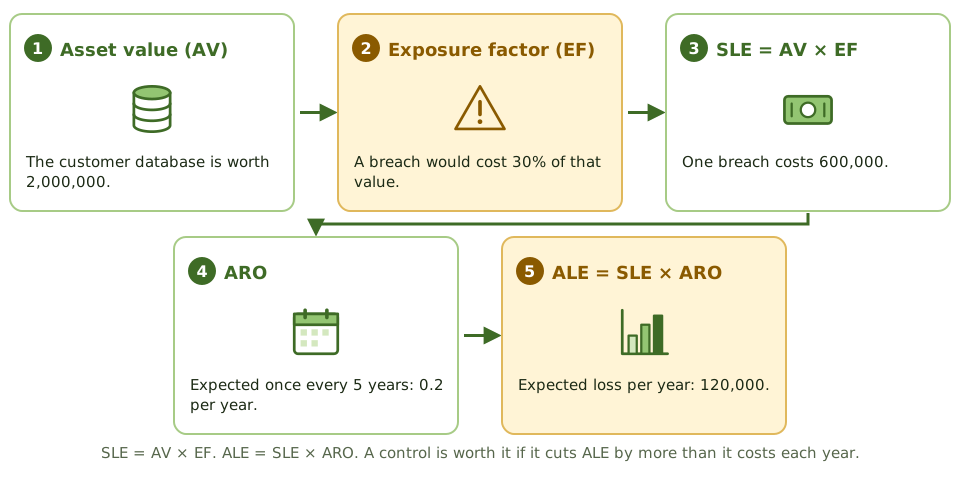
The classic formulas
Is the control worth it?
| Item | Value |
|---|---|
| ALE before control | 120,000 |
| ALE after control | 30,000 |
| Reduction in ALE | 90,000 |
| Annual cost of control | 40,000 |
| Net benefit | 50,000 a year: justified |
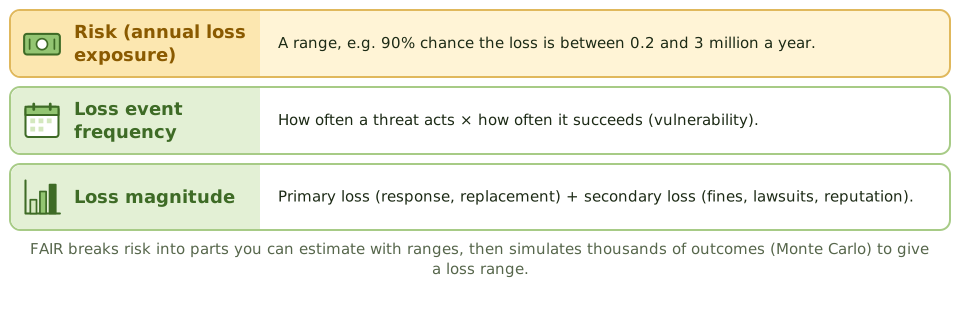
FAIR
Monte Carlo
Instead of single guesses, estimators give ranges: 'between two and six events a year, each costing 50,000 to 400,000'. Monte Carlo runs thousands of random combinations to show the range of likely annual losses and their probabilities.
How the exam asks about it
| If the question asks… | The answer is usually… |
|---|---|
| ALE formula | SLE × ARO |
| When a control is justified | ALE reduction exceeds its annual cost |
| FAIR's two main factors | Loss event frequency and loss magnitude |
| Purpose of Monte Carlo simulation | Produce a range of outcomes with probabilities |
Key takeaways
- ✓SLE = asset value × exposure factor; ALE = SLE × annualised rate of occurrence.
- ✓A control is financially justified when it reduces ALE by more than its annual cost.
- ✓FAIR breaks risk into loss event frequency and loss magnitude, estimated as ranges.
- ✓Monte Carlo simulation turns ranges into a distribution of possible annual losses.
- ✓Quantitative results are only as good as their input data and assumptions.
Exam traps
- !Confusing SLE with ALE.
- !Comparing a control's cost with total ALE instead of the reduction in ALE.
- !Presenting a single precise number when inputs are uncertain.
- !Using quantitative methods with no data to support the inputs.
Risk Analysis Techniques: Bow-Tie, Fault Tree, Event Tree and Delphi
The structured techniques risk practitioners use to analyse causes, consequences and controls, and to get reliable estimates from experts, with guidance on when to use each.
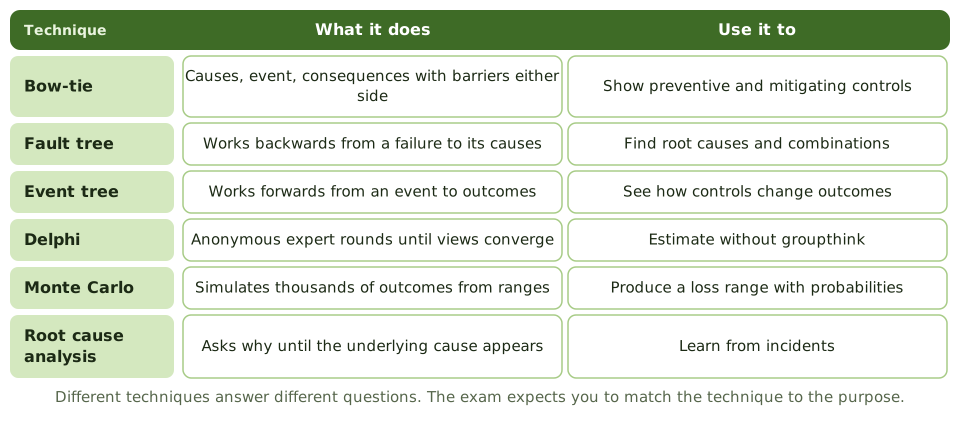
Choosing a technique
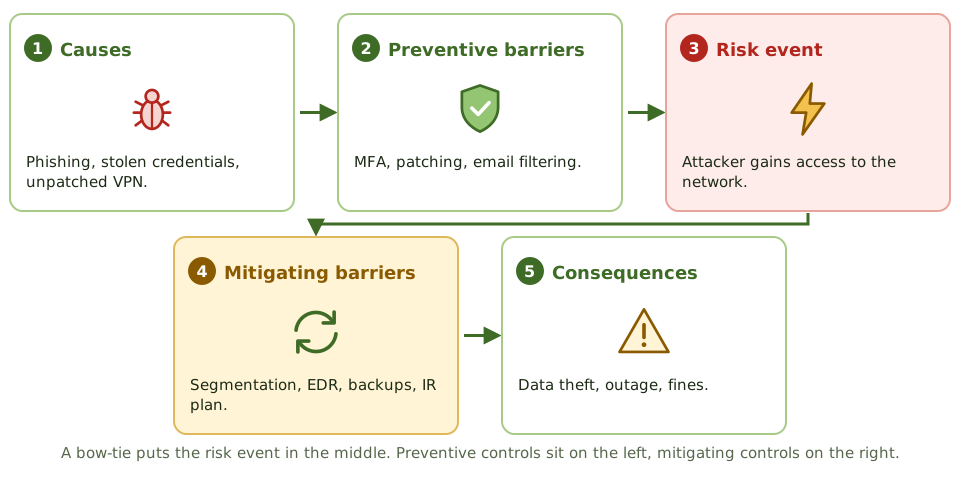
The bow-tie
Fault tree versus event tree
Getting good estimates
- 1Delphi: anonymous rounds until experts converge.
- 2Structured interviews and workshops with clear scales.
- 3Calibrate estimates against incident and industry data.
How the exam asks about it
| If the question asks… | The answer is usually… |
|---|---|
| Technique showing preventive and mitigating controls | Bow-tie |
| Work backwards from a failure to causes | Fault tree analysis |
| Avoid groupthink in expert estimates | Delphi technique |
| Prevent an incident recurring | Root cause analysis |
Key takeaways
- ✓Bow-tie analysis shows causes and preventive controls on one side and consequences and mitigating controls on the other.
- ✓Fault tree analysis works backwards from a failure to the combinations of causes that produce it.
- ✓Event tree analysis works forwards from an event through control success or failure to possible outcomes.
- ✓The Delphi technique gathers anonymous expert estimates in rounds to avoid groupthink.
- ✓Root cause analysis finds the underlying cause so that fixes prevent recurrence.
- ✓Match the technique to the question you need to answer.
Exam traps
- !Confusing fault tree (backwards to causes) with event tree (forwards to outcomes).
- !Using open group discussion where Delphi's anonymity is needed to avoid dominant voices.
- !Treating symptoms because root cause analysis wasn't done.
- !Choosing a complex technique where a simple workshop would do.
Choosing a Consistent Assessment Methodology
Why risk assessments need agreed methods, scales and criteria, how to define likelihood and impact scales the business understands, and how consistency makes results comparable over time.
Why consistency matters
If the finance team's 'high' means a 1 million loss and IT's 'high' means a server outage, nobody can compare risks or add them up. A common methodology makes results comparable across teams and across years.
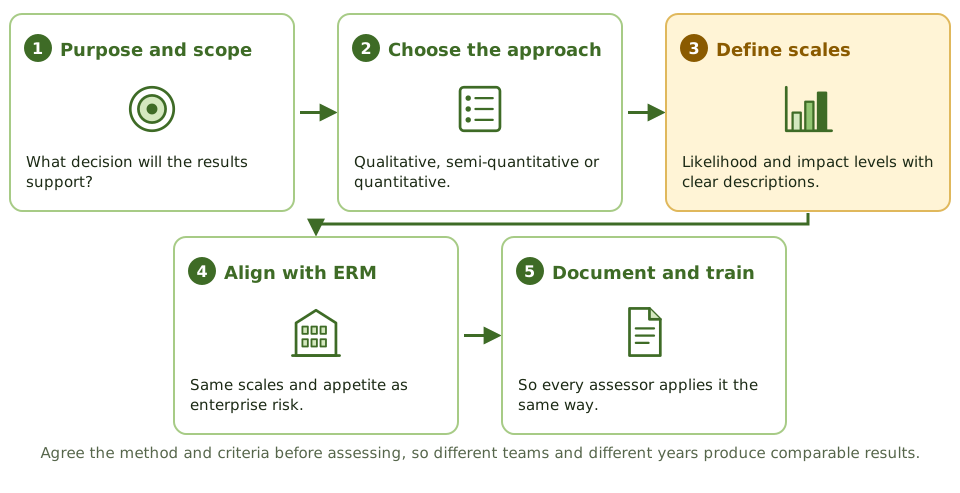
Setting up the method
Describing the scales
| Impact level | Business description |
|---|---|
| 1 Minor | Under 50,000; no customer impact |
| 2 Moderate | 50,000-500,000; some customers affected |
| 3 Major | 0.5-5 million; regulator notified |
| 4 Severe | Over 5 million; licence or strategy at risk |
Keeping it consistent
- 1Document the methodology and examples.
- 2Train everyone who assesses risk.
- 3Calibrate ratings in review sessions.
- 4Change the method only deliberately, and restate past results.
How the exam asks about it
| If the question asks… | The answer is usually… |
|---|---|
| BEST way to make risk results comparable | Common methodology and scales across the organisation |
| Two assessments differ widely | Check methods, scales and assumptions |
| Most important feature of impact scales | Clear descriptions in business terms |
| Relationship with ERM | Use the same scales as enterprise risk |
Key takeaways
- ✓Agree the method, scales and criteria before assessing.
- ✓Likelihood and impact scales need clear descriptions in business terms for each level.
- ✓Use the same scales as enterprise risk management so IT risks can be compared with other risks.
- ✓Document the methodology and train assessors so different people reach similar results.
- ✓Consistency over time lets trends be measured; change the method only deliberately.
Exam traps
- !Letting each team use its own scales.
- !Defining levels with labels only ('medium') and no descriptions.
- !Changing the method every year, so trends can't be seen.
- !Choosing a methodology because it's popular rather than because it fits.
Translating Technical Events into Business Impact
How the risk practitioner turns technical findings and events into the business impact decision-makers act on, using agreed impact categories and the people who know the business.
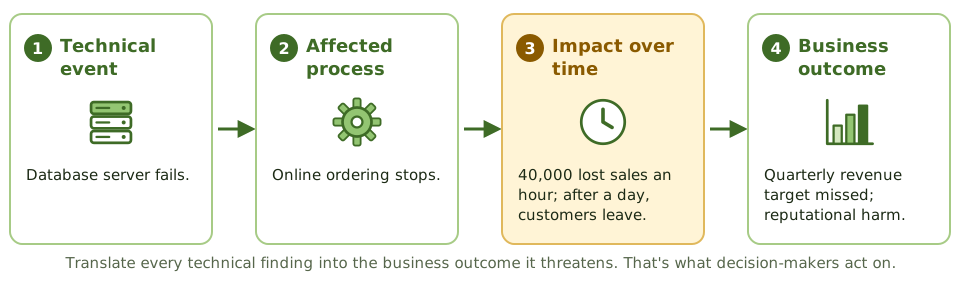
From technical to business
Impact categories
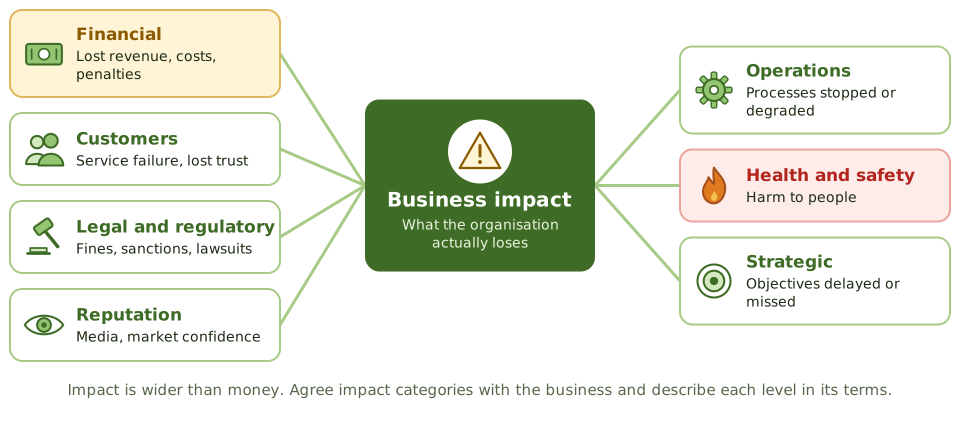
Who knows the impact
| Question | Best source |
|---|---|
| What stops if this system fails? | Business process owner |
| What would the regulator do? | Compliance and legal |
| How would customers react? | Sales, customer service |
| How long to restore? | IT operations |
Time changes impact
Most impacts grow with duration. A one-hour outage of online sales may cost little; a three-day outage may lose customers for good. Ask owners how impact changes over an hour, a day and a week.
How the exam asks about it
| If the question asks… | The answer is usually… |
|---|---|
| BEST way to communicate technical risk to executives | Express it as business impact |
| Best source for impact estimates | Business process owners |
| Impact category often overlooked | Regulatory, reputational or safety impact |
| Why consider duration | Impact grows over time |
Key takeaways
- ✓Decision-makers act on business impact, not technical severity.
- ✓Trace each technical event to the process it affects, how impact grows over time and the resulting business outcome.
- ✓Use agreed impact categories: financial, customers, legal and regulatory, reputation, operations, safety and strategy.
- ✓Business owners are the best source of impact estimates; IT supplies the technical facts.
- ✓Impact often grows with time; a one-hour outage and a one-week outage are different risks.
Exam traps
- !Reporting a risk as 'critical CVE' instead of what it means for the business.
- !Asking IT to estimate business impact.
- !Counting only financial impact and ignoring regulatory, safety or reputational effects.
- !Ignoring how impact changes with duration.
Business Impact Analysis for Risk Prioritisation
How a business impact analysis identifies critical processes and how quickly their disruption causes harm, and how the risk practitioner uses its results to prioritise IT risks.
What a BIA does
A business impact analysis asks one question: if this process stops, how much harm does that cause, and how fast? It sets recovery priorities and objectives. It doesn't ask how likely disruption is; that's the risk assessment's job.
The BIA steps
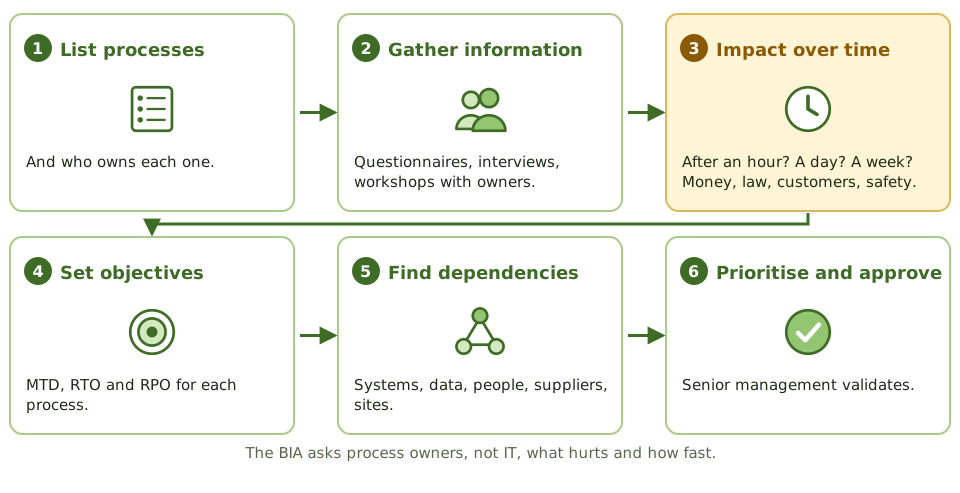
BIA and risk assessment together
| BIA | Risk assessment | |
|---|---|---|
| Main question | Impact of disruption over time | Likelihood and impact of scenarios |
| Focus | Processes and recovery | Threats, vulnerabilities, controls |
| Outputs | MTD, RTO, RPO, priorities | Risk ratings, register |
Using BIA results
- 1Rate impact for scenarios affecting critical processes.
- 2Prioritise risks on assets critical processes depend on.
- 3Set recovery objectives that responses must meet.
- 4Spot dependencies missed by technical inventories.
How the exam asks about it
| If the question asks… | The answer is usually… |
|---|---|
| PRIMARY purpose of a BIA | Identify critical processes and impact of disruption over time |
| Who provides BIA information | Business process owners |
| What a BIA doesn't measure | Likelihood |
| How BIA helps risk management | Prioritises risks by business criticality |
Key takeaways
- ✓A BIA measures the impact of disrupting business processes over time; it doesn't assess likelihood.
- ✓It sets maximum tolerable downtime, recovery time objectives and recovery point objectives.
- ✓Process owners, not IT, provide the impact information.
- ✓BIA results show which assets and dependencies matter most, which sharpens risk prioritisation.
- ✓Risk assessment adds likelihood; together they give a complete picture.
Exam traps
- !Thinking a BIA estimates threat likelihood.
- !Letting IT complete the BIA alone.
- !Treating every process as critical.
- !Forgetting dependencies such as suppliers, data and key staff.
Inherent and Residual Risk
The difference between risk before and after controls, how to estimate residual risk realistically and why the comparison shows the value of controls.
Before and after controls
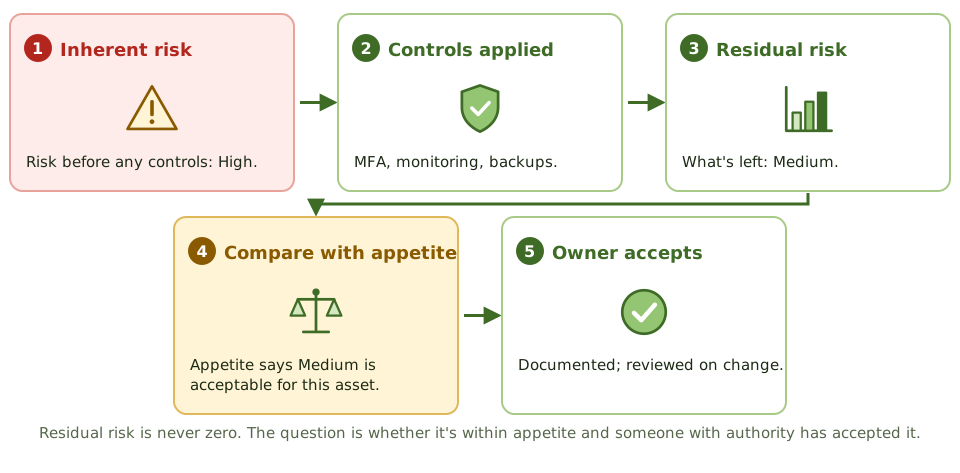
Why both matter
Estimating residual risk honestly
- 1Base it on how controls actually operate, using test results.
- 2Discount controls that are untested or have failed.
- 3Consider how controls could be bypassed.
- 4Re-estimate after control changes or failures.
How the exam asks about it
| If the question asks… | The answer is usually… |
|---|---|
| Risk before controls | Inherent risk |
| Risk after controls | Residual risk |
| Residual risk exceeds appetite | Further response or formal acceptance |
| BEST basis for residual estimate | Controls' tested effectiveness |
Key takeaways
- ✓Inherent risk is the level of risk before considering controls; residual risk is what remains after them.
- ✓Residual risk should reflect controls as they actually operate, not as designed on paper.
- ✓Comparing inherent and residual risk shows how much controls reduce risk, and which controls matter most.
- ✓Residual risk is never zero; it must be within appetite or formally accepted.
- ✓If key controls fail, risk returns towards its inherent level.
Exam traps
- !Estimating residual risk assuming every control works perfectly.
- !Believing residual risk can be eliminated.
- !Closing a risk because controls exist, without checking residual risk against appetite.
- !Ignoring inherent risk, which shows the exposure if controls fail.
Evaluating Risk Against Business Objectives and Appetite
How risk evaluation turns analysed ratings into decisions: comparing each risk with appetite and tolerance, prioritising, and deciding which risks need a response and at what level.
What evaluation does
Analysis gives each risk a rating. Evaluation asks what that rating means for the business: is it acceptable, does it need a response, and who must decide? The yardstick is the appetite and tolerance the board has set.
From rating to action
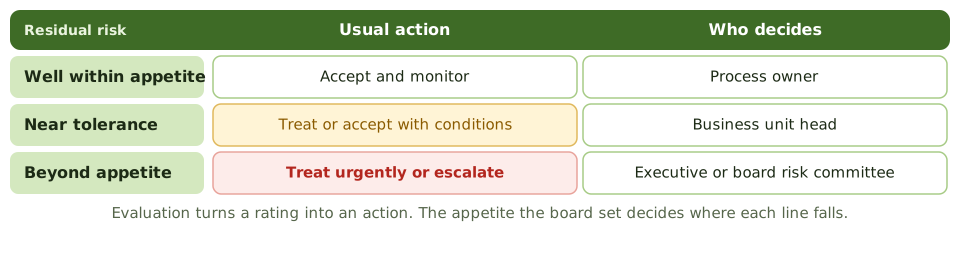
Prioritising
- 1Impact on business objectives first.
- 2Distance from appetite or tolerance.
- 3Speed of onset: how quickly harm arrives.
- 4Trends: is the risk rising?
How the exam asks about it
| If the question asks… | The answer is usually… |
|---|---|
| After analysing a risk | Evaluate it against appetite |
| Risk well within appetite | Accept and monitor |
| MOST important basis for prioritising | Impact on business objectives |
| Risk beyond appetite | Treat or escalate to a level that can accept it |
Key takeaways
- ✓Evaluation compares analysed risk with appetite and tolerance to decide whether a response is needed.
- ✓Risks well within appetite are usually accepted and monitored; risks beyond it need treatment or escalation.
- ✓Prioritise by impact on business objectives, not technical severity.
- ✓The level of authority needed to decide rises with the size of the risk.
- ✓Evaluation comes after analysis and before choosing a response.
Exam traps
- !Choosing a response before comparing the risk with appetite.
- !Prioritising by the order risks were found or by cost to fix.
- !Treating all risks above zero as needing mitigation.
- !Letting a low-level manager decide on a risk beyond appetite.
Creating and Maintaining the IT Risk Register
What goes into an IT risk register, who maintains it, how to keep it accurate and current, and why one consistent register is the backbone of IT risk management.
What a register holds
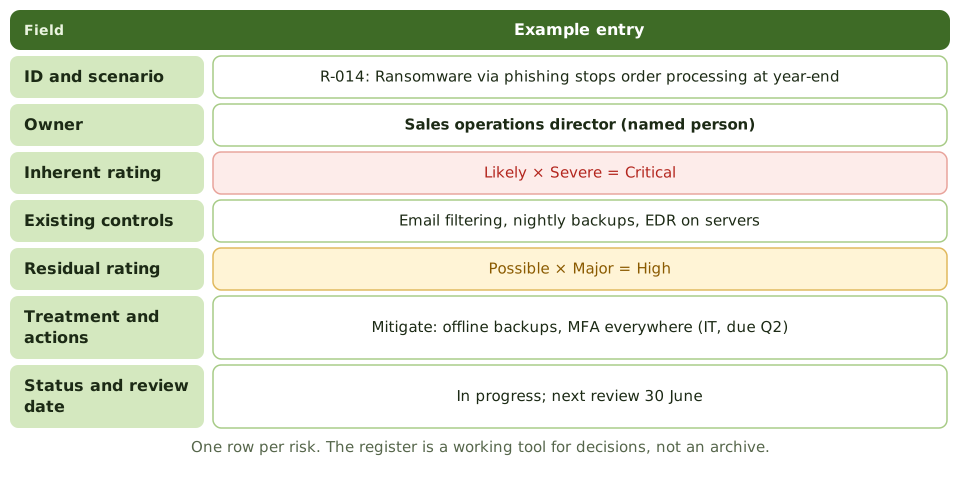
Who does what
| Role | Register responsibility |
|---|---|
| Risk practitioner | Maintains structure, quality and consistency |
| Risk owner | Keeps their entries accurate; approves responses |
| Control and action owners | Update action status |
| Senior management | Reviews top risks and trends |
Keeping it current
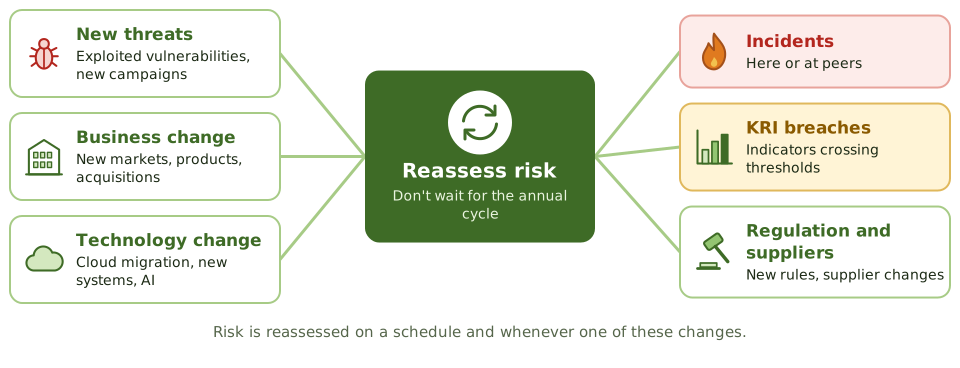
Quality checks
- 1Every entry has a named owner and review date.
- 2Scenarios are specific, not one-word labels.
- 3Ratings use the common scales.
- 4Accepted risks show who accepted and until when.
How the exam asks about it
| If the question asks… | The answer is usually… |
|---|---|
| PRIMARY purpose of the risk register | Record and track risks, owners and responses |
| When to update it | Continuously, on change and new information |
| Accepted risk | Keep it on record with acceptance details and review date |
| Many local registers | Consolidate into one consistent register |
Key takeaways
- ✓The risk register records each risk with its owner, ratings, controls, response, actions and status.
- ✓One consistent register, linked to the enterprise register, beats many local spreadsheets.
- ✓The risk practitioner maintains the register; owners keep their entries accurate.
- ✓Update it on change, incidents, audit findings, KRI breaches and completed actions, not just once a year.
- ✓Closed and accepted risks stay on record with their decisions and review dates.
Exam traps
- !Letting each department keep its own register with different scales.
- !Updating the register only before audits.
- !Deleting accepted risks instead of recording the acceptance.
- !Entries with no named owner or review date.
Using the Risk Register to Support Decisions
How the risk register becomes a management tool rather than an archive: prioritising resources, tracking treatment, building the risk profile and informing budgets, audits and strategy.
From archive to tool
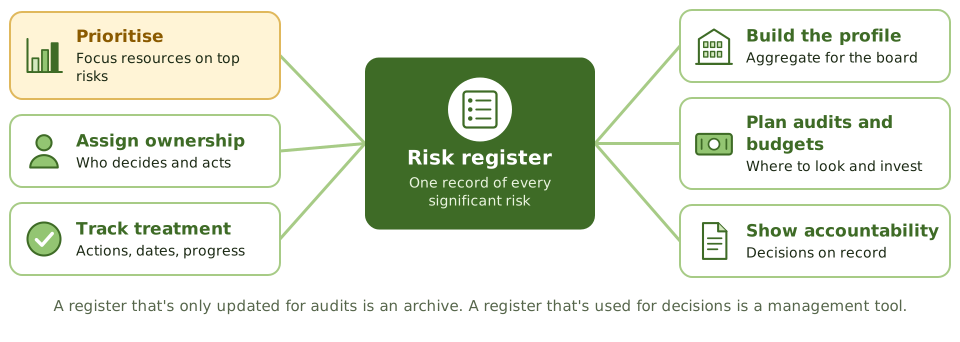
Views that answer questions
| Management question | Register view |
|---|---|
| Where should we spend next year? | Top risks beyond appetite, with costed options |
| Which supplier matters most? | Risks grouped by third party |
| Are we getting better? | Trend of residual ratings over time |
| Who's behind on actions? | Overdue treatment by owner |
Feeding other processes
- 1Budget planning: fund responses to top risks.
- 2Audit planning: focus assurance on high risks.
- 3Project approval: check new risks against the profile.
- 4Strategy: show risks to new objectives.
How the exam asks about it
| If the question asks… | The answer is usually… |
|---|---|
| BEST use of the risk register | Support risk-based decisions and prioritisation |
| What the board should receive | A summarised profile, not the full register |
| Input to the audit plan | High residual risks from the register |
| Many overdue actions | Escalate to owners and senior management |
Key takeaways
- ✓The register's value comes from using it in decisions, not from completing it.
- ✓It supports prioritising resources, assigning ownership, tracking treatment and building the risk profile.
- ✓Filtered views (by owner, process, supplier or trend) answer specific management questions.
- ✓Budgets, audit plans and project approvals should draw on the register.
- ✓Stale or untrusted registers stop being used, so data quality matters.
Exam traps
- !Treating a complete register as the goal.
- !Sending the full register to the board instead of a summarised profile.
- !Planning budgets and audits without reference to the register.
- !Ignoring overdue actions shown in the register.
Risk Response and Reporting
Risk response · Ownership and accountability · Third-party risk · Issues and exceptions · Control design · Control testing · Risk data and treatment plans · Monitoring and metrics · Reporting · Emerging risk
Risk Response Options: Accept, Mitigate, Transfer, Avoid
The four ways to respond to IT risk, when each fits, and why the risk owner chooses the response after the risk practitioner sets out the options.
Four responses
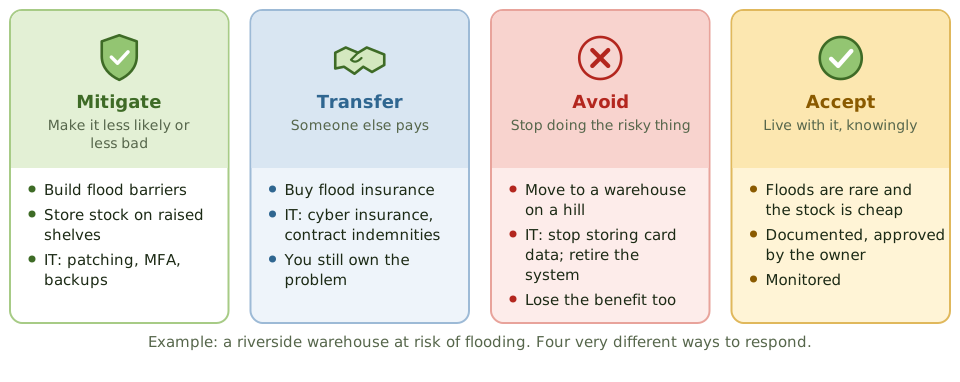
Choosing a response
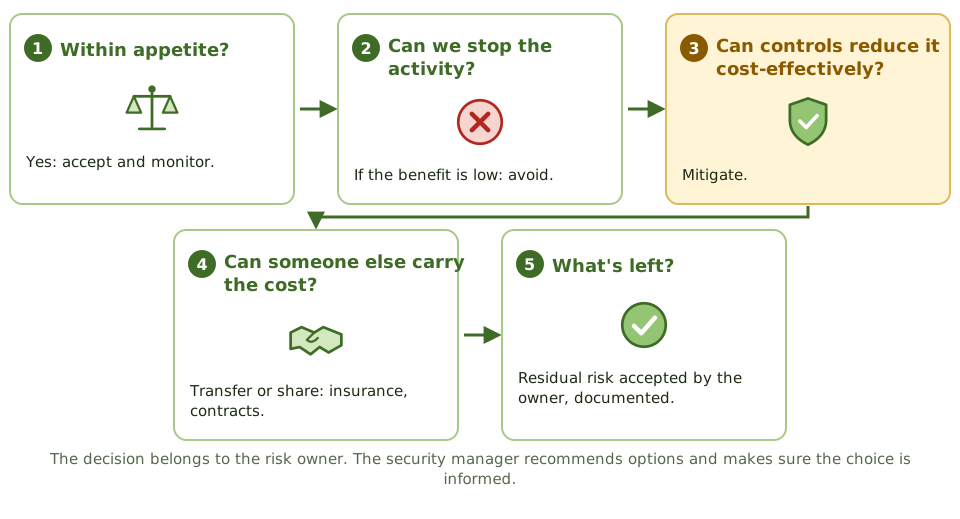
When each fits
| Response | Fits when… |
|---|---|
| Accept | Risk is within appetite, or treatment costs more than it saves |
| Mitigate | Controls reduce risk cost-effectively |
| Transfer | Financial impact can be shared through insurance or contracts |
| Avoid | The activity's benefit doesn't justify its risk |
Who decides
- 1The practitioner sets out options, costs and residual risk.
- 2The risk owner chooses within their authority.
- 3Higher risks escalate to more senior owners.
- 4The decision is recorded in the register.
How the exam asks about it
| If the question asks… | The answer is usually… |
|---|---|
| Who selects the risk response | The risk owner |
| Buying cyber insurance | Transfer; accountability stays |
| Stopping a risky service | Avoidance |
| Risk within appetite | Accept and monitor |
Key takeaways
- ✓The four responses are accept, mitigate (reduce), transfer (share) and avoid.
- ✓The risk owner chooses the response; the practitioner presents options with costs and residual risk.
- ✓Acceptance must be informed, documented and within the owner's authority.
- ✓Transfer shares financial impact but never accountability.
- ✓Avoidance removes the activity, and its benefits, entirely.
- ✓Responses are often combined; residual risk must end up within appetite.
Exam traps
- !Treating mitigation as the only option.
- !Thinking insurance transfers accountability or reputational damage.
- !Accepting a risk by default because nobody decided.
- !The practitioner choosing the response instead of the owner.
Aligning Responses with Appetite and Tolerance
How to size a risk response so that residual risk lands within appetite and tolerance, avoiding both over-treatment that wastes resources and under-treatment that leaves the business exposed.
Aim for appetite, not zero
The goal of a response is residual risk within appetite. Spending more than that buys little extra value; spending less leaves the business carrying more risk than the board agreed to.
Sizing the response
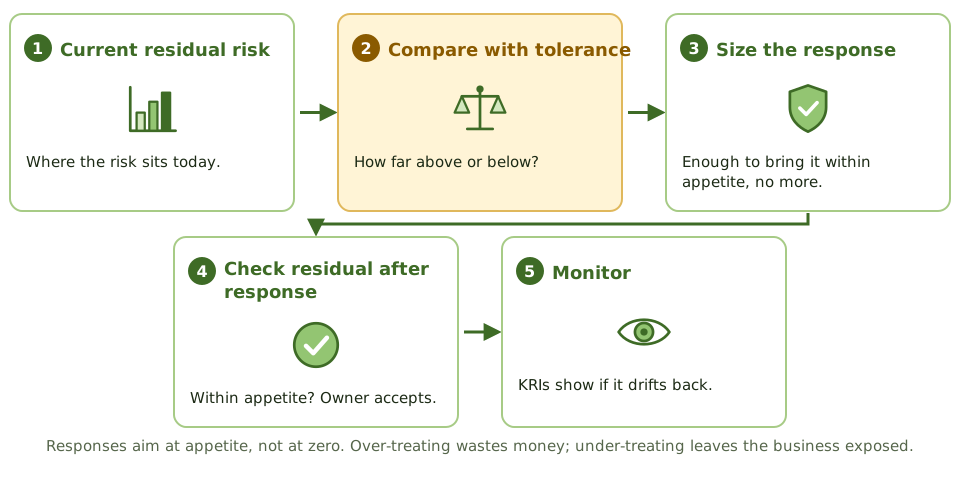
Over- and under-treating
Different appetites
| Risk type | Typical appetite |
|---|---|
| Customer data breach | Low |
| Safety of operational systems | Very low |
| Trying new technology in pilots | Moderate |
| Minor internal service outages | Moderate |
How the exam asks about it
| If the question asks… | The answer is usually… |
|---|---|
| Goal of a risk response | Residual risk within appetite |
| Residual still above appetite | Further response or escalation |
| After implementing a response | Re-assess residual risk |
| Most expensive control option | Not best unless needed to reach appetite |
Key takeaways
- ✓Responses aim to bring residual risk within appetite, not to eliminate risk.
- ✓Over-treating wastes money and can slow the business; under-treating leaves risk above appetite.
- ✓Check residual risk after the response, not just whether a control was added.
- ✓If residual risk stays above appetite, respond further or escalate for formal acceptance.
- ✓Appetite can differ by risk type; a low appetite for safety risk can sit alongside a higher one for innovation risk.
Exam traps
- !Choosing the response that removes the most risk regardless of appetite or cost.
- !Closing a risk once a control is added without re-rating residual risk.
- !Applying one appetite level to every type of risk.
- !Leaving risks above appetite without escalation.
Cost-Benefit Analysis of Risk Responses
How to compare response options by their full cost and the risk they remove, including doing nothing, and when non-financial factors override the numbers.
Comparing options
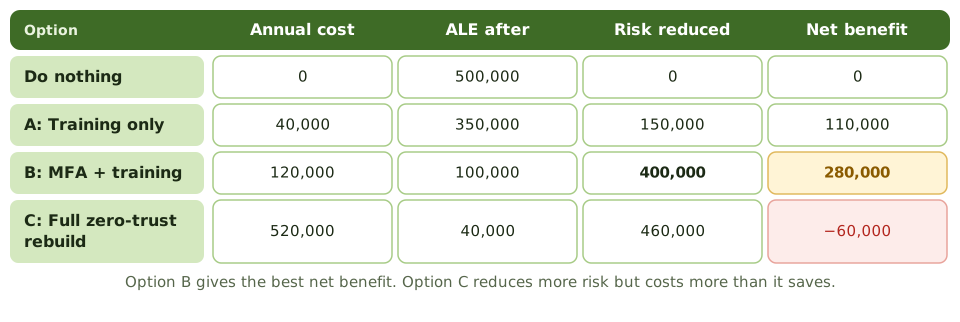
Total cost of a response
- 1Purchase and licences.
- 2Implementation and integration.
- 3Staff time to operate and maintain.
- 4Training and support.
- 5Business friction and lost productivity.
When numbers aren't enough
How the exam asks about it
| If the question asks… | The answer is usually… |
|---|---|
| BEST basis for choosing between controls | Risk reduction relative to total cost |
| Cost most often missed | Ongoing staff time and operation |
| Option every business case should include | Do nothing, with its residual risk |
| Control fails cost-benefit but is legally required | Implement it; compliance overrides |
Key takeaways
- ✓Compare each option's total annual cost with the risk reduction it delivers.
- ✓Include a 'do nothing' option so decision-makers can see the residual risk of not acting.
- ✓Total cost includes purchase, implementation, staff time, maintenance and business friction.
- ✓The best option is usually the one with the greatest net benefit that brings risk within appetite.
- ✓Legal requirements, safety and reputation can justify controls the numbers alone don't support.
Exam traps
- !Comparing control cost with total ALE instead of the reduction in ALE.
- !Leaving out staff time and ongoing operating costs.
- !Choosing the option that removes most risk even when it costs more than it saves.
- !Ignoring legal or safety requirements because the numbers are unfavourable.
Bias in Risk Decisions and Reporting
The cognitive biases that distort risk estimates, responses and reports, and the structured methods a risk practitioner uses to keep decisions objective.
Biases to watch
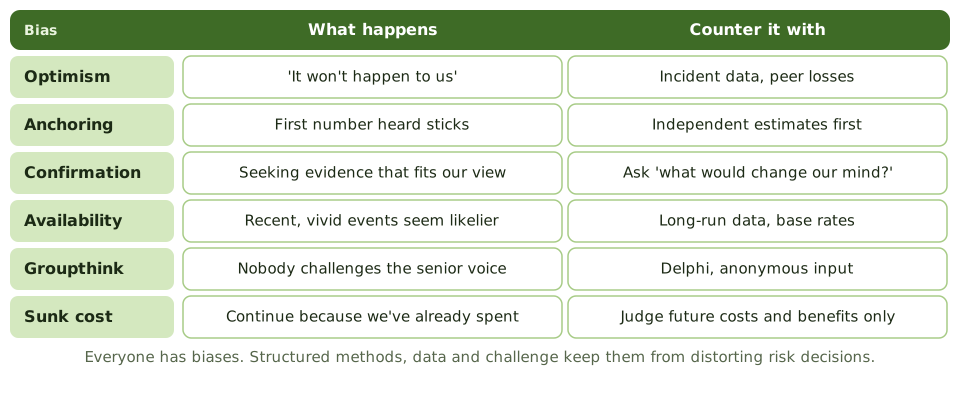
Where bias creeps in
| Stage | How bias shows up |
|---|---|
| Estimating | Optimistic likelihoods; anchored on first number |
| Choosing responses | Favouring familiar controls; sunk cost |
| Reporting | Selective data; softened wording; misleading scales |
Countering bias
- 1Collect independent estimates before discussion.
- 2Use incident and industry data as a check.
- 3Ask what evidence would change the conclusion.
- 4Invite challenge from people outside the team.
- 5Show the same scales and periods in every report.
How the exam asks about it
| If the question asks… | The answer is usually… |
|---|---|
| Reduce groupthink in estimates | Anonymous methods such as Delphi |
| Project continues because of money spent | Sunk cost bias; judge future value |
| BEST check on optimistic estimates | Incident and industry data |
| Report hides an unfavourable trend | Present complete, consistent data |
Key takeaways
- ✓Common biases include optimism, anchoring, confirmation, availability, groupthink and sunk cost.
- ✓Bias affects estimates, the choice of response and how risk is reported.
- ✓Structured methods, data and independent challenge reduce bias.
- ✓Anonymous estimation such as Delphi reduces anchoring and groupthink.
- ✓Reports can be biased by selective data, misleading scales or softened wording.
Exam traps
- !Assuming experienced people aren't biased.
- !Letting the most senior person speak first in estimation workshops.
- !Continuing a project because of money already spent.
- !Rating a risk higher simply because a similar incident was in the news.
Risk Owners and Control Owners
The difference between owning a risk and owning a control, why they're often different people, and how the two work together to keep risk within appetite.
Two kinds of ownership
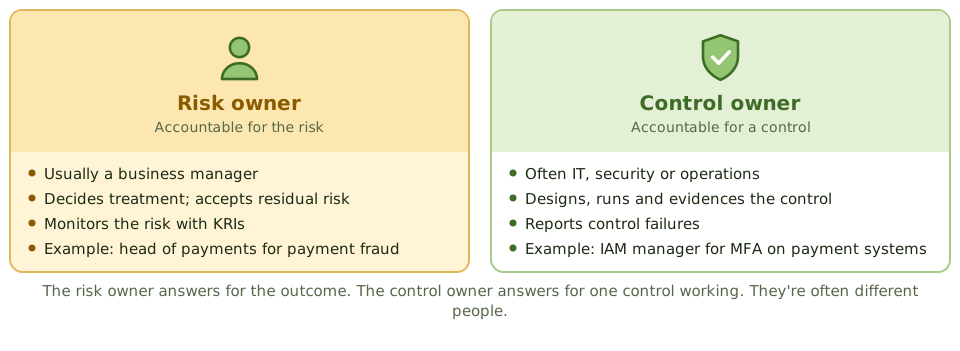
Many-to-many
| Risk (owner) | Controls (owners) |
|---|---|
| Payment fraud (CFO) | Dual approval (finance), MFA (IAM team), monitoring (SOC) |
| Customer data breach (head of sales) | Encryption (infrastructure), DLP (security), access reviews (sales managers) |
Working together
- 1 Control owner detects failure
- 2 Reports to risk owner
- 3 Practitioner reassesses risk
- 4 Risk owner decides response
How the exam asks about it
| If the question asks… | The answer is usually… |
|---|---|
| Who is accountable for a control operating | The control owner |
| Who decides when a control fails | The risk owner |
| Can one person be both | Yes, but often they're different |
| BEST way to clarify ownership | Map risks to controls and named owners |
Key takeaways
- ✓The risk owner is accountable for the risk outcome; the control owner is accountable for a control operating effectively.
- ✓Risk owners are usually business managers; control owners are often in IT, security or operations.
- ✓One risk may rely on several controls with different owners; one control may support several risks.
- ✓Control owners report control failures to risk owners, who decide on the response.
- ✓Mapping risks to controls and owners shows who must act when something changes.
Exam traps
- !Assuming the control owner also owns the risk.
- !Making IT the risk owner because IT runs the controls.
- !Control failures reported only within IT, never reaching the risk owner.
- !Controls with no named owner.
RACI and Escalation
How a RACI chart makes responsibilities for risk activities clear, and how agreed escalation paths and thresholds move risks to the right decision-makers in time.
RACI for risk activities
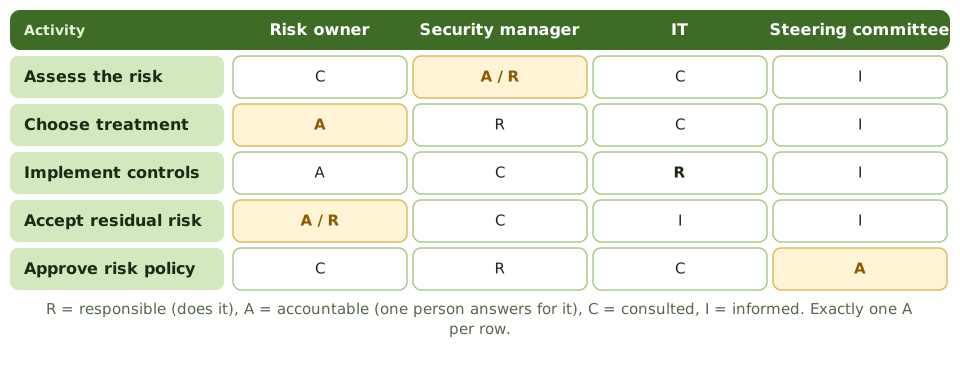
The four letters
| Letter | Meaning |
|---|---|
| R | Responsible: does the work |
| A | Accountable: answers for the result (exactly one) |
| C | Consulted: gives input before |
| I | Informed: told after |
Escalation paths
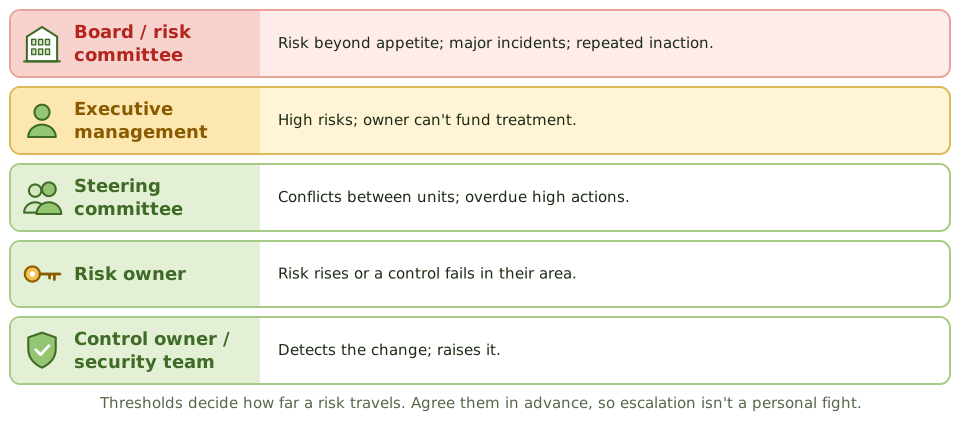
How the exam asks about it
| If the question asks… | The answer is usually… |
|---|---|
| How many Accountable per activity | Exactly one |
| Purpose of a RACI | Clarify roles and avoid gaps or overlaps |
| What triggers escalation | Agreed thresholds |
| Owner ignores an overdue high risk | Escalate through the agreed path |
Key takeaways
- ✓RACI shows who is Responsible, Accountable, Consulted and Informed for each activity.
- ✓Each activity has exactly one Accountable person.
- ✓Escalation paths define how far a risk travels based on agreed thresholds.
- ✓Escalation should be triggered by thresholds agreed in advance, not personal judgement alone.
- ✓Escalation is part of normal governance, not a sign of failure.
Exam traps
- !Two Accountable people for one activity.
- !Escalating directly to the board, skipping the risk owner.
- !Not escalating because it might upset the owner.
- !Escalation paths with no thresholds.
Third-Party Risk Governance and Due Diligence
How the organisation governs the risk of suppliers and outsourcing through the third-party life cycle, tiering by risk and due diligence before contracts are signed.
The third-party life cycle
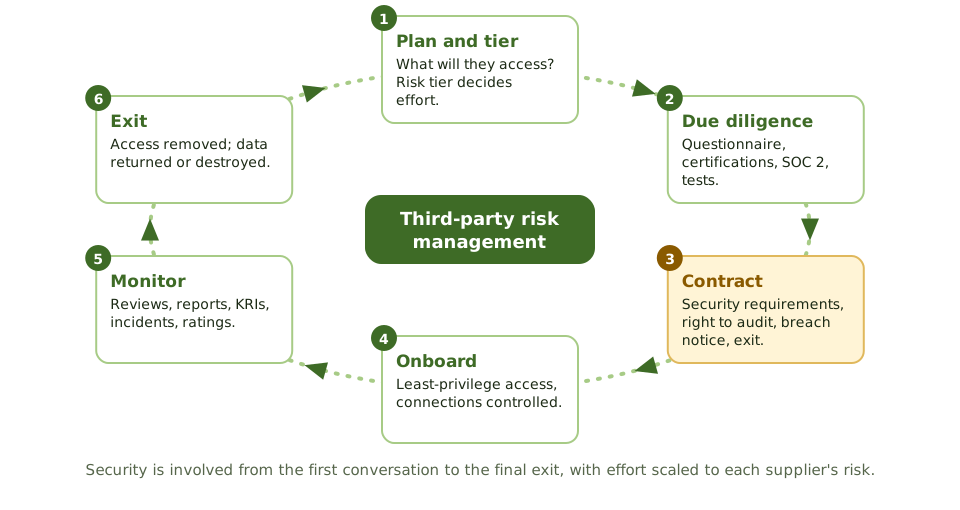
Tiering suppliers
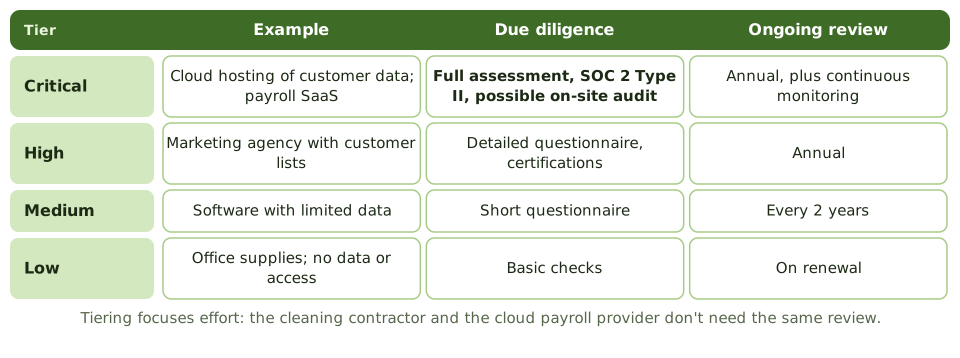
Due diligence
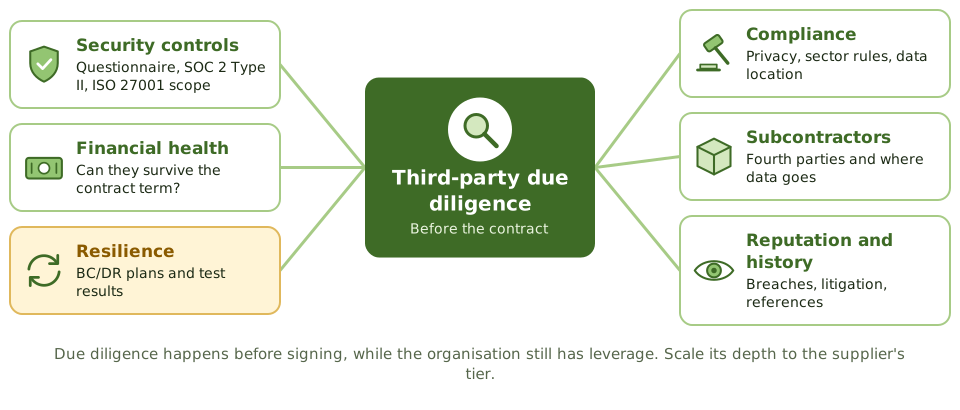
Beyond the third party
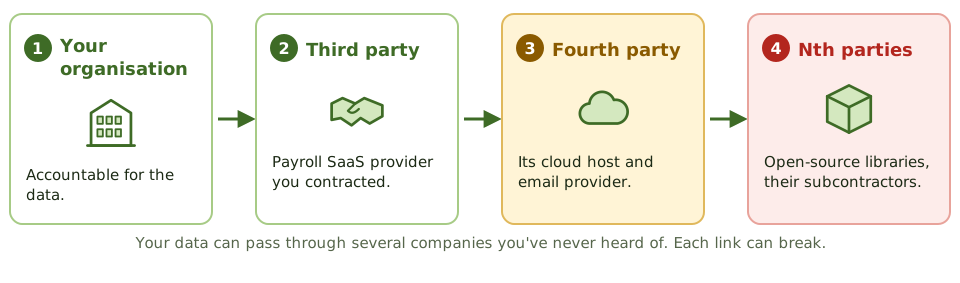
How the exam asks about it
| If the question asks… | The answer is usually… |
|---|---|
| When to assess a supplier's security | Before signing the contract |
| BEST way to manage many suppliers | Tier by risk and scale effort |
| Who is accountable for outsourced data | The organisation |
| Supplier presents an ISO 27001 certificate | Check the scope covers the service |
Key takeaways
- ✓Third-party risk management covers suppliers from planning through due diligence, contract, onboarding, monitoring and exit.
- ✓Outsourcing transfers activities, not accountability.
- ✓Tier suppliers by risk so that due diligence effort matches what they can affect.
- ✓Due diligence happens before signing and covers security, finances, resilience, compliance and subcontractors.
- ✓Fourth parties (suppliers' suppliers) are part of the risk.
Exam traps
- !Assessing suppliers only after the contract is signed.
- !Giving every supplier the same level of review.
- !Relying on a certificate without checking its scope.
- !Believing outsourcing moves accountability to the supplier.
Contracts, SLAs and the Right to Audit
How contracts and service level agreements turn risk requirements into enforceable obligations, and which clauses matter most for managing third-party IT risk.
Clauses that matter
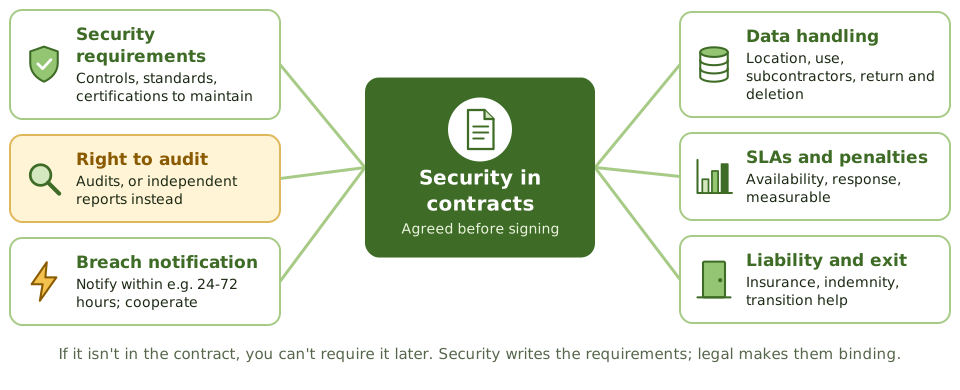
Good and bad SLAs
| Weak | Strong |
|---|---|
| High availability | 99.9% monthly, measured end to end |
| Prompt incident response | Severity 1 response within 30 minutes |
| Timely breach notice | Notify within 24 hours of discovery |
Right to audit
Without a right to audit, or at least to receive independent assurance reports such as SOC 2 Type II, the organisation can't verify that the supplier's controls work. Large providers often offer reports instead of on-site audits; check that their scope covers the services used.
How the exam asks about it
| If the question asks… | The answer is usually… |
|---|---|
| MOST important clause for oversight | Right to audit or receive assurance reports |
| Characteristic of a good SLA | Specific, measurable, monitored |
| When to define security requirements | Before the contract is signed |
| Provider refuses on-site audits | Accept independent assurance reports of relevant scope |
Key takeaways
- ✓If a requirement isn't in the contract, it usually can't be enforced later.
- ✓Key clauses cover security requirements, right to audit, breach notification, data handling, SLAs, liability and exit.
- ✓A right to audit, or to receive independent assurance reports, is essential for ongoing oversight.
- ✓SLAs must be specific and measurable, with consequences for breaches.
- ✓The risk practitioner defines requirements; legal makes them binding.
Exam traps
- !Vague SLAs such as 'high availability'.
- !Signing standard supplier terms with no right to audit.
- !Missing breach notification timelines.
- !No clause on returning or deleting data at exit.
Monitoring Third Parties and Planning Exit
How to keep watching supplier risk during the relationship, and how a planned exit strategy protects the business if a supplier fails, is breached or has to be replaced.
Ongoing monitoring
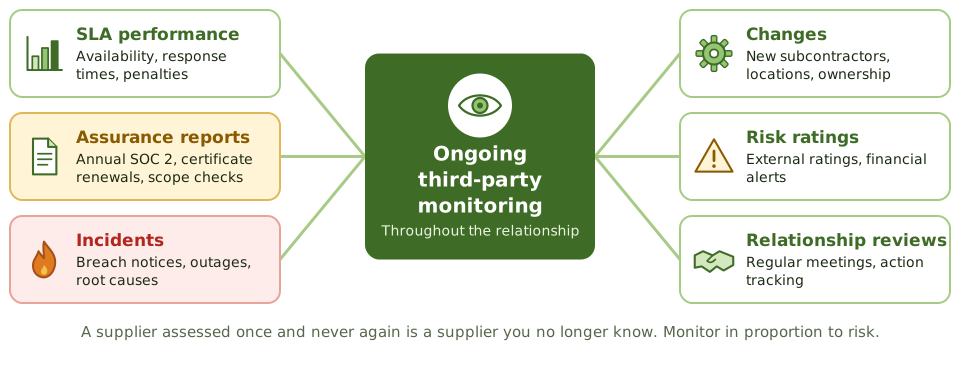
Warning signs
- 1Repeated SLA breaches.
- 2Late or qualified assurance reports.
- 3New subcontractors or data locations without notice.
- 4Financial distress or change of ownership.
- 5Security incidents or poor incident communication.
Planning exit
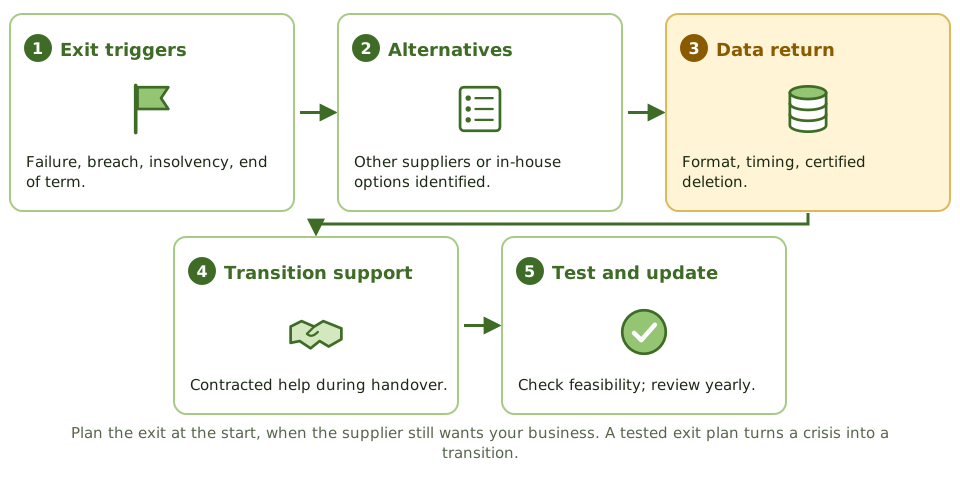
How the exam asks about it
| If the question asks… | The answer is usually… |
|---|---|
| How often to review a critical supplier | Regularly, in proportion to risk |
| BEST control for supplier failure risk | A tested exit plan and alternatives |
| When to plan exit | At the start of the relationship |
| At contract end | Revoke access; return or destroy data |
Key takeaways
- ✓Third-party risk changes during the contract; monitor in proportion to the supplier's tier.
- ✓Monitoring covers SLAs, assurance reports, incidents, changes, external ratings and relationship reviews.
- ✓Exit strategies should be planned at the start and tested for critical suppliers.
- ✓Exit plans cover triggers, alternatives, data return and deletion, and transition support.
- ✓Concentration on a single critical supplier is a risk in itself.
Exam traps
- !Assessing suppliers only once, before signing.
- !No exit plan until the supplier fails.
- !Forgetting to revoke supplier access and recover data at exit.
- !Ignoring changes in a supplier's subcontractors or ownership.
Managing Issues, Findings and Control Deviations
How findings from audits, control tests, incidents and self-assessments are logged, rated by their effect on risk, assigned and tracked to verified closure.
The issue life cycle
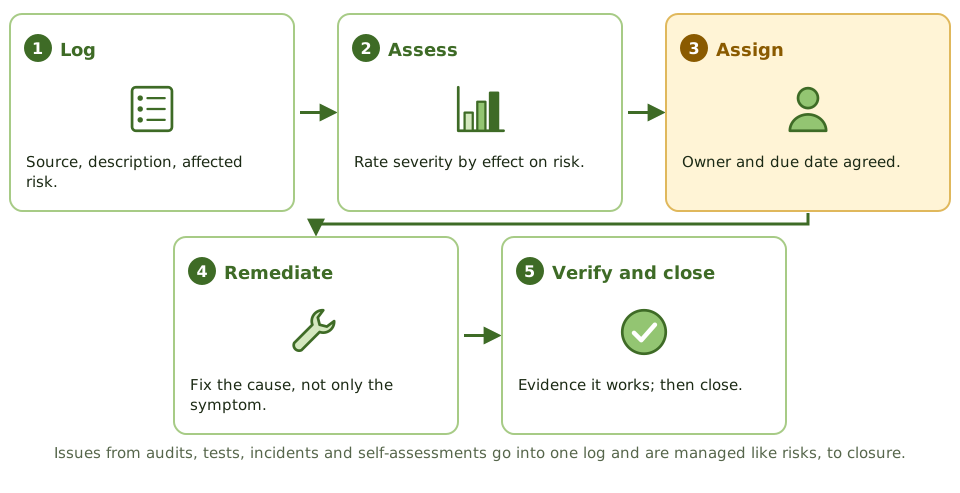
A well-described finding
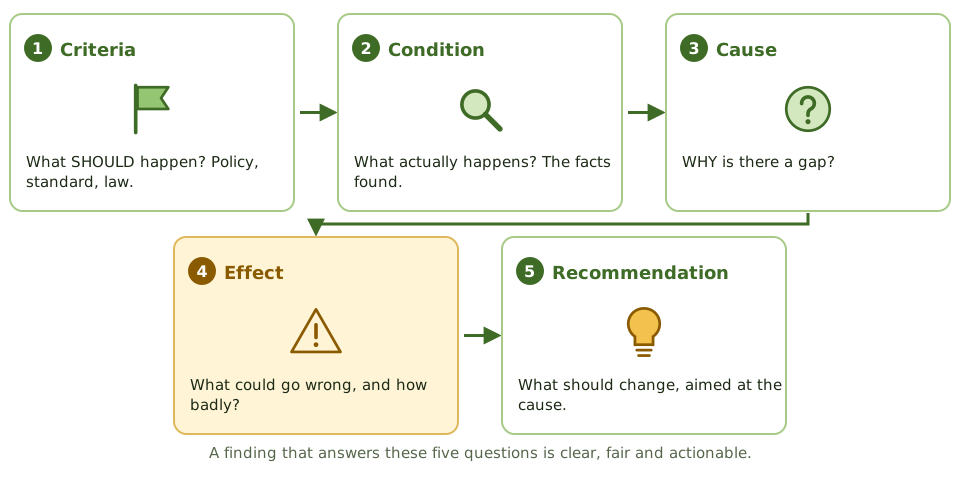
Link issues to risks
- 1Which risks does the issue affect?
- 2Does it change residual risk ratings?
- 3Does it reveal a missing scenario?
- 4Update the register when issues open and close.
Tracking to closure
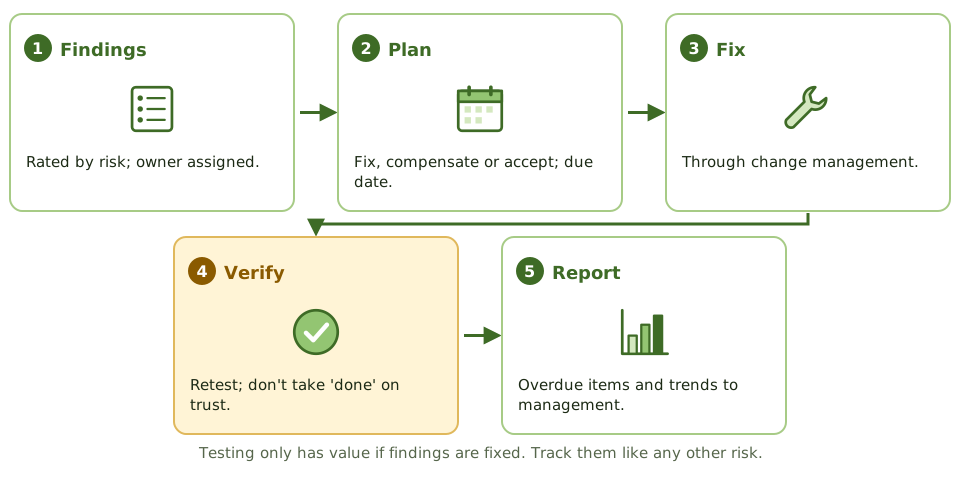
How the exam asks about it
| If the question asks… | The answer is usually… |
|---|---|
| BEST basis for prioritising issues | Effect on risk |
| Before closing an issue | Verify the fix with evidence |
| Recurring findings | Address the root cause |
| Issue affects a key control | Re-assess the related risk |
Key takeaways
- ✓Issues come from audits, control tests, incidents, assessments and regulators; manage them in one log.
- ✓Rate each issue by its effect on risk, not by its source or how embarrassing it is.
- ✓Every issue needs an owner, an agreed action and a due date.
- ✓Fix the root cause, not just the symptom, so the issue doesn't recur.
- ✓Close issues only when evidence shows the fix works.
- ✓Update the related risks in the register when issues are raised and closed.
Exam traps
- !Closing an issue on management's word without evidence.
- !Treating audit findings as more important than internal test results by default.
- !Fixing the single example found instead of the process.
- !Not linking issues to the risks they affect.
Risk Acceptance, Exceptions and Exemptions
How risks are formally accepted at the right level, how policy exceptions and exemptions differ, and why every one needs an owner, conditions and a review date.
Who may accept
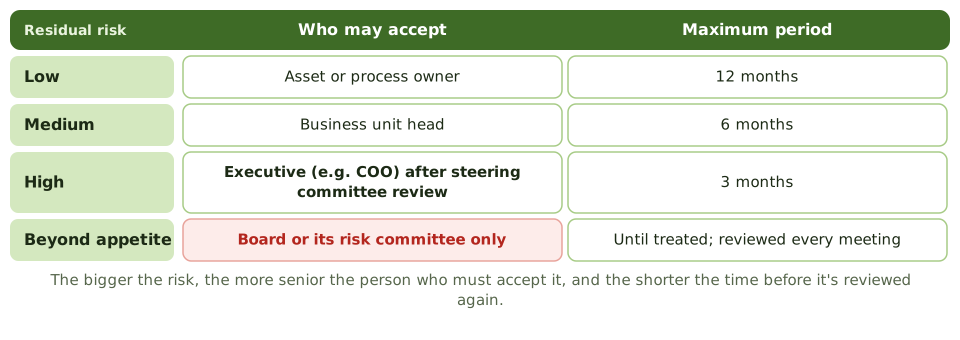
Exceptions, exemptions and acceptances
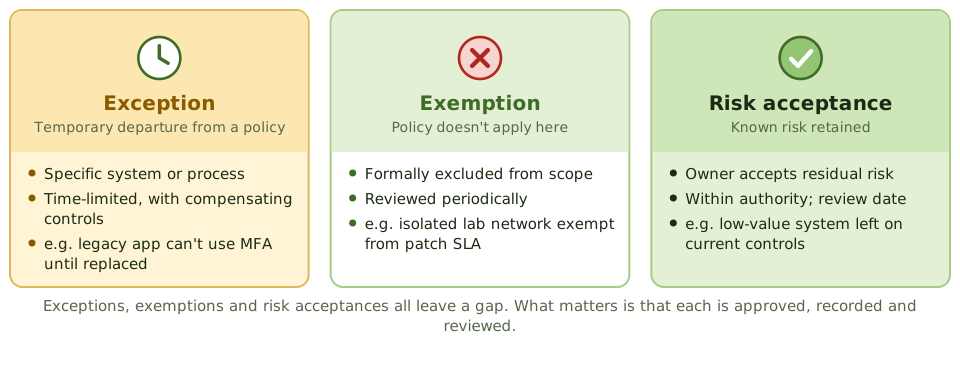
What every record needs
| Element | Why |
|---|---|
| Description of the risk or gap | Everyone knows what's accepted |
| Owner and approver | Accountability at the right level |
| Compensating controls | Reduce what's left |
| Conditions and expiry date | Forces review |
How the exam asks about it
| If the question asks… | The answer is usually… |
|---|---|
| Who accepts residual risk | The risk owner with suitable authority |
| Risk beyond appetite | Senior management or board acceptance |
| MOST important element of an acceptance | Owner, authority and review date |
| Accepted risk at expiry | Re-assess; renew, treat or close |
Key takeaways
- ✓Risk acceptance is a conscious, documented decision to retain a known risk.
- ✓Acceptance authority scales with the size of the risk; risks beyond appetite need the most senior approval.
- ✓An exception is a temporary, approved departure from a policy; an exemption formally takes something out of a policy's scope.
- ✓Every acceptance, exception and exemption needs an owner, compensating controls where possible and an expiry or review date.
- ✓Unreviewed acceptances quietly become permanent.
Exam traps
- !The risk practitioner or IT accepting risk for the business.
- !Accepting risk by doing nothing.
- !Acceptances with no expiry date.
- !Accepting a risk beyond appetite at a low level of authority.
Control Frameworks and Their Purpose
What control frameworks and catalogues are for, the main ones a CRISC candidate should recognise, and how to use them without letting the catalogue replace risk-based thinking.
Why use a control framework
Frameworks save the organisation from inventing controls from scratch, give auditors and regulators a familiar structure, and make gaps easier to spot. They're a starting point; risk assessment decides what's actually needed.
Main catalogues
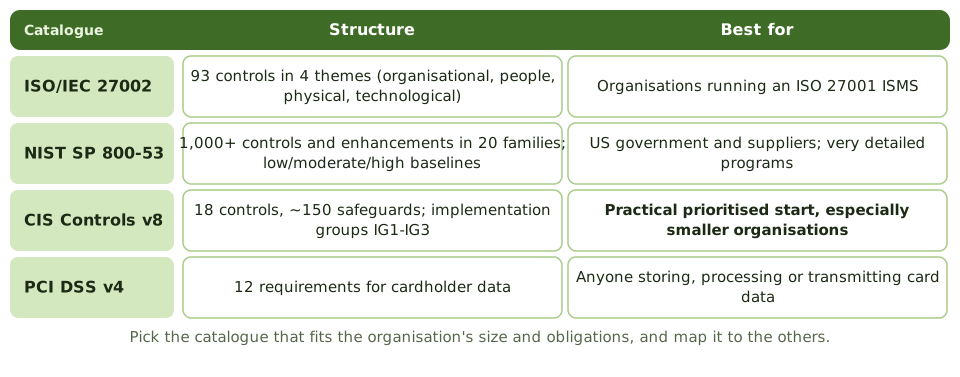
Use as a menu, not a checklist
- 1Start from the risk scenarios and appetite.
- 2Select controls that address those risks.
- 3Justify exclusions (e.g. a Statement of Applicability).
- 4Map selected controls to every relevant framework.
How the exam asks about it
| If the question asks… | The answer is usually… |
|---|---|
| PRIMARY benefit of a control framework | Structured, tested set of controls and common language |
| How to choose controls from a catalogue | Based on risk assessment |
| Several frameworks apply | Map one control set to all |
| Framework compliance achieved | Doesn't on its own prove risk is within appetite |
Key takeaways
- ✓Control frameworks give a tested, structured set of controls and a common language.
- ✓Common catalogues include ISO/IEC 27002, NIST SP 800-53, CIS Controls, COBIT and PCI DSS.
- ✓Use frameworks as a menu: risk assessment decides which controls apply and how strongly.
- ✓Mapping one control set to several frameworks reduces duplication.
- ✓COSO's internal control framework underpins control thinking in many organisations.
Exam traps
- !Implementing every control in a catalogue regardless of risk.
- !Treating framework compliance as proof that risk is managed.
- !Running separate control programs for each framework.
- !Confusing a control framework with a risk management framework.
Control Types and Functions
How controls are classified by function (deterrent, preventive, detective, corrective, compensating) and by type (administrative, technical, physical), and why good designs layer them.
Functions over time
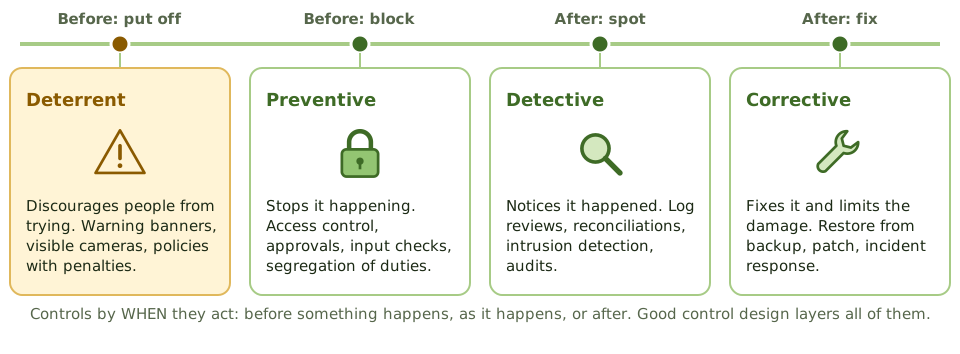
Function and type together
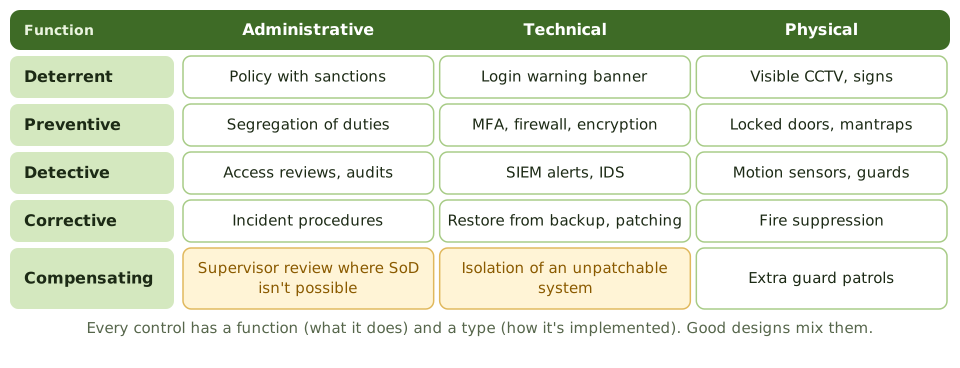
Likelihood or impact?
| Function | Mainly reduces |
|---|---|
| Deterrent, preventive | Likelihood |
| Detective | Impact (by catching it early) |
| Corrective | Impact (by recovering) |
How the exam asks about it
| If the question asks… | The answer is usually… |
|---|---|
| Restoring from backup | Corrective |
| Reviewing logs | Detective |
| Control replacing one that can't be used | Compensating |
| Reduce impact of a risk | Detective or corrective controls |
Key takeaways
- ✓Control functions describe when a control acts: deterrent and preventive before, detective during or after, corrective after.
- ✓Compensating controls provide equivalent protection when the preferred control isn't possible.
- ✓Control types describe how they're implemented: administrative, technical or physical.
- ✓Preventive controls reduce likelihood; detective and corrective controls reduce impact.
- ✓Layering different functions and types gives defence in depth.
Exam traps
- !Thinking preventive controls make detective controls unnecessary.
- !Classifying a backup restore as preventive; it's corrective.
- !Using a compensating control performed by the person with the conflict.
- !Relying on one type of control for a critical risk.
Designing and Selecting Controls
How to choose and design controls from the risk rather than the catalogue, weighing effectiveness, cost, fit and side effects, and building in ownership and evidence from the start.
Select from the risk
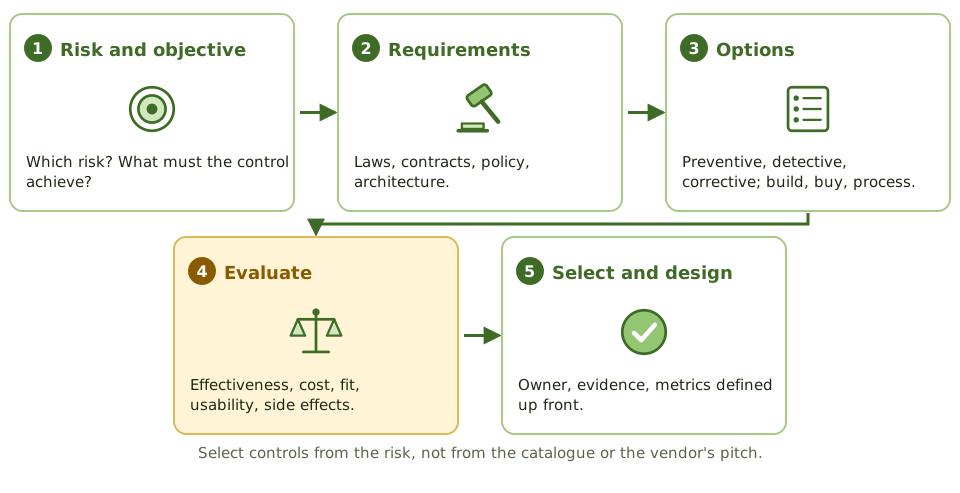
Principles of good design
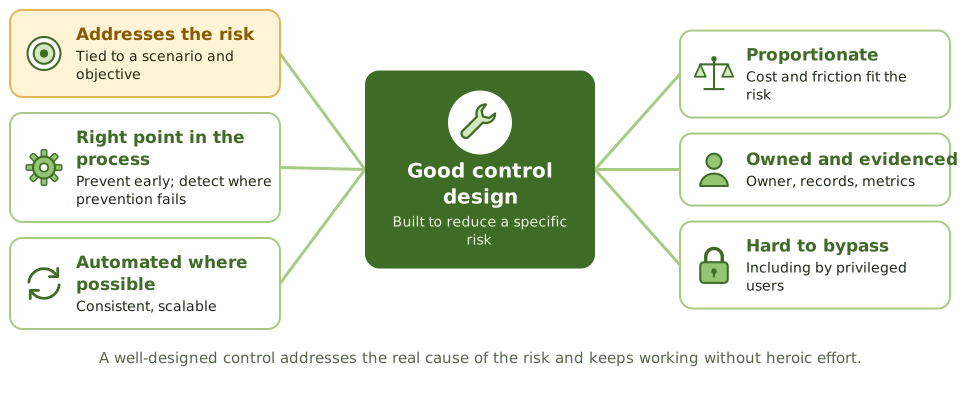
Weighing the trade-offs
| Factor | Question |
|---|---|
| Effectiveness | How much does it reduce the risk? |
| Cost | Total cost over its life |
| Fit | Does it work with our processes and systems? |
| Usability | Will people use it or work around it? |
| Side effects | Does it create new risks or slow the business? |
How the exam asks about it
| If the question asks… | The answer is usually… |
|---|---|
| FIRST step in selecting a control | Understand the risk and control objective |
| MOST effective control type, all else equal | Automated preventive |
| Control people work around | Poor fit; redesign |
| When to define control evidence | At design |
Key takeaways
- ✓Start from the risk and the control objective, not from a product or catalogue.
- ✓Evaluate options for effectiveness, cost, fit with processes and architecture, usability and side effects.
- ✓Prefer automated, preventive controls where they fit, backed by detective controls.
- ✓Good design addresses the root cause, sits at the right point in the process and is hard to bypass.
- ✓Define the owner, evidence and metrics when the control is designed.
Exam traps
- !Selecting a control because a vendor recommends it.
- !Choosing the most technically advanced control regardless of fit.
- !Designing controls that privileged users can easily bypass.
- !Leaving ownership and evidence to be sorted out after go-live.
Implementing Controls and Why Implementations Fail
How a control moves from design to business as usual, the common reasons implementations fail, and how the risk practitioner checks that a control is genuinely operating.
From design to operation
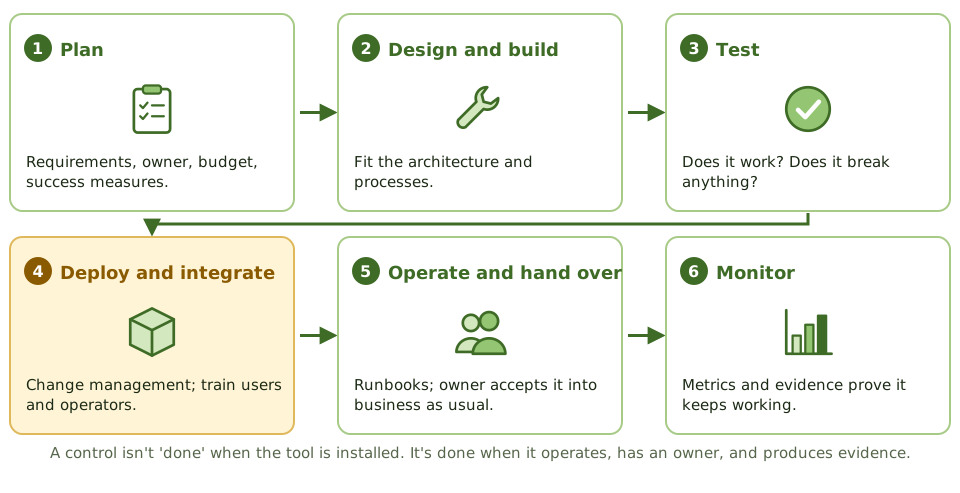
Why implementations fail
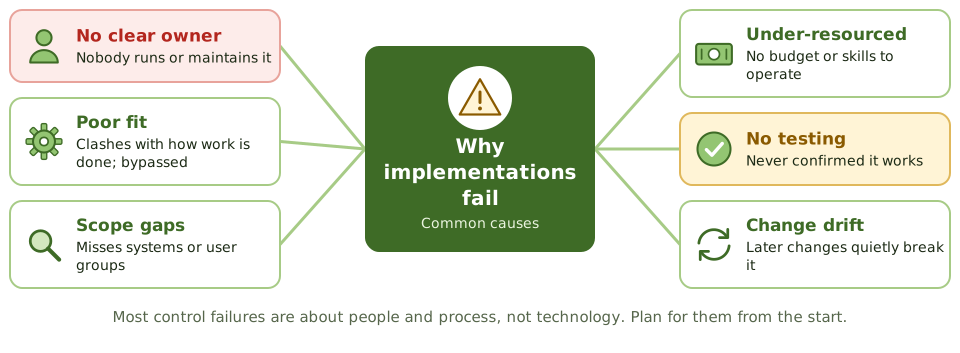
Checking it's real
- 1Is there a named operational owner?
- 2Does it cover the full scope intended?
- 3Has it been tested in production conditions?
- 4Is evidence produced and retained?
- 5Has residual risk been re-assessed?
How the exam asks about it
| If the question asks… | The answer is usually… |
|---|---|
| When is a control implemented | When it operates, is owned and produces evidence |
| MOST common cause of control failure | Lack of ownership or poor fit with processes |
| After a new control goes live | Test it and re-assess residual risk |
| Changes to a control | Through change management |
Key takeaways
- ✓A control is implemented when it operates, has an owner and produces evidence, not when a tool is installed.
- ✓Implementation follows plan, build, test, deploy, hand over and monitor.
- ✓Common failure causes: no owner, poor fit, scope gaps, lack of resources, no testing and later changes.
- ✓Changes to controls go through change management.
- ✓After implementation, reassess residual risk based on the control as it actually works.
Exam traps
- !Marking a risk treated once the tool is purchased.
- !Skipping testing because the vendor says the product works.
- !No handover to an operational owner.
- !Assuming a control stays effective after system changes.
Control Design versus Operating Effectiveness
The two questions every control test answers (could it work, and did it work throughout the period?) and why design is tested first.
Two questions
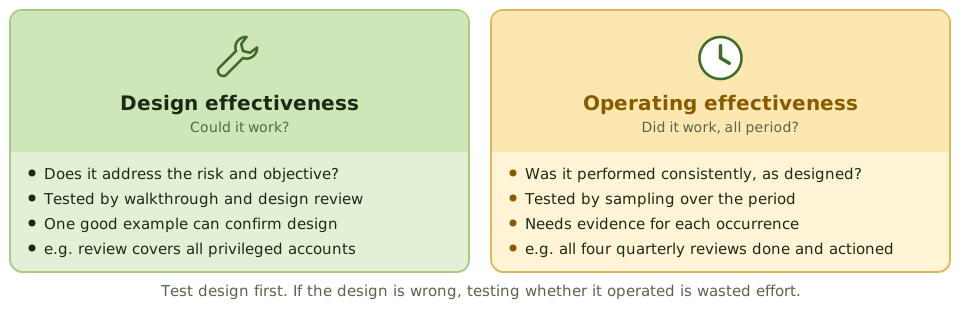
Design first
If an access review excludes administrator accounts, it can't control privileged access however diligently it's performed. Finding that design gap first saves time and points straight to the fix.
Evidence for each
| Question | Typical evidence |
|---|---|
| Design | Walkthrough, design documents, one example traced |
| Operation | Samples across the period, logs, sign-offs |
How the exam asks about it
| If the question asks… | The answer is usually… |
|---|---|
| Test FIRST | Design effectiveness |
| Control can't meet its objective | Design deficiency |
| Control not performed consistently | Operating deficiency |
| Evidence for operating effectiveness | Samples across the period |
Key takeaways
- ✓Design effectiveness asks whether the control, if performed as designed, would achieve its objective.
- ✓Operating effectiveness asks whether it was performed consistently, as designed, throughout the period.
- ✓Test design first; if the design is flawed, testing operation is wasted effort.
- ✓Design is often confirmed with a walkthrough; operation needs samples across the period.
- ✓Both must be effective for the control to reduce risk as expected.
Exam traps
- !Testing operation of a control whose design can't achieve its objective.
- !Concluding a control operated all year from one walkthrough.
- !Assuming a well-documented control operates.
- !Ignoring changes to a control during the period.
Control Testing: Objectives, Evidence and Frequency
How to plan a control test from its objective, choose testing methods and evidence, size samples and set test frequency by risk, and turn results into decisions.
Planning a test
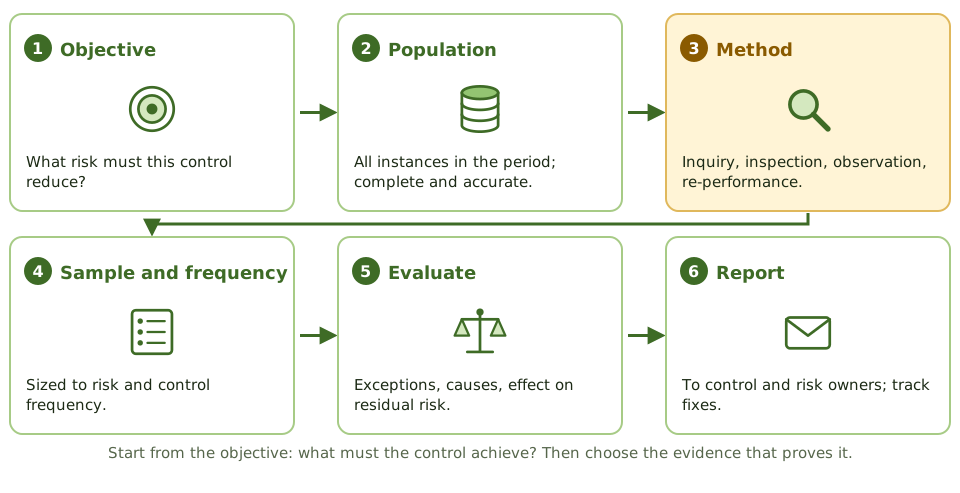
Strength of evidence
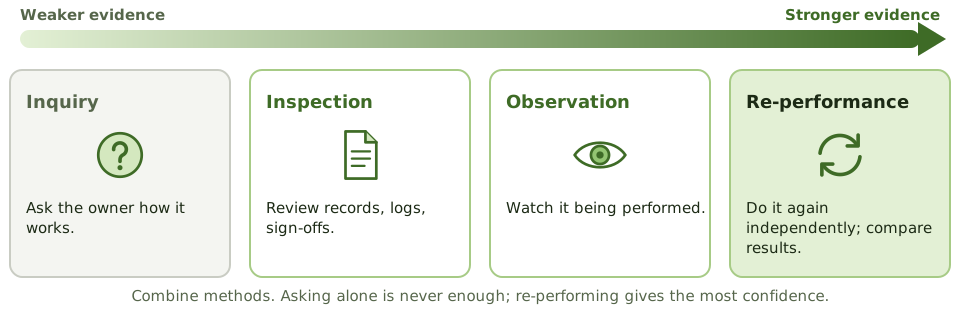
How often to test
| Factor | Effect on frequency |
|---|---|
| High risk or key control | Test more often |
| Recent failures or changes | Test more often |
| Automated, stable control | Test less often if change control is strong |
| Low risk, mature control | Test less often |
Evaluating exceptions
- 1What caused it: one-off or systemic?
- 2Does it change residual risk?
- 3Is a compensating control in place?
- 4Who must be told, and what's the fix?
How the exam asks about it
| If the question asks… | The answer is usually… |
|---|---|
| Weakest form of evidence | Inquiry |
| Strongest form of evidence | Re-performance |
| BEST basis for test frequency | Risk and importance of the control |
| Test finds exceptions | Investigate cause and effect on risk |
Key takeaways
- ✓Start every test from the control objective: what risk must this control reduce?
- ✓Testing methods range from inquiry (weakest) through inspection and observation to re-performance (strongest).
- ✓Inquiry alone is never enough; combine methods.
- ✓Sample size and test frequency rise with the risk and the control's importance.
- ✓Exceptions must be investigated for cause and their effect on residual risk.
- ✓Results go to control and risk owners and feed the risk register.
Exam traps
- !Relying only on interviews as evidence.
- !Testing every control with the same frequency regardless of risk.
- !Ignoring exceptions because the overall pass rate looks high.
- !Using a population that isn't complete.
Building and Tracking Risk Action Plans
How a chosen risk response becomes an action plan with owners, dates, resources and success measures, and how progress is tracked and escalated until residual risk reaches its target.
What a plan contains
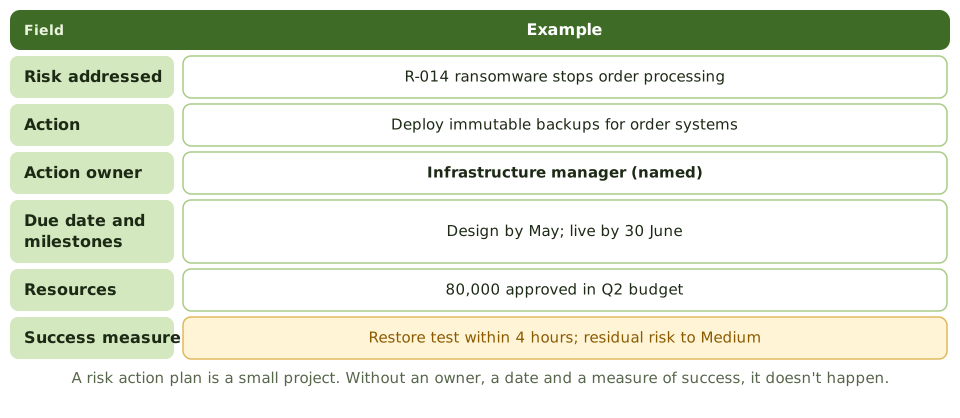
Tracking progress
- 1 Plan approved by risk owner
- 2 Owner updates status regularly
- 3 Practitioner monitors and reports
- 4 Overdue items escalated
- 5 Residual risk verified
Success is risk reduced
A plan can complete every task and still miss its purpose. Success means the residual risk has reached the target agreed with the risk owner, confirmed by testing the new or improved controls.
How the exam asks about it
| If the question asks… | The answer is usually… |
|---|---|
| MOST important element of an action plan | Owner and due date |
| When is a plan complete | When target residual risk is verified |
| High-risk action is overdue | Escalate per the agreed path |
| Who approves the plan | The risk owner |
Key takeaways
- ✓A risk action plan turns a chosen response into specific, owned, dated actions.
- ✓Each plan needs an owner, milestones, resources and a measure of success tied to residual risk.
- ✓Track plans in the risk register or a linked tool, with regular status updates.
- ✓Overdue actions on high risks are escalated through the agreed path.
- ✓A plan is complete when the residual risk target is verified, not when tasks are ticked off.
Exam traps
- !Plans with no owner or due date.
- !Closing a risk when the plan is approved rather than delivered.
- !Measuring success by tasks completed instead of risk reduced.
- !Letting overdue actions on high risks drift without escalation.
Collecting and Aggregating Risk Data
Where risk data comes from, how to normalise and aggregate data from different sources so it means something, and how aggregation reveals concentrations of risk.
Where risk data comes from
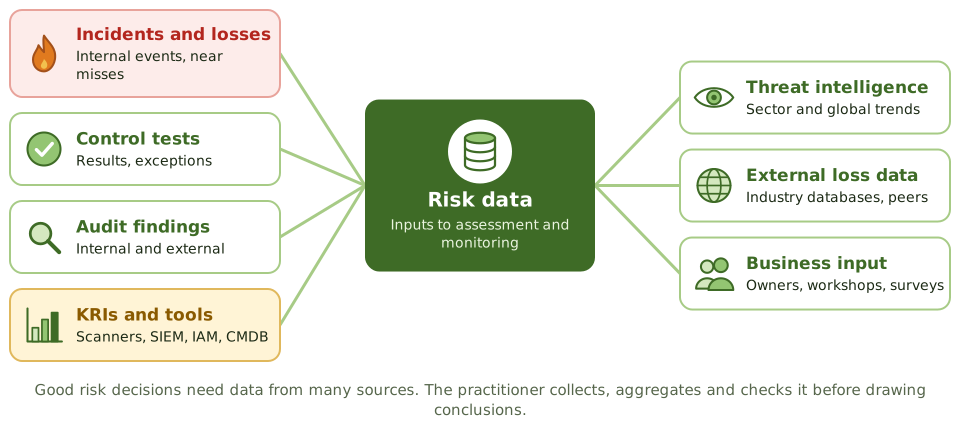
Normalise, then aggregate
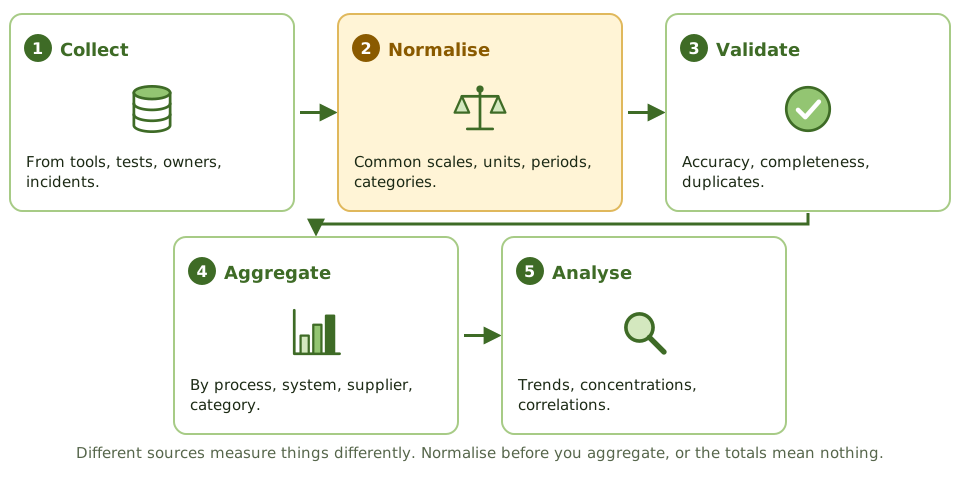
What aggregation reveals
- 1Several medium risks on one critical supplier.
- 2The same control weakness across many systems.
- 3A business unit with many overdue actions.
- 4Risk rising in one category over several quarters.
How the exam asks about it
| If the question asks… | The answer is usually… |
|---|---|
| Before aggregating data from many sources | Normalise it |
| Benefit of aggregation | Reveals concentrations and trends |
| BEST way to improve timeliness | Automate collection |
| Several small risks on one supplier | Consider their combined effect |
Key takeaways
- ✓Risk data comes from incidents, control tests, audits, KRIs and tools, threat intelligence, external loss data and the business.
- ✓Normalise data (common scales, units, periods and categories) before aggregating it.
- ✓Aggregation by process, system, supplier or category reveals concentrations individual items hide.
- ✓Automate collection where possible to improve timeliness and reduce errors.
- ✓Every data source should have a known owner and definition.
Exam traps
- !Adding up scores from different scales.
- !Relying on a single data source.
- !Collecting data nobody uses for decisions.
- !Missing concentrations by looking only at individual risks.
Validating Risk Data Quality
Why risk decisions depend on data quality, the dimensions of good risk data, and how the risk practitioner validates data before using it to rate, report or decide.
Dimensions of quality
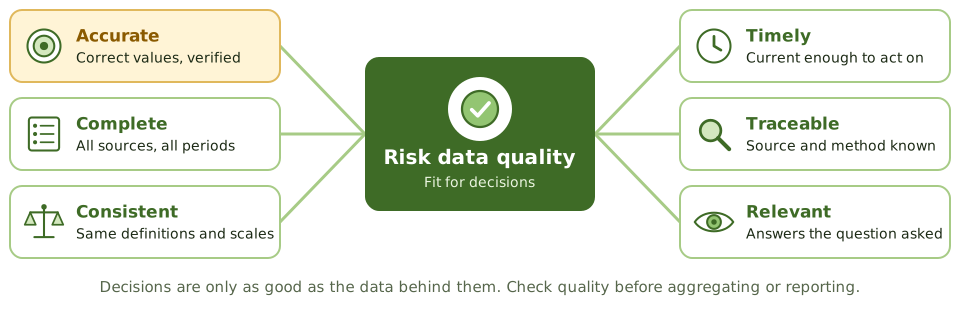
Validation checks
| Check | Example |
|---|---|
| Completeness | Scanner covers all servers in the CMDB? |
| Accuracy | Sample of records checked against source |
| Consistency | Same definition of 'critical' as last quarter? |
| Reasonableness | Outliers and sudden jumps investigated |
| Timeliness | Data date shown and recent enough |
Be honest about limits
Sometimes the data isn't perfect and a decision can't wait. That's fine, as long as the report says so: which data is missing, how estimates were made and how confident the practitioner is.
How the exam asks about it
| If the question asks… | The answer is usually… |
|---|---|
| Before reporting a metric | Validate the underlying data |
| KRI suddenly improves sharply | Check data and definitions before celebrating |
| Data has known gaps | Disclose limitations in the report |
| MOST important data quality attribute for a decision | Accuracy and completeness |
Key takeaways
- ✓Risk data should be accurate, complete, consistent, timely, traceable and relevant.
- ✓Validate data before aggregating or reporting; bad data produces confident but wrong decisions.
- ✓Reconcile data with independent sources and check for gaps, duplicates and outliers.
- ✓Every metric and data feed needs a defined source, owner and calculation method.
- ✓Disclose known data limitations in reports rather than hiding them.
Exam traps
- !Reporting tool output without checking completeness.
- !Mixing definitions between periods so trends are false.
- !Hiding data gaps to make a report look cleaner.
- !Assuming automated data is always accurate.
KRIs, KPIs and KCIs
The difference between key risk, performance, control and goal indicators, what makes each useful, and how to choose indicators that warn before risk materialises.
Four kinds of indicator
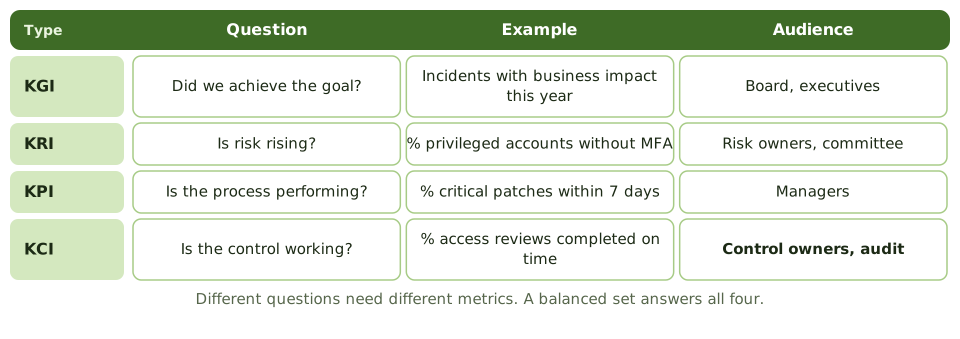
Same goal, different indicators
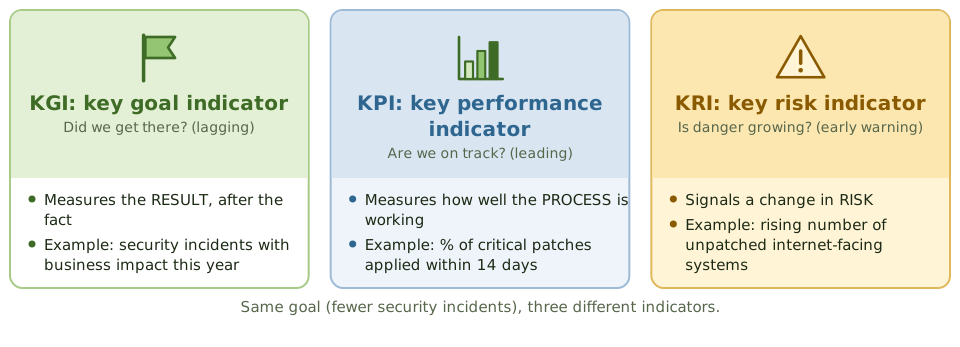
What makes a good indicator
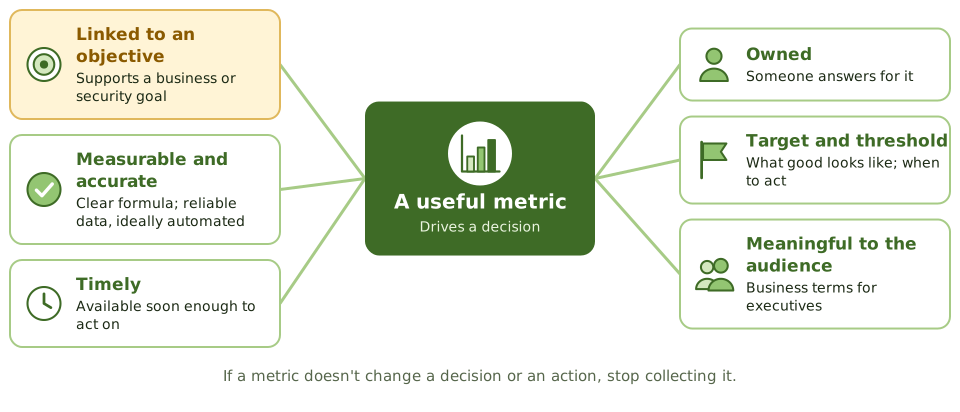
Leading versus lagging
| Lagging (after the fact) | Leading (early warning) |
|---|---|
| Number of breaches last year | Privileged accounts without MFA |
| Outage hours last quarter | Failed backup tests this month |
| Fraud losses | Overdue supplier bank-detail verifications |
How the exam asks about it
| If the question asks… | The answer is usually… |
|---|---|
| MOST useful characteristic of a KRI | It's a leading indicator of risk change |
| Measures whether a control works | KCI |
| Measures process performance | KPI |
| Who should help choose KRIs | The risk owner |
Key takeaways
- ✓KRIs signal changes in risk; KPIs measure process performance; KCIs measure control effectiveness; KGIs measure goal achievement.
- ✓The best KRIs are leading indicators: they change before the risk materialises.
- ✓Good indicators are linked to a risk or objective, measurable, timely, owned and have thresholds.
- ✓Indicators should be chosen with the risk owner and reviewed as risks change.
- ✓A small set of meaningful indicators beats a long list nobody reads.
Exam traps
- !Using lagging measures such as incident counts as early warnings.
- !Confusing a KPI (process performance) with a KRI (risk change).
- !Indicators with no threshold or owner.
- !Collecting indicators because the data is easy to get.
Thresholds, Escalation Triggers and Appetite
How KRI thresholds are set inside risk tolerance so that warnings arrive in time to act, and how each threshold triggers a named response and escalation.
Thresholds inside tolerance
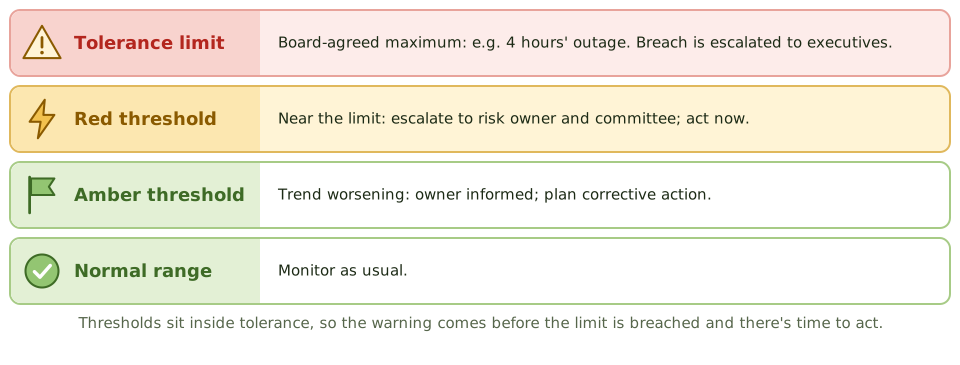
Each level triggers action
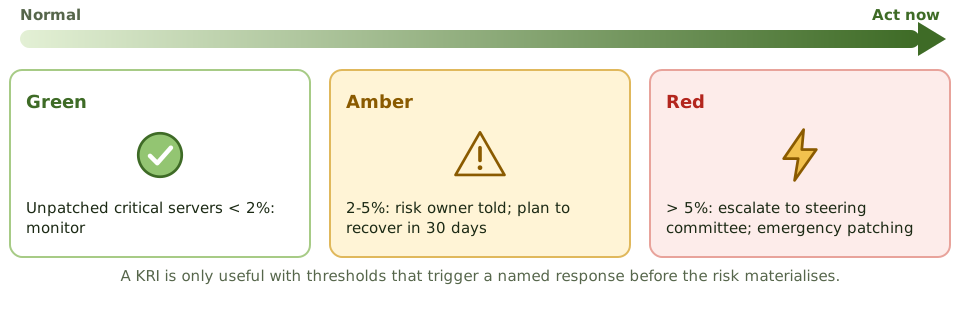
Setting thresholds
- 1Start from the tolerance agreed with the owner.
- 2Use history to see normal variation.
- 3Allow lead time to act before the limit.
- 4Name the response and recipient for each level.
Don't move the goalposts
When a KRI turns red, the right reaction is to respond, not to raise the threshold. Thresholds change only when appetite, the business or the risk itself changes, and that change is approved and recorded.
How the exam asks about it
| If the question asks… | The answer is usually… |
|---|---|
| Where to set KRI thresholds | Inside tolerance, with time to act |
| KRI breaches its threshold | Follow the agreed escalation and response |
| Basis for thresholds | Risk appetite and tolerance |
| Owner wants to raise a red threshold | Only if appetite or risk has changed, with approval |
Key takeaways
- ✓Thresholds turn indicators into action: each level triggers a defined response.
- ✓Set thresholds inside tolerance so there's time to act before the limit is breached.
- ✓Thresholds come from risk appetite and tolerance agreed with risk owners.
- ✓Each threshold names who is told and what must happen.
- ✓Review thresholds when appetite, the business or the risk changes, not to make a red indicator green.
Exam traps
- !Setting thresholds at the tolerance limit, leaving no time to act.
- !Raising a threshold to stop an indicator showing red.
- !Thresholds with no defined response or owner.
- !One threshold level for every indicator regardless of risk.
Metric Pitfalls and Misuse
How risk metrics mislead (measuring activity instead of risk, gaming, vanity metrics, overload and bad data) and how the risk practitioner designs and reads metrics to avoid it.
How metrics mislead
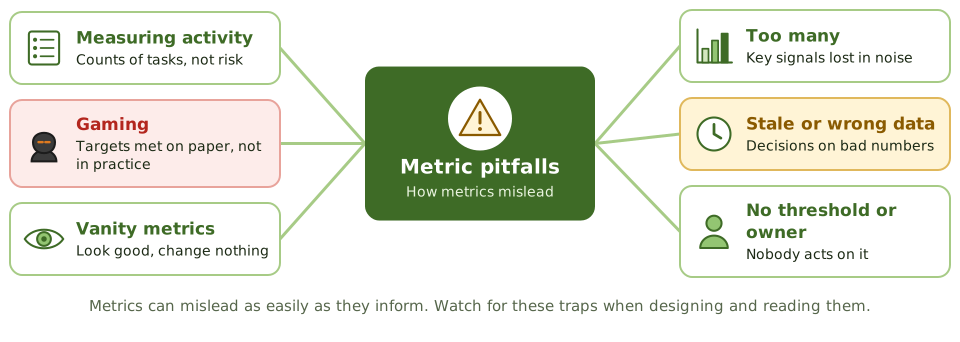
Activity versus risk
| Activity metric | Risk-focused alternative |
|---|---|
| Scans run per month | Critical vulnerabilities open past deadline |
| Policies published | Exceptions open beyond expiry |
| Training sessions held | Phishing simulation report rate |
Gaming
When a number becomes a target, people find ways to hit it. Closing tickets without fixing problems, or reclassifying incidents to a lower severity, makes metrics look good while risk stays the same.
Keeping metrics honest
- 1Pair each metric with a quality check or sample.
- 2Watch for sudden improvements.
- 3Keep a small set of meaningful indicators.
- 4Retire metrics that don't drive decisions.
How the exam asks about it
| If the question asks… | The answer is usually… |
|---|---|
| All metrics green, but a major incident occurred | Metrics measure the wrong things |
| Weakness of activity metrics | Don't show changes in risk |
| Metric improves suddenly | Verify data and behaviour |
| Too many metrics | Focus on a few that drive decisions |
Key takeaways
- ✓Metrics that count activity can stay green while risk grows.
- ✓Targets tied to rewards invite gaming; check that behaviour matches the numbers.
- ✓Too many metrics hide the important signals.
- ✓Metrics need owners, thresholds and accurate data to drive action.
- ✓Retire metrics that no longer support a decision.
Exam traps
- !Reporting the number of policies or training sessions as risk metrics.
- !Celebrating a sharp improvement without checking how it was achieved.
- !Adding more metrics when the real problem is poor ones.
- !Ignoring a metric because it's always red.
Continuous Monitoring versus Periodic Assessment
How continuous, automated monitoring of risks and controls complements periodic assessments, what each is good at, and where each fits in the risk program.
Two complementary approaches
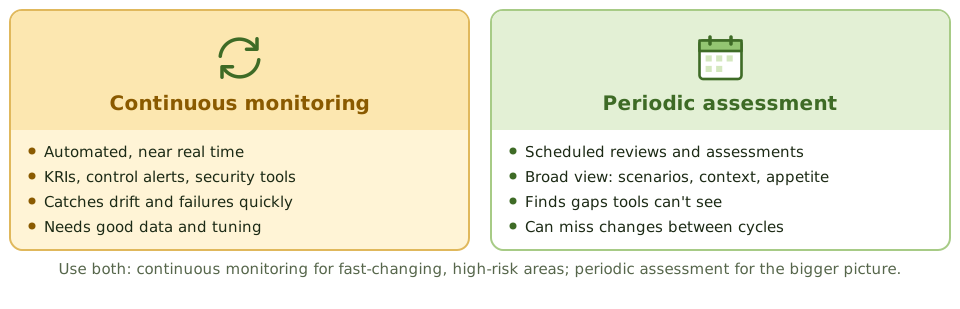
Who does what
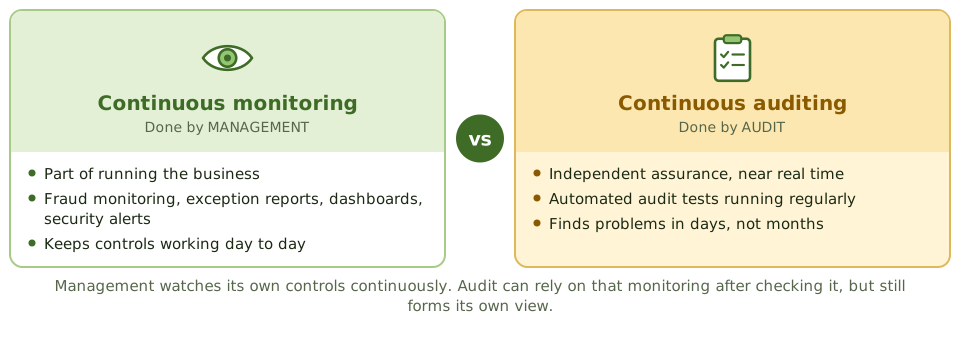
Where continuous monitoring fits
- 1Privileged access and configuration changes.
- 2Patch and vulnerability status.
- 3Backup success and recovery tests.
- 4Payment and transaction anomalies.
- 5Cloud configuration drift.
How the exam asks about it
| If the question asks… | The answer is usually… |
|---|---|
| Main benefit of continuous monitoring | Timely detection of changes and failures |
| Does it replace risk assessment? | No; they complement each other |
| Who owns continuous monitoring | Management |
| Monitoring alerts nobody reviews | Little value; assign ownership |
Key takeaways
- ✓Continuous monitoring uses automated data to watch risks and controls in near real time.
- ✓Periodic assessments give the broad view: context, scenarios, appetite and gaps tools can't see.
- ✓Use continuous monitoring for fast-changing, high-risk areas and key controls.
- ✓Monitoring is a management responsibility; audit may use it but stays independent.
- ✓Automated monitoring needs good data, tuning and someone to act on alerts.
Exam traps
- !Thinking continuous monitoring replaces risk assessment.
- !Relying only on annual assessments for fast-changing risks.
- !Deploying monitoring tools with nobody reviewing the output.
- !Confusing management's continuous monitoring with audit's continuous auditing.
Tailoring Risk Reports to the Audience
How the same risk information is reported differently to the board, executives, committees, risk owners and regulators, and what every good risk report contains.
Same risks, different reports
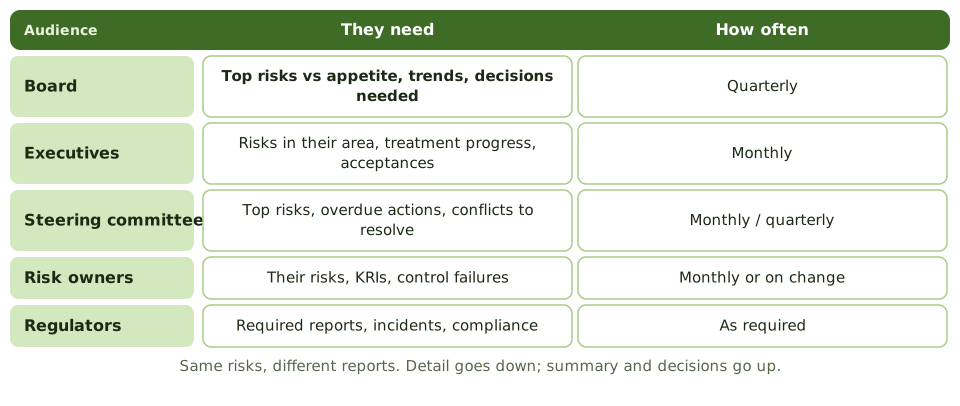
What every report needs
- 1What's changed since last time, and why.
- 2Risks against appetite, with trends.
- 3Progress on treatment and overdue actions.
- 4Decisions or support needed.
- 5Data date and known limitations.
Writing for the board
| Instead of… | Say… |
|---|---|
| 147 critical vulnerabilities | Customer portal breach risk is above appetite |
| EDR coverage 82% | 1 in 5 laptops could spread ransomware undetected |
| SIEM ingested 2 billion events | (Leave it out) |
How the exam asks about it
| If the question asks… | The answer is usually… |
|---|---|
| MOST important content for the board | Top risks against appetite, in business terms |
| Why tailor reports | Each audience needs different detail to decide |
| Report risk owners need | Their risks, KRIs and action status |
| Board receives the full register | Summarise into a risk profile |
Key takeaways
- ✓Different audiences need different detail: summary and decisions go up, detail goes down.
- ✓Board reports show top risks against appetite, trends and decisions needed, in business terms.
- ✓Risk owners need their risks, KRIs, control failures and action status.
- ✓Good reports are accurate, timely, consistent, concise and explain what's changed and why.
- ✓Reports should lead to decisions; say clearly what's being asked of the reader.
Exam traps
- !Sending the board the full risk register.
- !Reporting technical metrics to executives.
- !Changing formats and scales every period, hiding trends.
- !Reports that inform but never ask for a decision.
Heat Maps, Dashboards and Scorecards
The visual formats used in risk reporting, what each is best at, how they can mislead, and how to design a one-page view that leads to decisions.
Choosing a format
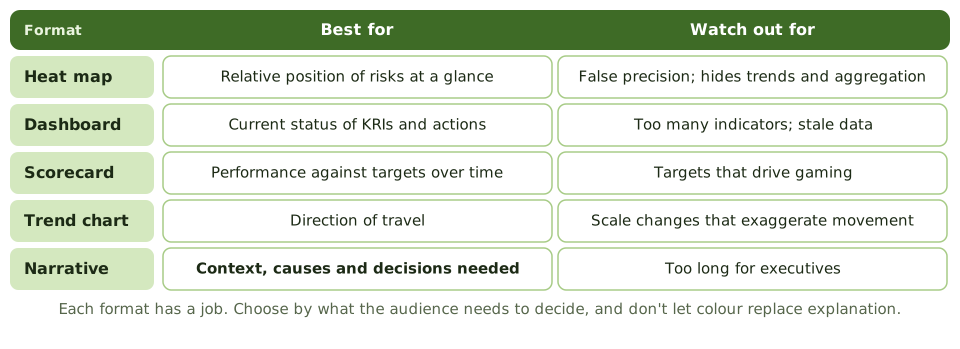
The heat map
A one-page board view
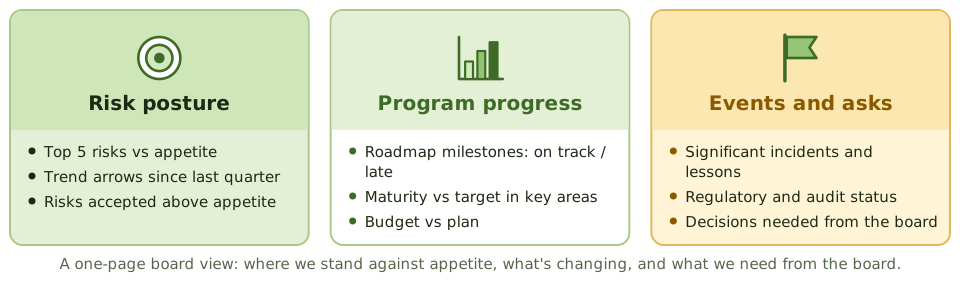
Making visuals honest
- 1Show the appetite line or tolerance on the chart.
- 2Add trend arrows or previous positions.
- 3Keep scales the same every period.
- 4Add two or three sentences on what it means.
How the exam asks about it
| If the question asks… | The answer is usually… |
|---|---|
| Main benefit of a heat map | Quick view of relative risk priority |
| Main weakness of a heat map | Subjective; hides trends and aggregation |
| Best format for tracking against targets | Scorecard |
| Make a dashboard more useful | Fewer indicators with context and trends |
Key takeaways
- ✓Heat maps show the relative position of risks by likelihood and impact.
- ✓Dashboards show the current status of indicators and actions; scorecards track performance against targets.
- ✓Visuals need context: trends, appetite lines and a short narrative.
- ✓Heat maps can hide trends, aggregation and uncertainty, and imply false precision.
- ✓Choose the format by what the audience must decide.
Exam traps
- !Letting colours replace explanation.
- !Treating heat map positions as precise measurements.
- !Dashboards so crowded the key signal is lost.
- !Changing scales between reports so trends look different.
Identifying and Assessing Emerging Risks
What emerging risks are, where the early signals come from, and how to assess risks that are uncertain, fast-moving and hard to quantify.
What makes a risk emerging
Emerging risks are new, or changing quickly, and hard to size because there's little history. Generative AI, quantum computing, new regulation and new attack methods have all been emerging risks. The challenge is acting early without overreacting.
Where signals come from
Assessing under uncertainty
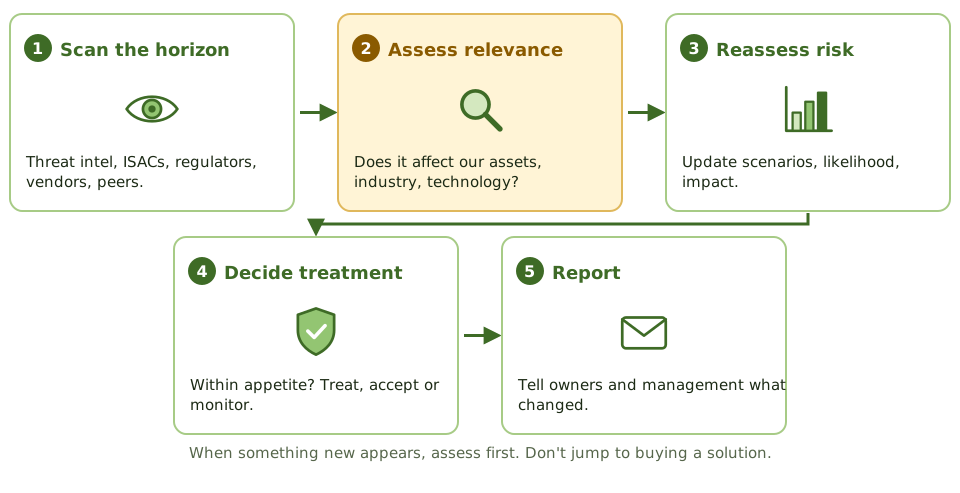
Useful techniques
- 1Scenario analysis with best, likely and worst cases.
- 2Expert judgement using Delphi.
- 3Ranges instead of single numbers.
- 4Watch lists reviewed regularly.
How the exam asks about it
| If the question asks… | The answer is usually… |
|---|---|
| FIRST step with an emerging risk | Assess relevance to the organisation |
| Little data available | Use scenarios and expert judgement |
| New technology adopted by staff | Assess risk before banning or approving |
| Where to find early signals | Threat intelligence, regulators, industry bodies |
Key takeaways
- ✓Emerging risks are new or changing risks whose likelihood and impact are uncertain.
- ✓Signals come from threat intelligence, regulators, technology trends, industry bodies, peers and internal incidents.
- ✓Assess relevance first: does it affect our assets, sector, technology or objectives?
- ✓Use scenarios and ranges rather than precise estimates when data is scarce.
- ✓Assess before acting; don't jump to buying a solution for a risk not yet understood.
Exam traps
- !Ignoring a risk because there's no data on it yet.
- !Buying a tool before assessing whether the risk applies.
- !Treating every headline as a top risk.
- !Waiting for the annual assessment to consider new risks.
Integrating Emerging Risk into Decisions
How emerging risks move from a watch list into the normal risk process, with scenarios, owners, indicators and a place in reports, so leaders can make timely decisions.
From watch list to register
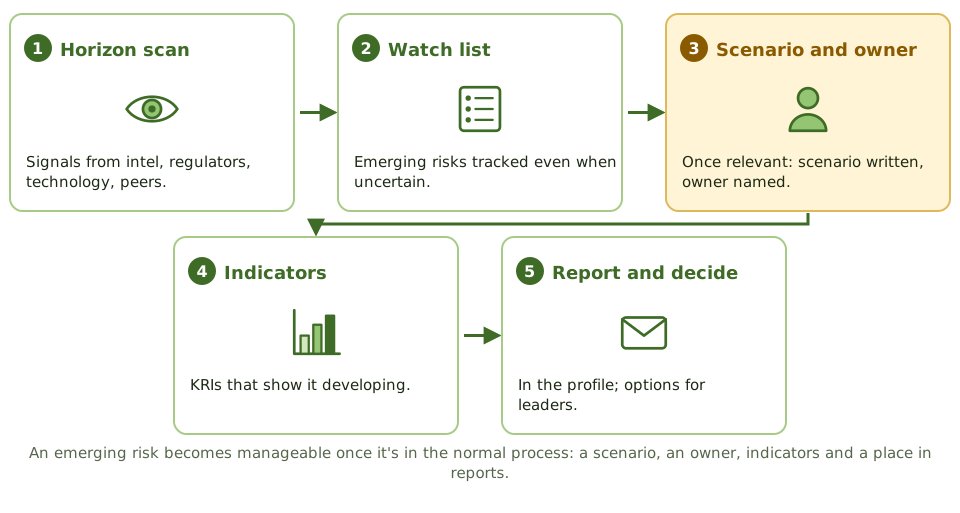
Reporting uncertainty honestly
Emerging risks rarely fit a heat map neatly. Report them with ranges and a confidence level, explain what would change the assessment, and set out the options. Leaders can decide well with uncertain information if it's presented honestly.
Response options
| Option | When it fits |
|---|---|
| Monitor | Relevance unclear; watch indicators |
| Pilot with guardrails | Opportunity worth exploring safely |
| Early controls | Clear risk, low-cost protection available |
| Avoid for now | Risk clearly beyond appetite |
How the exam asks about it
| If the question asks… | The answer is usually… |
|---|---|
| How to track uncertain new risks | Watch list reviewed regularly |
| Emerging risk becomes relevant | Add to register with scenario and owner |
| Reporting an emerging risk | Include uncertainty and options |
| New opportunity with unclear risk | Pilot with guardrails |
Key takeaways
- ✓Keep a watch list of emerging risks even when they're too uncertain to rate precisely.
- ✓Once relevant, give each emerging risk a scenario, an owner and indicators.
- ✓Report emerging risks alongside established ones, with honest uncertainty.
- ✓Options may include monitoring, small pilots with guardrails, or early controls.
- ✓Review the watch list regularly; some risks fade, others become top risks.
Exam traps
- !Leaving emerging risks outside the register until they cause an incident.
- !Reporting emerging risks with false precision.
- !Assuming emerging risks can't be owned.
- !Never removing items from the watch list.
Information Technology and Security
Architecture and operations · Projects and development · Data lifecycle · Resilience · Emerging technology · Security principles
Enterprise Architecture and IT Risk
How enterprise architecture gives the risk practitioner a map of business processes, data, applications and technology, and how architecture choices and technology roadmaps create or reduce IT risk.
The architecture layers
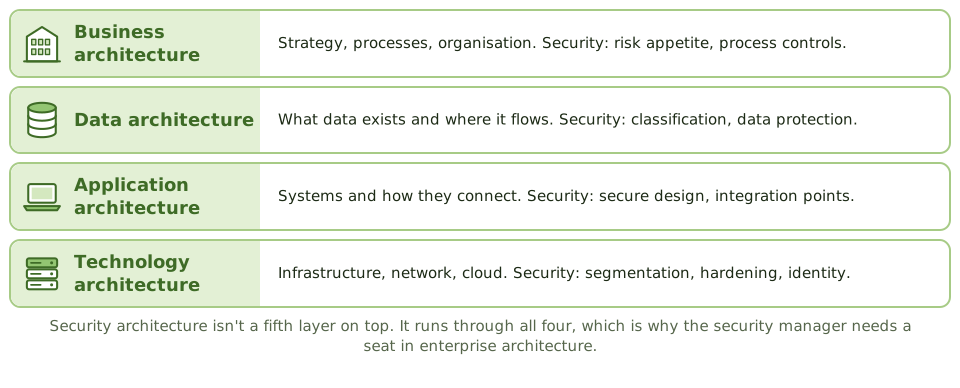
Why it matters for risk
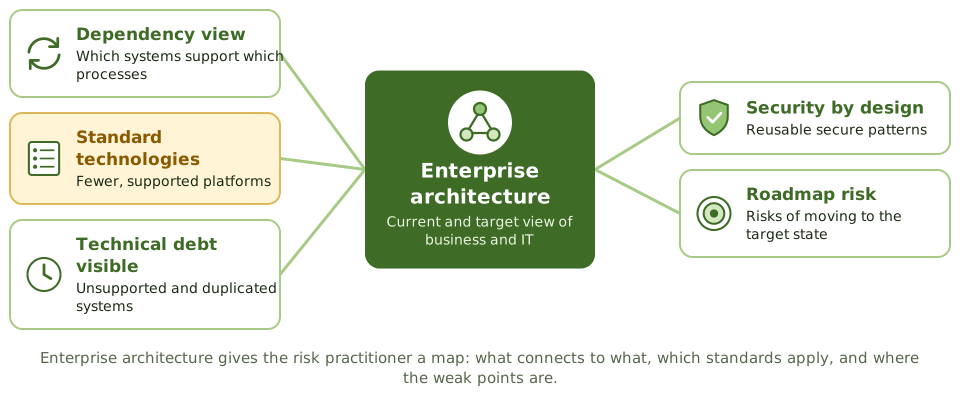
Roadmaps and transition risk
A technology roadmap moves the organisation from its current architecture to a target state. The destination may be lower risk, but the journey isn't: migrations, parallel systems and skills gaps all create risk along the way.
Architecture governance
- 1Architecture standards approved and maintained.
- 2Projects reviewed against standards at design.
- 3Exceptions risk-assessed and time-limited.
- 4Unsupported systems tracked in the risk register.
How the exam asks about it
| If the question asks… | The answer is usually… |
|---|---|
| Benefit of EA to risk management | Shows dependencies and supports risk-aware decisions |
| Project wants a non-standard technology | Risk-assessed architecture exception |
| Risk of moving to a target architecture | Transition risk must be assessed |
| Unsupported legacy system | Record and manage the risk; plan replacement |
Key takeaways
- ✓Enterprise architecture describes the business, data, application and technology layers and how they connect.
- ✓It shows dependencies, technical debt and single points of failure that drive IT risk.
- ✓Standard, supported technologies reduce complexity and risk; sprawl and unsupported systems increase it.
- ✓Technology roadmaps move from current to target state; the transition itself carries risk.
- ✓Security and risk should be built into architecture decisions, not reviewed afterwards.
Exam traps
- !Treating architecture as an IT-only concern with no business input.
- !Ignoring the risk of the transition between current and target states.
- !Allowing projects to bypass architecture standards without exceptions.
- !Leaving unsupported legacy systems off the risk register.
Change Management Risk
Why uncontrolled change is one of the biggest sources of IT incidents, how a risk-based change process works, and what the risk practitioner looks for in emergency and standard changes.
The change process
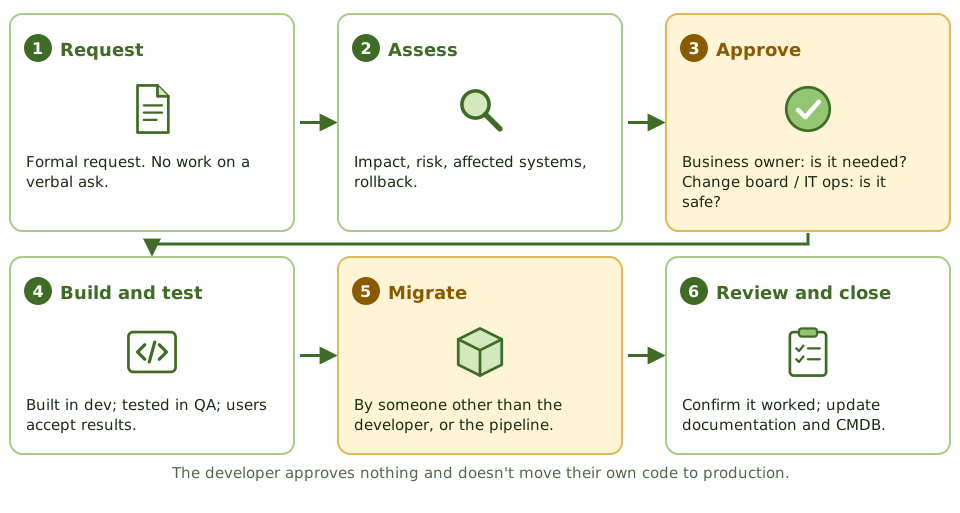
Scaling to risk
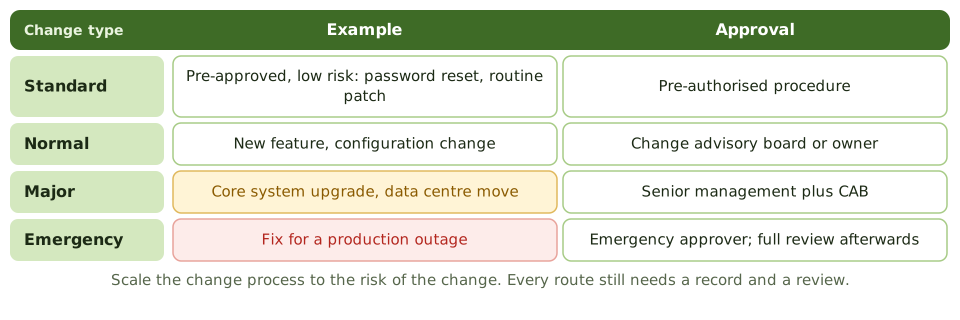
Emergency changes
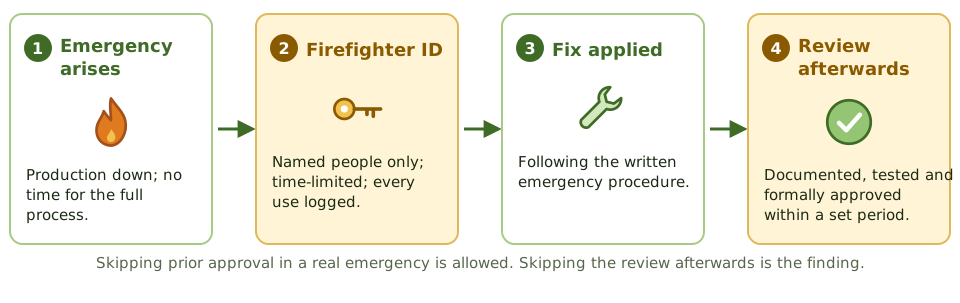
Risk indicators for change
- 1Changes causing incidents (change failure rate).
- 2Share of emergency changes.
- 3Unauthorised changes detected.
- 4Changes without rollback plans.
How the exam asks about it
| If the question asks… | The answer is usually… |
|---|---|
| GREATEST change management risk | Unauthorised or untested changes reaching production |
| Emergency change made without approval | Document, test and approve afterwards |
| BEST way to detect unauthorised changes | Compare production with approved changes |
| Who should migrate code to production | Someone other than the developer, or the pipeline |
Key takeaways
- ✓Many outages and security gaps are caused by changes; change management assesses risk before changes go live.
- ✓Changes are requested, assessed, approved, built and tested, migrated by someone other than the developer, and reviewed.
- ✓Scale the process to risk: standard, normal, major and emergency changes.
- ✓Emergency changes can skip prior approval but must be documented, tested and approved afterwards.
- ✓Unauthorised changes are detected by comparing production with approved change records.
Exam traps
- !Developers moving their own code to production.
- !Emergency changes never reviewed afterwards.
- !Treating every change the same regardless of risk.
- !Relying on change tickets to find unauthorised changes.
Assets, Configuration and Dependencies
How IT asset management and configuration management keep an accurate picture of what exists, how it's configured and what depends on it, so risk can be assessed and changes made safely.
Assets and configuration
Dependencies
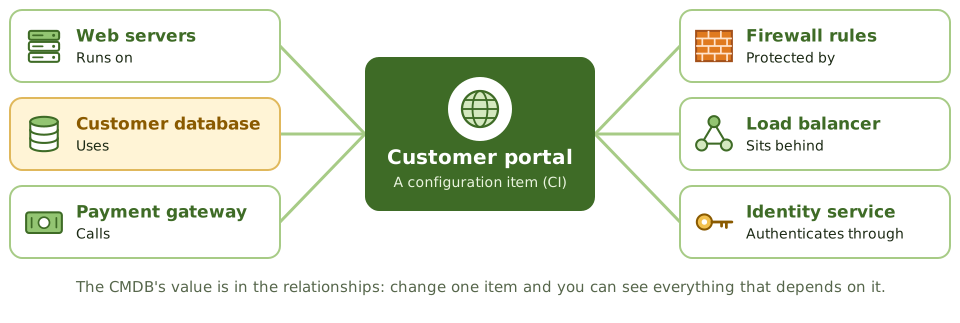
Baselines and drift
- 1Baselines define approved, hardened settings.
- 2Automated tools compare systems with baselines.
- 3Drift is investigated: authorised change or problem?
- 4Baselines are updated through change management.
How the exam asks about it
| If the question asks… | The answer is usually… |
|---|---|
| MOST useful CMDB feature for risk | Relationships between configuration items |
| How to keep the CMDB accurate | Update it through change management |
| Systems drift from baseline | Investigate; may indicate unauthorised change |
| Purpose of dependency mapping | Impact analysis for changes, incidents and continuity |
Key takeaways
- ✓Asset management tracks what the organisation has; configuration management tracks how it's configured and how items relate.
- ✓A CMDB's value lies in relationships: change one item and you see what depends on it.
- ✓Configuration baselines define approved settings; drift from them is a risk signal.
- ✓Accurate dependency data supports impact analysis, incident response and continuity.
- ✓The CMDB must be updated through change management or it drifts from reality.
Exam traps
- !Treating the asset register as a finance list rather than a risk tool.
- !A CMDB not updated after changes.
- !No baseline, so drift can't be detected.
- !Missing cloud and SaaS assets from the inventory.
Incident and Problem Management Oversight
How incident management restores service and problem management removes root causes, and how the risk practitioner uses incident and problem data to keep risk assessments honest.
Two related processes
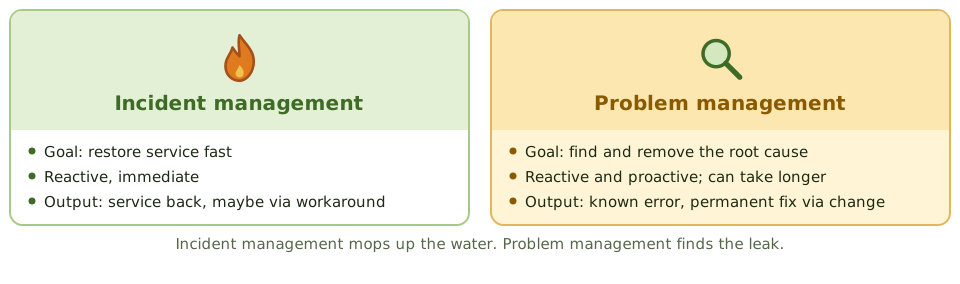
What the risk practitioner uses
| Data | Risk use |
|---|---|
| Incident trends | Likelihood estimates; KRIs |
| Root causes | Control weaknesses to address |
| Incidents with no matching scenario | Gaps in the risk register |
| Repeat incidents | Problem management not working |
Oversight questions
- 1Are incidents prioritised by business impact?
- 2Do major incidents get a root cause analysis?
- 3Are known errors tracked to permanent fixes?
- 4Does incident data feed the risk register?
How the exam asks about it
| If the question asks… | The answer is usually… |
|---|---|
| Recurring incidents of the same type | Problem management needed |
| How to prioritise incidents | Business impact and urgency |
| Incident not matching any scenario | Update risk identification |
| Value of incident data to risk | Evidence for likelihood and control effectiveness |
Key takeaways
- ✓Incident management restores service quickly; problem management finds and removes root causes.
- ✓Incidents should be prioritised by business impact and urgency.
- ✓Recurring incidents point to weak problem management.
- ✓Incident and problem data are evidence for risk assessments, KRIs and control effectiveness.
- ✓Incidents not covered by any risk scenario reveal gaps in risk identification.
Exam traps
- !Closing incidents repeatedly without addressing root causes.
- !Prioritising incidents by who reported them.
- !Keeping incident data away from the risk function.
- !Treating a low number of reported incidents as proof of low risk.
Project Governance and IT Risk
The risks IT projects carry, both to their own delivery and to the operations they change, and how project governance and risk checkpoints keep them visible and owned.
What can go wrong
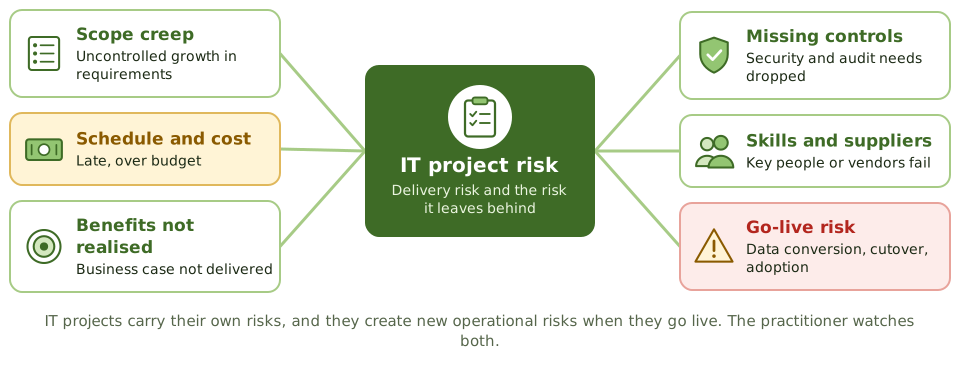
Risk at each gate
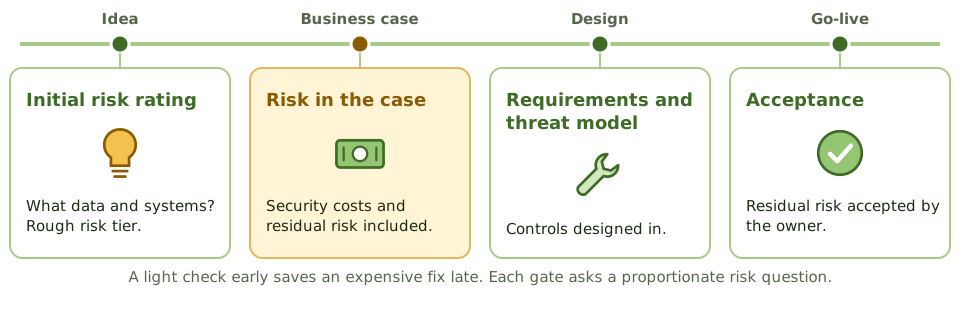
The triple constraint
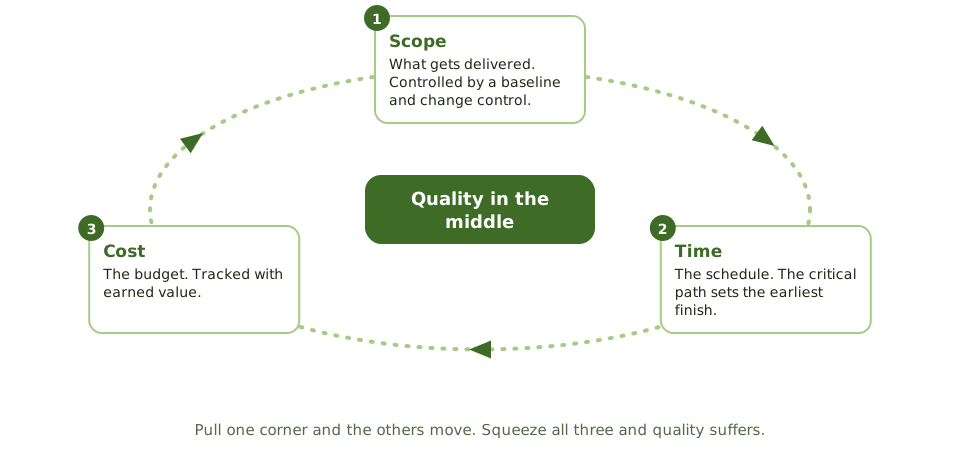
How the exam asks about it
| If the question asks… | The answer is usually… |
|---|---|
| BEST time to assess project risk | At initiation and each gate |
| Who owns the business case and benefits | The project sponsor |
| Project drops a control to meet a deadline | Formal risk decision by the right owner |
| Risks remaining after go-live | Transfer to the operational risk register |
Key takeaways
- ✓IT projects carry delivery risk (late, over budget, benefits missed) and leave operational risk when they go live.
- ✓Project governance assigns a sponsor who owns the business case and benefits.
- ✓Risk checkpoints at project gates catch risks while they're cheap to fix.
- ✓Scope, time and cost are linked; squeezing all three reduces quality and controls.
- ✓Project risks should feed the enterprise risk register, especially those that remain after go-live.
Exam traps
- !Assessing security and control risk only at go-live.
- !Letting the project team accept operational risks beyond its authority.
- !Dropping control requirements to meet a deadline without a formal decision.
- !Keeping project risks in a separate log that never reaches the enterprise register.
Governing the Secure SDLC
How security and control requirements are built into each stage of the system development life cycle, and the governance that makes sure they don't get dropped.
Security at every stage
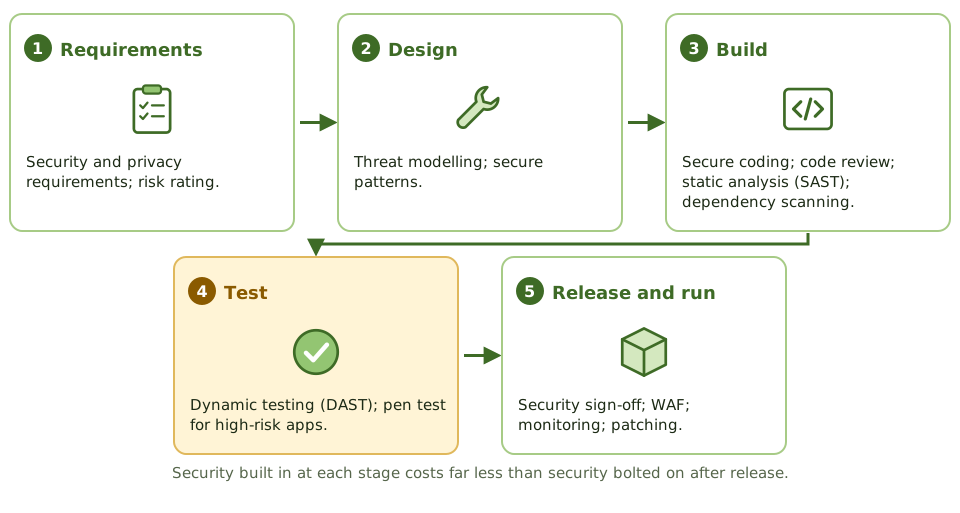
Earlier is cheaper
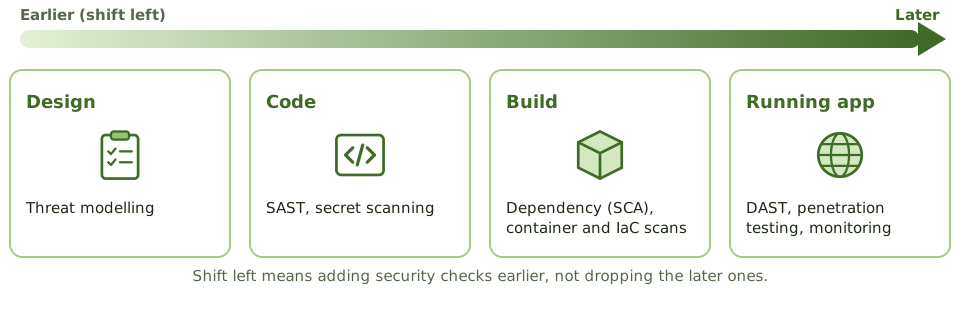
Governance that works
- 1Secure development standards approved and trained.
- 2Security requirements in every specification.
- 3Gates with defined security evidence.
- 4Independent review before release.
- 5Software bill of materials for components.
How the exam asks about it
| If the question asks… | The answer is usually… |
|---|---|
| MOST cost-effective time to add security | Requirements and design |
| BEST way to ensure security isn't dropped | Defined gates with evidence |
| Open-source components | Inventory and scan them (SBOM) |
| Who approves code for release | Someone independent of the developer |
Key takeaways
- ✓Security built in during requirements and design costs far less than security added after release.
- ✓Each SDLC stage has security activities: requirements, threat modelling, secure coding, testing and release sign-off.
- ✓Application controls (input, processing, output) are defined as requirements, not afterthoughts.
- ✓Governance means defined standards, gates and evidence, not just good intentions.
- ✓Third-party and open-source components need the same scrutiny as in-house code.
Exam traps
- !Penetration testing just before go-live as the only security activity.
- !No security requirements in the original specification.
- !Ignoring open-source and third-party libraries.
- !Developers approving their own code for release.
DevOps, CI/CD and Agile Delivery Risk
How fast, frequent delivery changes IT risk, and how agile and DevOps teams keep controls such as segregation of duties, testing and approval working inside the pipeline.
Controls move into the workflow
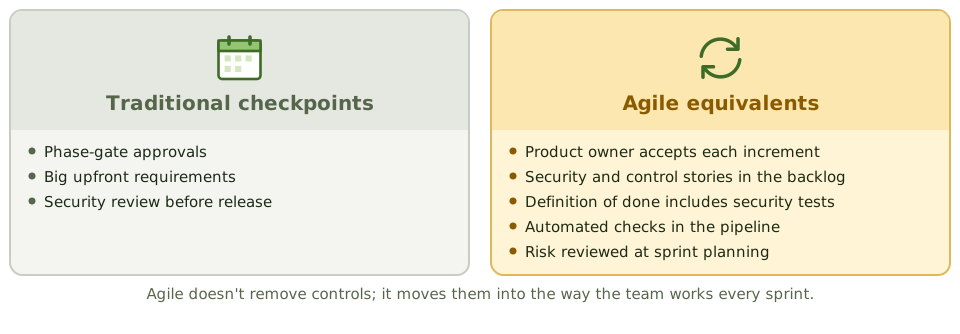
Segregation of duties in DevOps
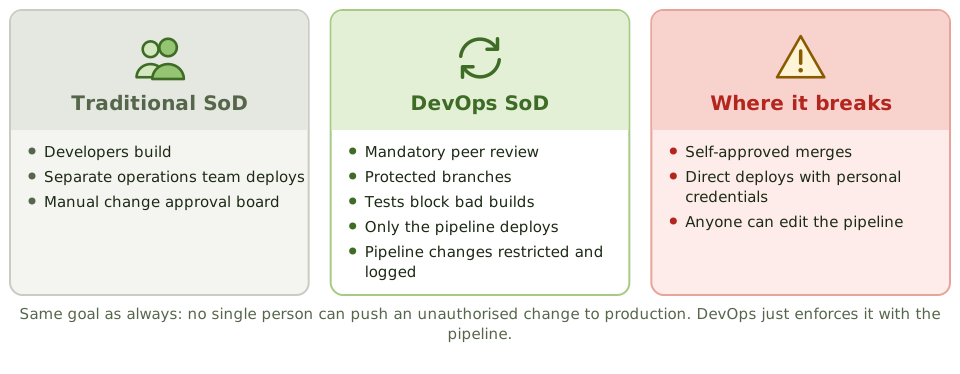
Protecting the pipeline
- 1Restrict who can change pipeline configuration.
- 2Log and review pipeline changes.
- 3Protect secrets and signing keys used by the pipeline.
- 4Scan code, dependencies and containers automatically.
How the exam asks about it
| If the question asks… | The answer is usually… |
|---|---|
| SoD in CI/CD | Peer review and pipeline-only deployment |
| Security in agile | Backlog items and definition of done |
| GREATEST DevOps risk | Unreviewed changes reaching production, or an unprotected pipeline |
| Keeping security pace with releases | Automated testing in the pipeline |
Key takeaways
- ✓Agile and DevOps deliver small changes often; controls must be built into the way teams work.
- ✓Security and control requirements go into the backlog and the definition of done.
- ✓In CI/CD, segregation of duties is enforced by peer review, protected branches and pipeline-only deployment.
- ✓The pipeline itself is a critical asset; changes to it must be restricted and logged.
- ✓Automated testing and scanning keep pace with frequent releases.
Exam traps
- !Assuming agile means no documentation or controls.
- !Developers self-approving merges and deploying with personal credentials.
- !Leaving the pipeline open for anyone to edit.
- !Manual security reviews that can't keep up with release frequency.
Testing, Release and Deployment Risk
How testing levels, release management and go-live decisions control the risk of putting new or changed systems into production, including data conversion and rollback.
Levels of testing
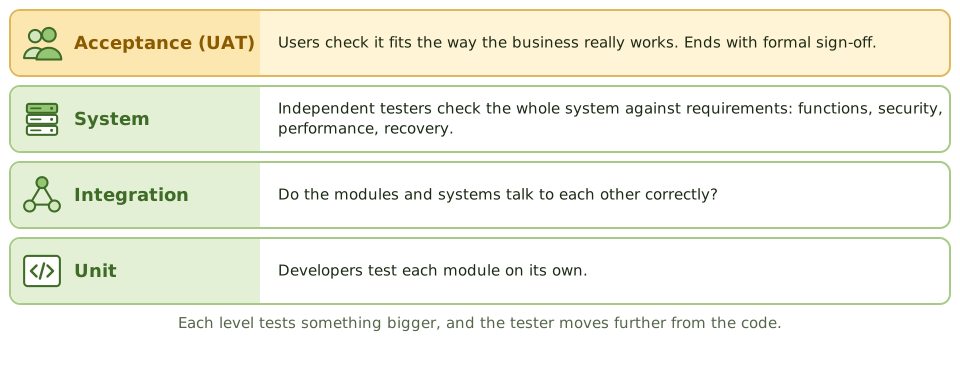
Controlled release
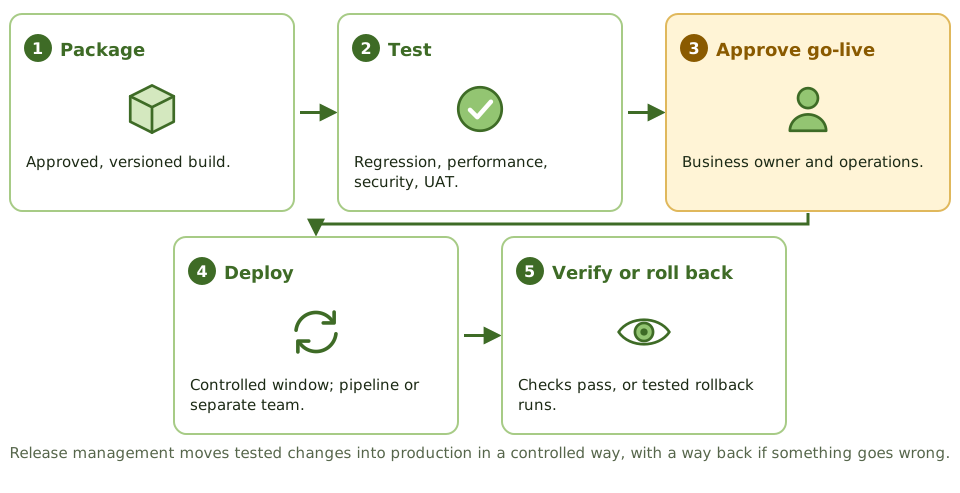
The go/no-go decision
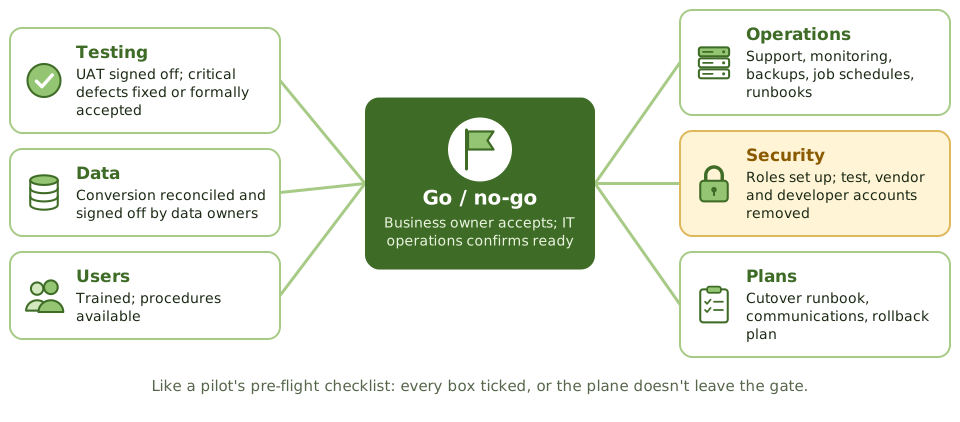
Test data
- 1Use masked or synthetic data where possible.
- 2Protect test environments if real data is unavoidable.
- 3Remove test accounts before go-live.
How the exam asks about it
| If the question asks… | The answer is usually… |
|---|---|
| Who accepts a system for production | The business owner |
| Critical defects before go-live | Business owner decides with full knowledge |
| Essential for a major release | A tested rollback plan |
| Production data in testing | Mask it or protect it equally |
Key takeaways
- ✓Testing moves from unit to integration, system and user acceptance testing, each checking something bigger.
- ✓Users or business owners formally accept a system before go-live.
- ✓Release management moves tested changes into production in a controlled way, with a tested rollback.
- ✓Go/no-go decisions rest with the business owner, based on test results and residual risk.
- ✓Data conversion must be reconciled and signed off by data owners.
Exam traps
- !Developers testing and accepting their own work.
- !Going live with critical defects open and no formal risk decision.
- !No rollback plan for a major release.
- !Using unmasked production data in test environments.
Data Classification, Ownership and Handling
How data is classified by sensitivity, who decides the classification, and how clear handling rules for each level turn classification into everyday protection.
Classification levels
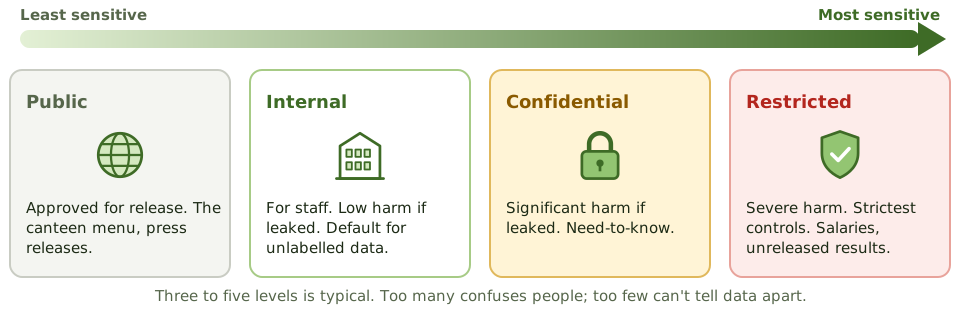
Who does what
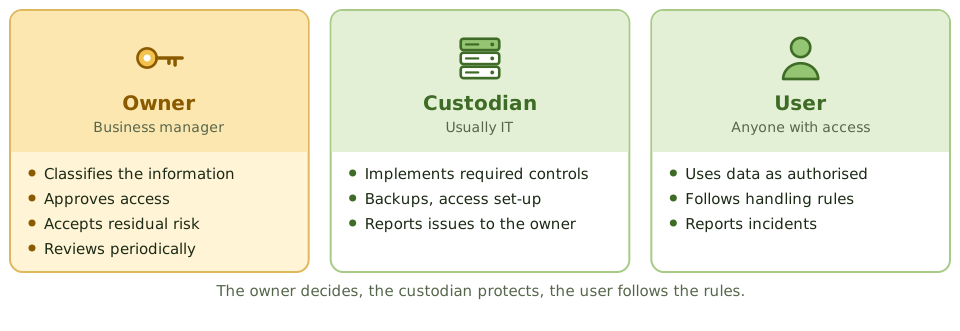
Handling rules
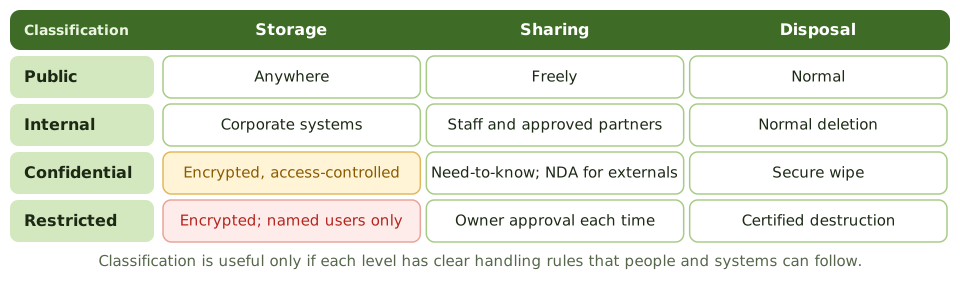
How the exam asks about it
| If the question asks… | The answer is usually… |
|---|---|
| Who classifies data | The data owner |
| MAIN benefit of classification | Protection matched to value |
| Result of over-classification | Wasted cost and ignored labels |
| Classification without handling rules | Ineffective; define rules for each level |
Key takeaways
- ✓Classification matches protection to the value and sensitivity of data.
- ✓Data owners, who are business managers, set classification; custodians implement the controls; users follow the rules.
- ✓Three to five levels is typical; too many confuses people.
- ✓Each level needs clear handling rules for storage, sharing and disposal.
- ✓Classification is reviewed as data's sensitivity changes.
Exam traps
- !Letting IT classify business data.
- !Over-classifying everything, which makes labels meaningless.
- !Classification levels with no handling rules.
- !Never reviewing classifications after events such as public announcements.
Data Lifecycle: Integrity, Retention and Disposal
How data is protected from creation to destruction: keeping it accurate and complete, retaining it as long as the law and business require, and disposing of it securely.
The data life cycle
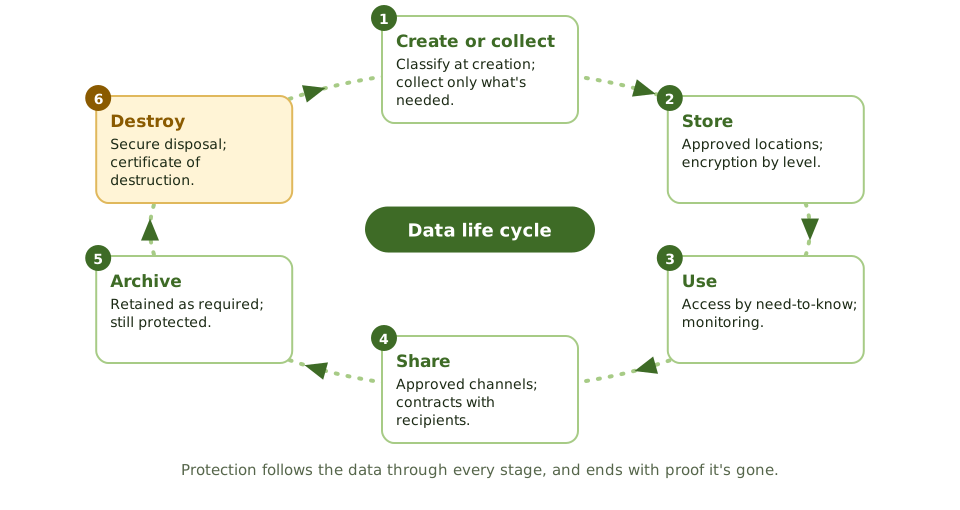
Integrity
- 1Input validation and edit checks.
- 2Reconciliations between systems.
- 3Access control and segregation of duties.
- 4Change control over data and programs.
- 5Integrity checks on archives and backups.
Retention
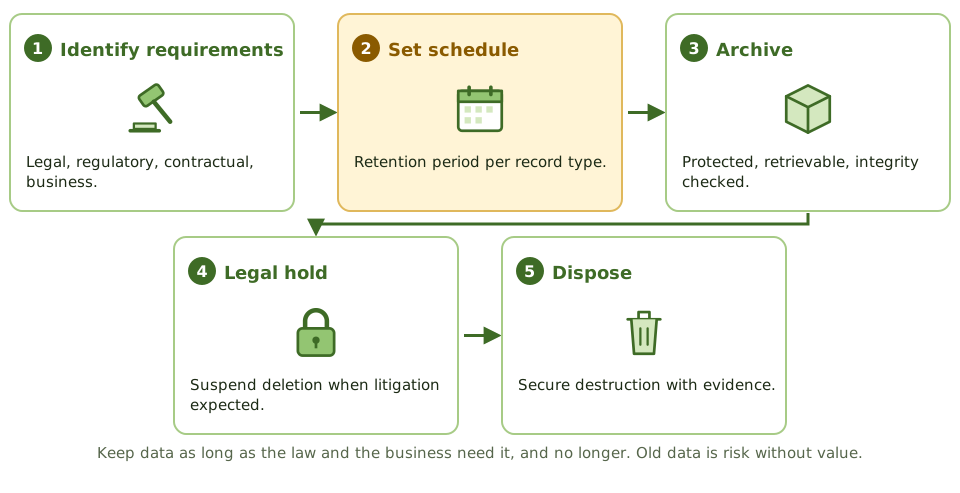
Secure disposal
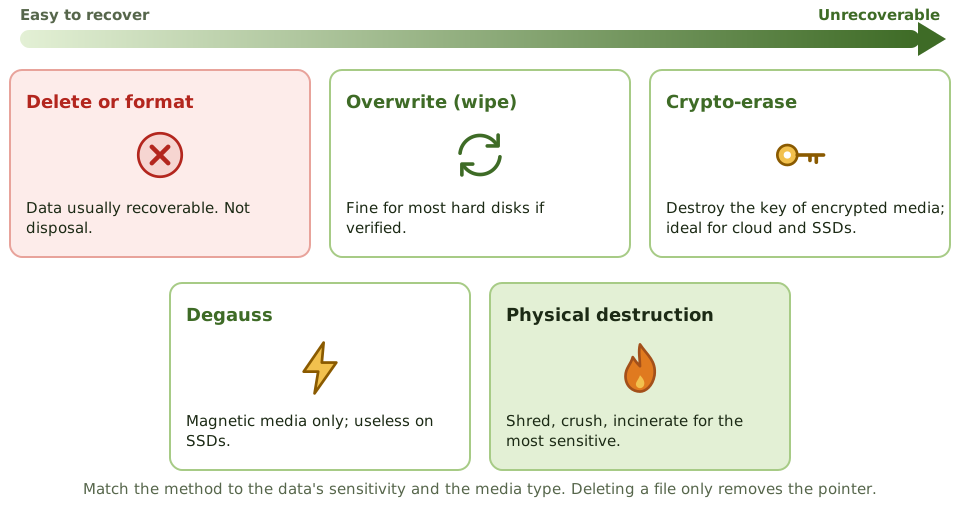
How the exam asks about it
| If the question asks… | The answer is usually… |
|---|---|
| Basis for retention periods | Legal, regulatory and business requirements |
| Litigation expected | Apply a legal hold |
| Risk of keeping data too long | Higher breach and legal exposure |
| Disposal of SSDs or cloud data | Crypto-erase or physical destruction |
Key takeaways
- ✓Protection follows data through creation, storage, use, sharing, archiving and destruction.
- ✓Data integrity controls keep data accurate, complete and unaltered: validation, reconciliation and access control.
- ✓Retention schedules come from legal, regulatory, contractual and business requirements.
- ✓Keeping data too long increases breach and legal exposure; legal holds suspend deletion when litigation is expected.
- ✓Secure disposal must match the media and sensitivity, with evidence of destruction.
Exam traps
- !Keeping all data forever 'just in case'.
- !Deleting data covered by a legal hold.
- !Treating file deletion or formatting as secure disposal.
- !Forgetting data held by suppliers and in backups.
Business Continuity Planning and Governance
How business continuity planning keeps critical processes running through disruption, from the BIA to strategies, plans, training and maintenance, and how it links to IT risk management.
The BCP life cycle
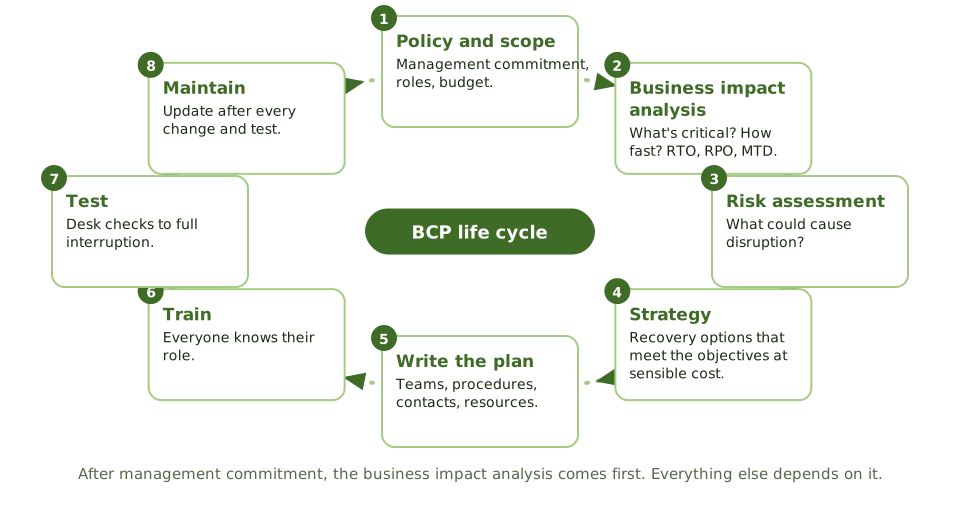
BCP and DRP
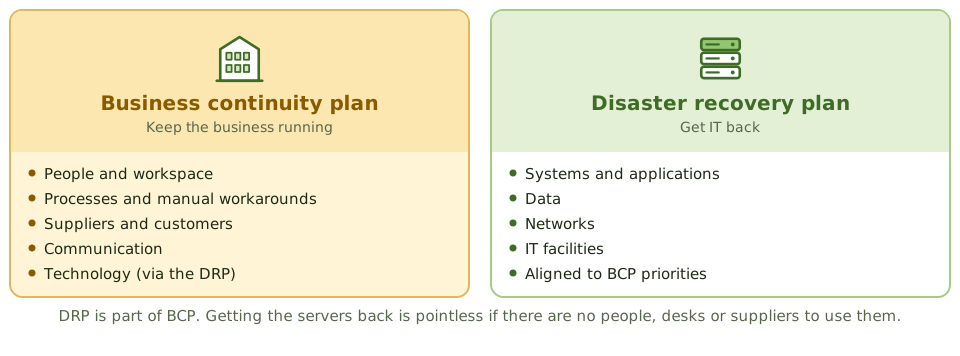
Strategies for each kind of loss
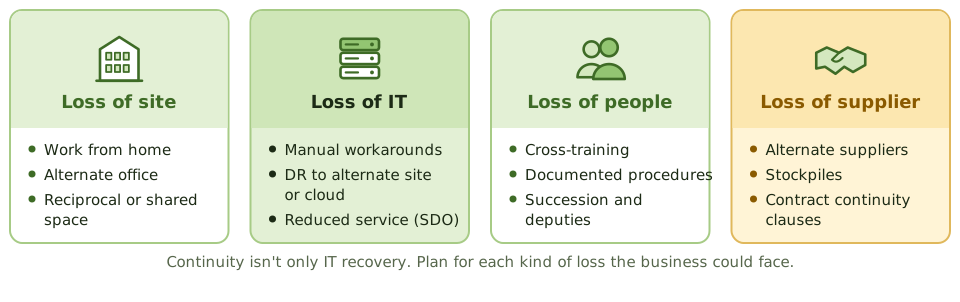
Governance
- 1Senior management sponsors and approves the program.
- 2Business owners own their process plans.
- 3Continuity risks appear in the risk register.
- 4Tests and lessons feed back into plans.
How the exam asks about it
| If the question asks… | The answer is usually… |
|---|---|
| FIRST step after management commitment | Business impact analysis |
| Who owns business continuity | Senior management and business owners |
| Relationship between BCP and DRP | DRP is part of BCP |
| Plan not updated after reorganisation | Significant weakness; update and retest |
Key takeaways
- ✓Business continuity keeps critical business processes running; disaster recovery restores IT within it.
- ✓After management commitment, the BIA comes first and drives recovery objectives and strategies.
- ✓Strategies cover loss of site, IT, people and suppliers, not only technology.
- ✓Plans must be trained, tested and maintained after every significant change.
- ✓Senior management owns continuity; the risk practitioner links it to the risk profile and appetite.
Exam traps
- !Treating continuity as an IT-only project.
- !Writing strategies before completing the BIA.
- !Plans that cover technology but forget people and suppliers.
- !Plans never updated after organisational change.
Disaster Recovery and Testing Recovery Capability
How recovery objectives drive the choice of recovery sites and backup strategies, and how progressively realistic testing proves the organisation can actually recover.
Objectives drive the solution
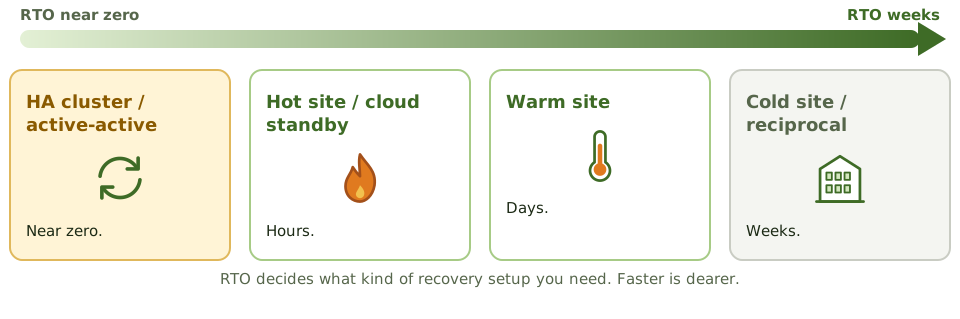
Recovery sites
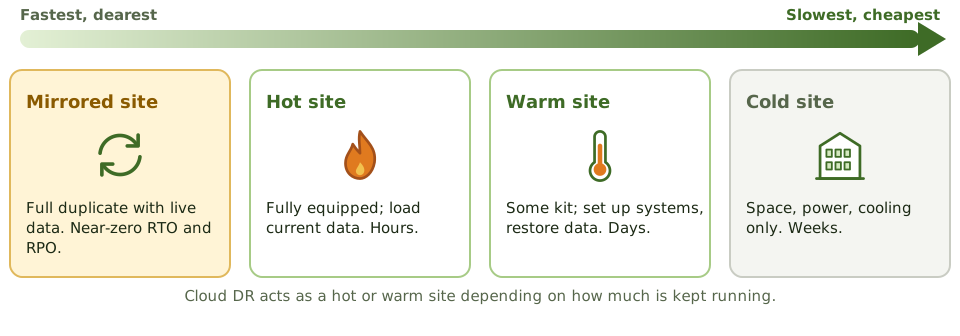
Testing recovery
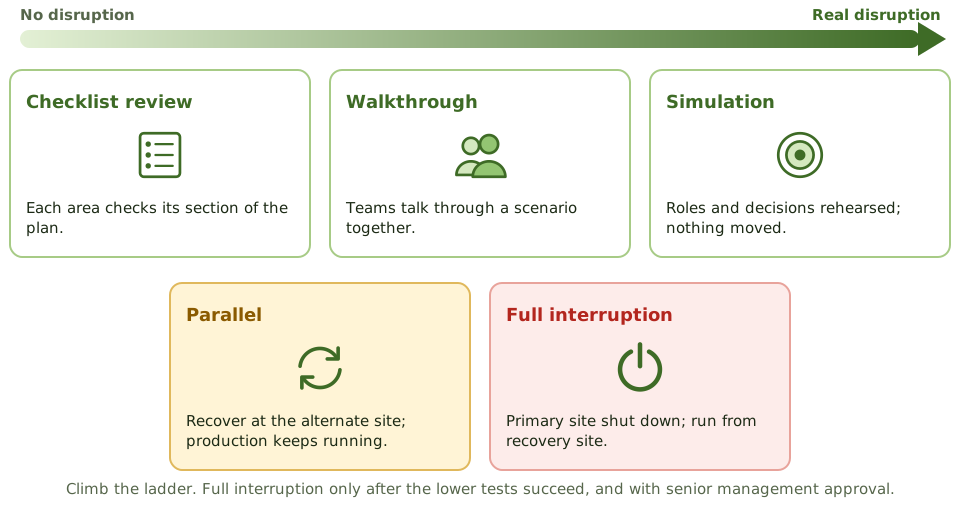
What a good test proves
- 1Objectives (RTO, RPO) were met.
- 2People knew their roles.
- 3Dependencies came up in the right order.
- 4Data was complete and consistent.
- 5Issues were logged and fixed.
How the exam asks about it
| If the question asks… | The answer is usually… |
|---|---|
| What drives recovery site choice | RTO and RPO from the BIA |
| MOST significant DR weakness | Plan not tested |
| Least disruptive test | Checklist review or walkthrough |
| Test reveals problems | Useful result; fix and retest |
Key takeaways
- ✓RTO decides how fast systems must return; RPO decides how much data loss is acceptable.
- ✓Faster recovery costs more; recovery options should match objectives from the BIA.
- ✓Recovery sites range from mirrored and hot to warm and cold; cloud DR can play any of these roles.
- ✓Tests progress from checklist and walkthrough to simulation, parallel and full interruption.
- ✓An untested plan can't be relied on; test results and fixes feed back into the plan.
Exam traps
- !Choosing a recovery site before setting RTO and RPO.
- !Assuming backups work without restore testing.
- !Running a full interruption test before simpler tests have succeeded.
- !Forgetting dependencies such as identity, DNS and network at the recovery site.
Emerging Technology Risk: Cloud, IoT and OT
The characteristic risks of cloud, IoT, operational technology and other emerging technologies, and how the risk practitioner assesses them before and after adoption.
Technologies and their risks
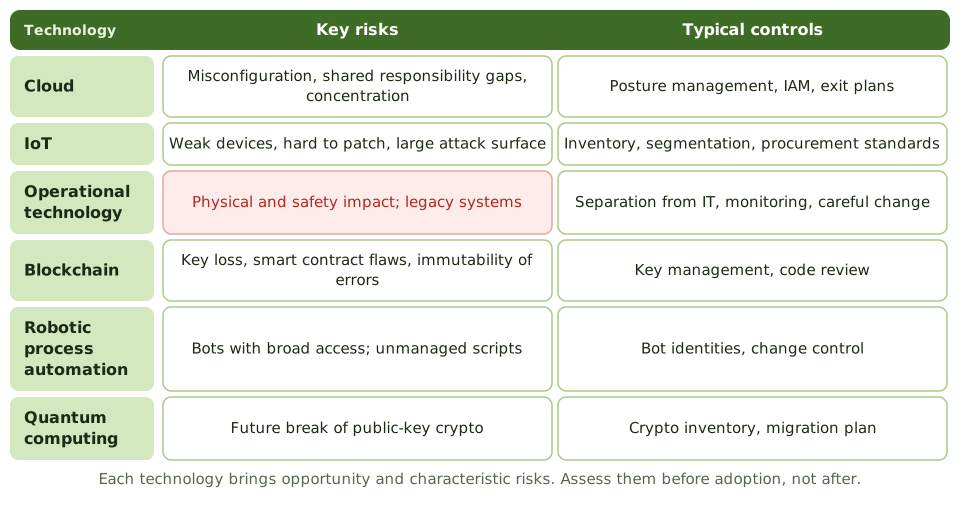
Cloud shared responsibility
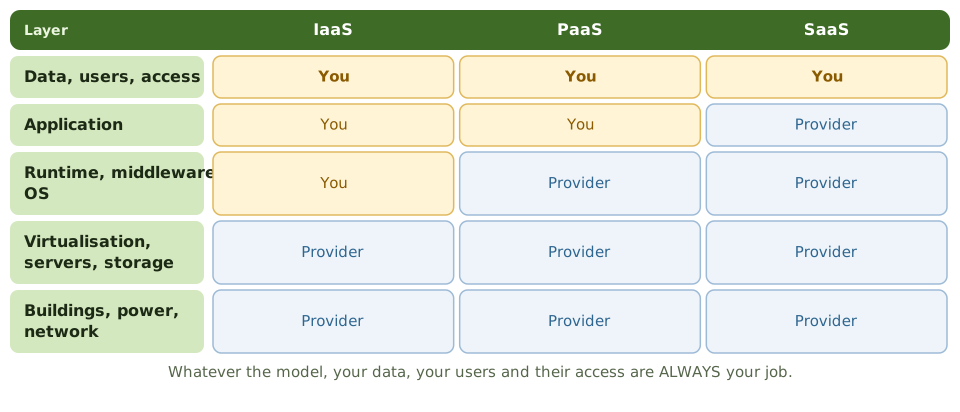
Assessing before adoption
- 1What business need does it serve?
- 2What data and processes will it touch?
- 3What new threats and dependencies does it bring?
- 4Do we have the skills to run it securely?
- 5Is the risk within appetite, and who owns it?
How the exam asks about it
| If the question asks… | The answer is usually… |
|---|---|
| MOST common cause of cloud breaches | Customer misconfiguration |
| Main concern when connecting OT to IT | Physical and safety impact |
| BEST control for IoT devices | Inventory and network segmentation |
| FIRST step with a new technology | Assess the risk before adoption |
Key takeaways
- ✓Every new technology brings opportunity and characteristic risks; assess them before adoption.
- ✓Cloud risk centres on shared responsibility, misconfiguration and concentration.
- ✓IoT devices are often weak, hard to patch and numerous; inventory and segment them.
- ✓Operational technology failures can cause physical and safety harm; changes need special care.
- ✓Quantum computing is a future threat to public-key cryptography; planning starts with a crypto inventory.
Exam traps
- !Assuming the cloud provider handles all security.
- !Connecting OT systems to corporate networks without assessing safety impact.
- !Letting IoT devices onto the network without inventory or segmentation.
- !Ignoring long-term risks such as quantum because they seem distant.
AI and Machine Learning Risk
The risks of using and building artificial intelligence, from data leakage and inaccurate output to bias, misuse and regulation, and how to govern AI like any other risk.
What can go wrong
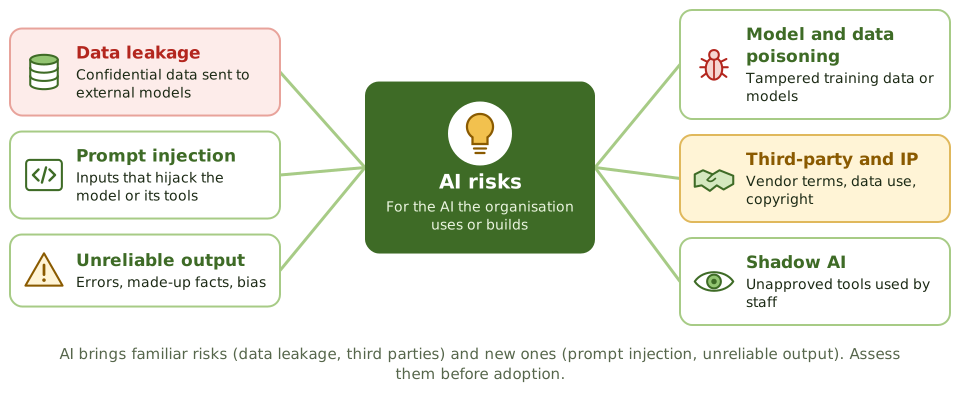
Governing AI
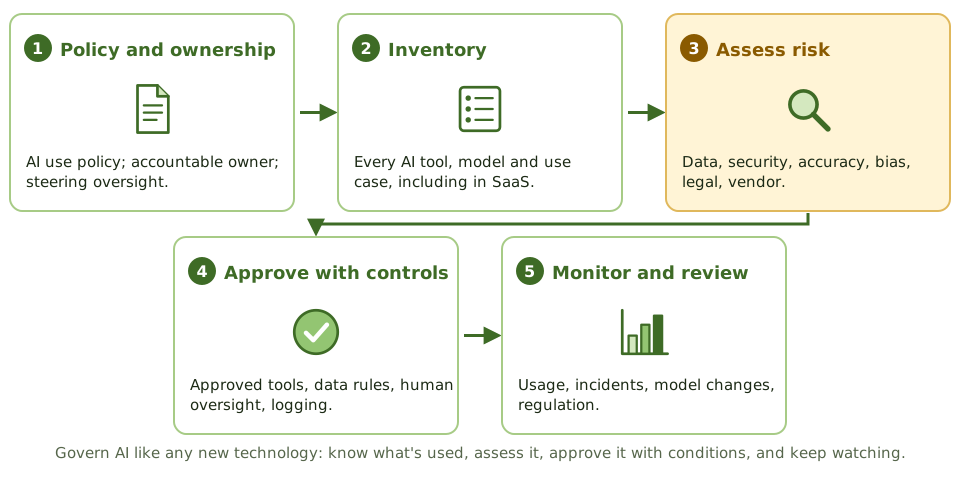
Risks and controls
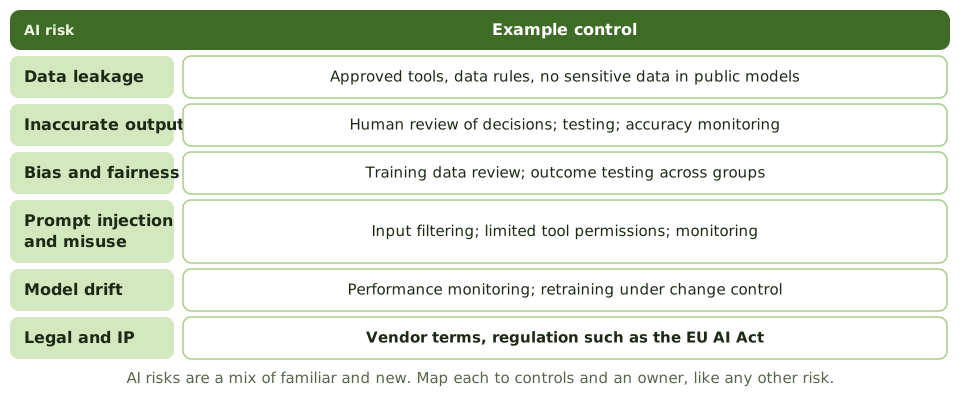
How the exam asks about it
| If the question asks… | The answer is usually… |
|---|---|
| FIRST step in governing AI use | Inventory AI uses and assign owners |
| Staff using public AI tools with company data | Assess the risk; provide approved options |
| Risk specific to machine learning | Bias, drift, poisoned training data |
| High-impact AI decisions | Human oversight and outcome testing |
Key takeaways
- ✓AI brings familiar risks (data leakage, third parties) and new ones (unreliable output, bias, prompt injection, model drift).
- ✓Govern AI with a policy, an inventory of uses, risk assessment, approval with controls and monitoring.
- ✓High-impact AI decisions need human oversight and testing for accuracy and fairness.
- ✓Shadow AI, staff using unapproved tools with company data, is a common early risk.
- ✓Regulation such as the EU AI Act sets obligations by risk level.
Exam traps
- !Banning AI outright, which pushes use underground.
- !Approving AI tools without checking what happens to the data entered.
- !Assuming AI output is accurate without testing or review.
- !Treating AI as purely a technology issue rather than a business, legal and ethical one.
Setting Risk Boundaries for Innovation
How the risk practitioner helps the business innovate safely, using appetite, guardrails, sandboxes and pilots instead of blanket bans or uncontrolled adoption.
Enable, don't block
Organisations that refuse all new technology lose ground to competitors; those that adopt it blindly suffer avoidable losses. The risk practitioner's job is to make safe experimentation possible within the appetite the board has set.
Guardrails in practice
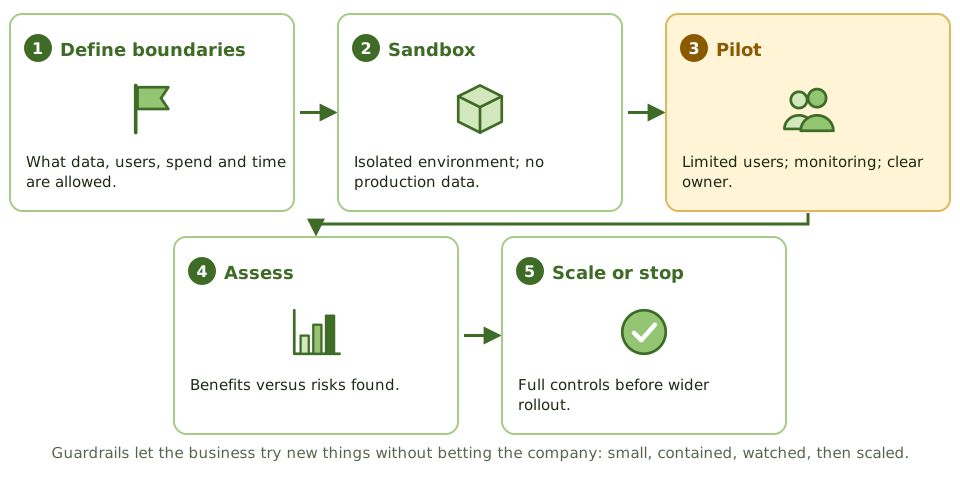
Typical boundaries
| Boundary | Example |
|---|---|
| Data | No customer or personal data in the pilot |
| Users | 50 internal users only |
| Time | 90-day trial, then decide |
| Spend | Capped budget |
| Integration | No connection to production systems |
How the exam asks about it
| If the question asks… | The answer is usually… |
|---|---|
| BEST approach to a promising but risky technology | Pilot with defined guardrails |
| Pilot becomes production | Apply full controls first |
| Data in a sandbox | No production or sensitive data |
| Role of risk management in innovation | Enable within appetite |
Key takeaways
- ✓Risk management should enable innovation within appetite, not block it.
- ✓Guardrails define what data, users, spend and time a new initiative may use.
- ✓Sandboxes and pilots let the business learn while limiting the impact of failure.
- ✓Full controls are required before an innovation scales to production.
- ✓Each innovation needs an owner who accepts its risk.
Exam traps
- !Banning new technology because its risks aren't fully known.
- !Letting pilots quietly become production systems without controls.
- !Using production data in sandboxes.
- !Innovation projects with no risk owner.
Core Security Concepts: CIA, IAM, Cryptography and Network Security
The security concepts a risk practitioner needs to discuss controls with confidence: confidentiality, integrity and availability, identity and access management, cryptography, and network and endpoint protection.
Security objectives
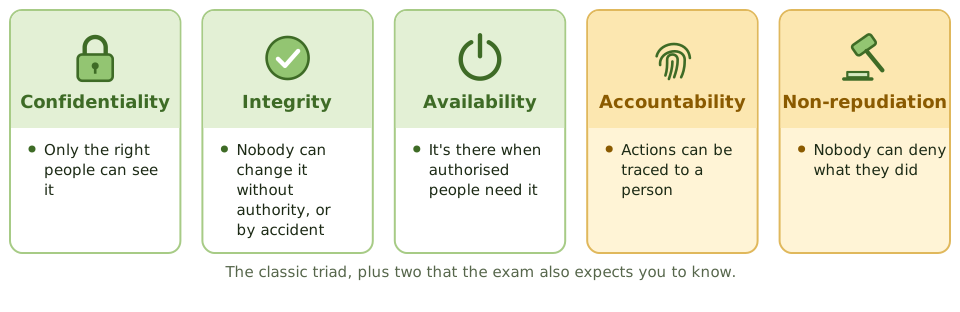
Identity and access
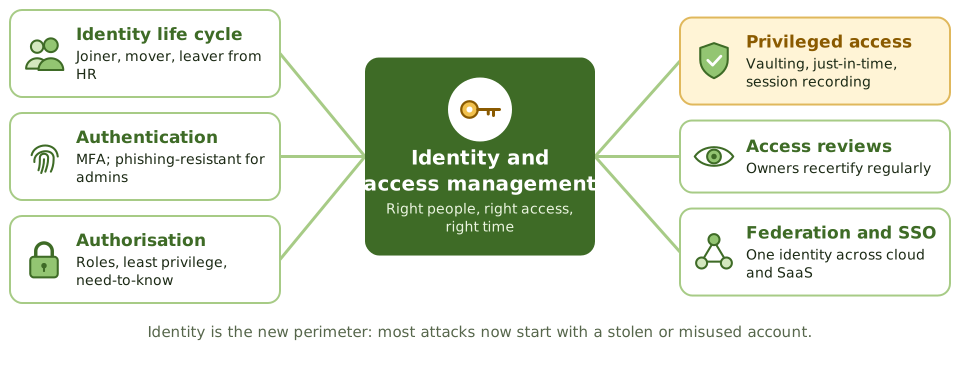
Cryptography in brief
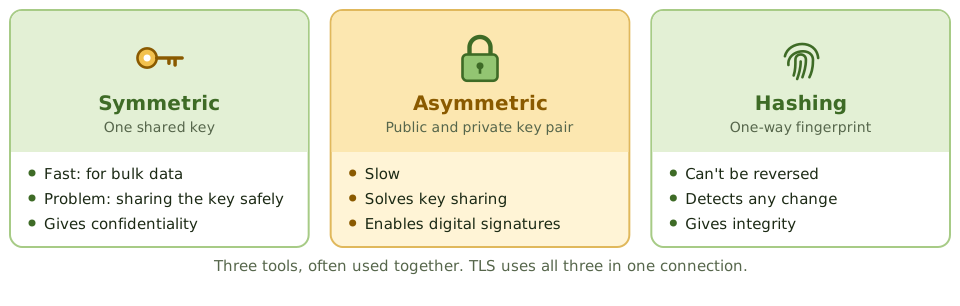
Network and endpoint
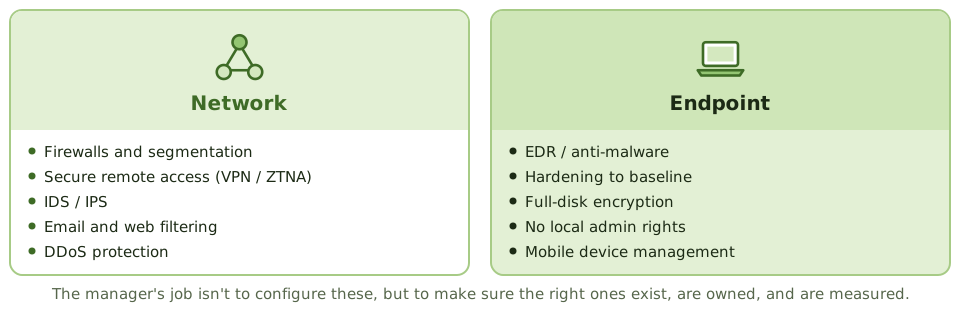
Zero trust
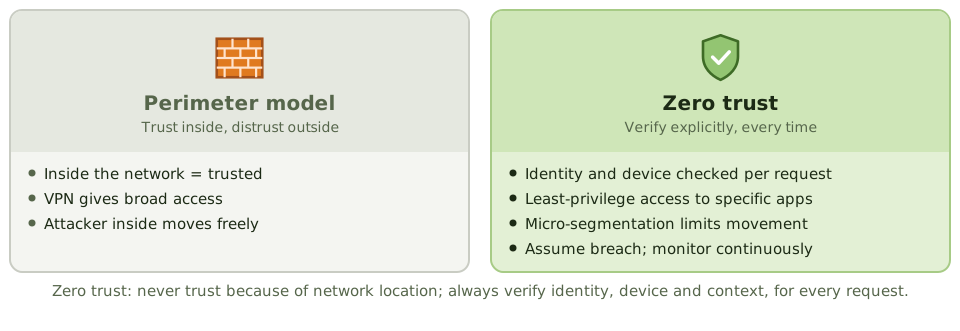
How the exam asks about it
| If the question asks… | The answer is usually… |
|---|---|
| Control proving data wasn't altered | Hashing or digital signature |
| MOST important control for remote access | Multi-factor authentication |
| Limits spread of an attack | Segmentation or zero trust |
| Weakest part of most encryption | Key management |
Key takeaways
- ✓Confidentiality, integrity and availability are the core security objectives; accountability and non-repudiation extend them.
- ✓Identity and access management covers the identity life cycle, authentication, authorisation, privileged access and reviews.
- ✓Symmetric encryption protects bulk data, asymmetric encryption solves key exchange and signatures, and hashing proves integrity.
- ✓Network and endpoint controls (segmentation, firewalls, EDR, hardening) limit how attacks spread.
- ✓Zero trust replaces trust based on network location with verification of every request.
- ✓Defence in depth layers controls so one failure doesn't expose the asset.
Exam traps
- !Thinking hashing provides confidentiality.
- !Relying on the network perimeter alone.
- !Treating MFA as optional for privileged and remote access.
- !Assuming encryption is strong when keys are poorly managed.
Security Frameworks and Control Standards
How security frameworks such as NIST CSF, ISO 27001 and the CIS Controls give structure to a security program, and how policies, standards and baselines turn them into enforced controls.
NIST CSF 2.0
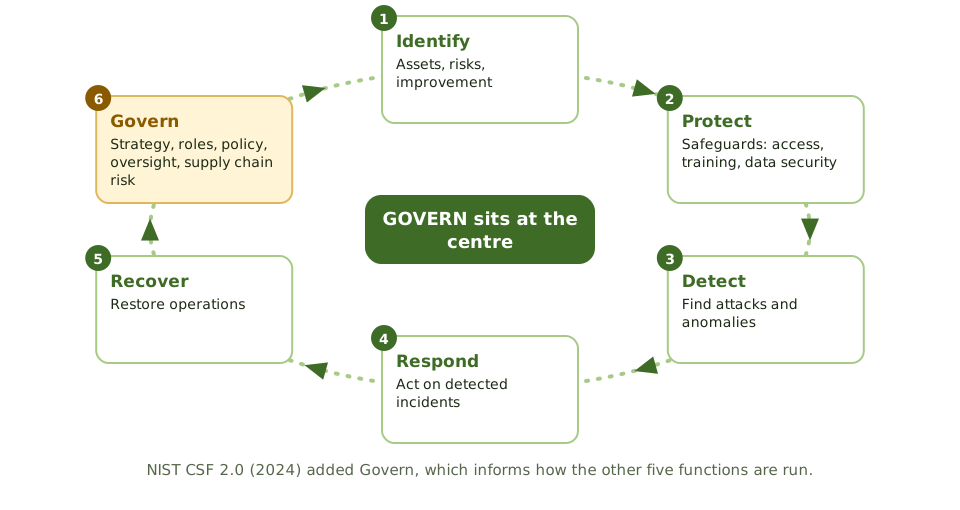
From framework to enforcement
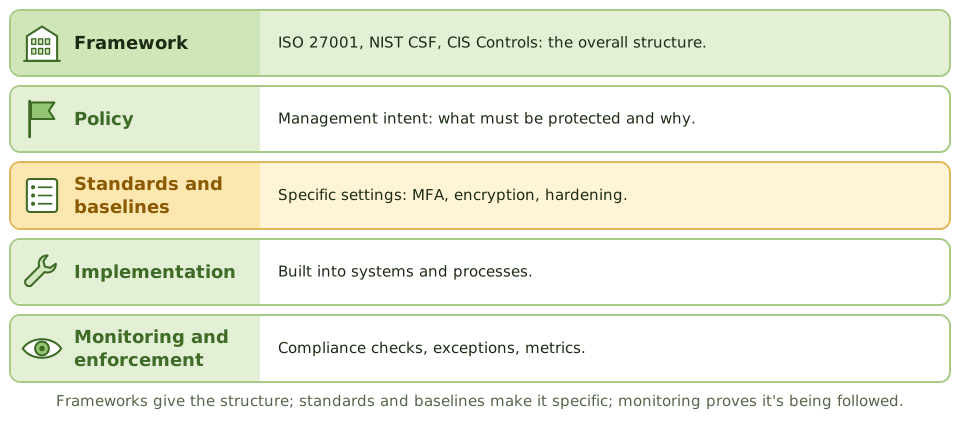
Choosing and using frameworks
| Framework | Use |
|---|---|
| ISO/IEC 27001 | Certifiable management system |
| NIST CSF 2.0 | Outcome-based structure and maturity view |
| CIS Controls | Prioritised practical safeguards |
| NIST SP 800-53 / ISO 27002 | Detailed control catalogues |
How the exam asks about it
| If the question asks… | The answer is usually… |
|---|---|
| Function added in NIST CSF 2.0 | Govern |
| Certifiable security standard | ISO/IEC 27001 |
| Where specific security settings belong | Standards and baselines |
| Evidence standards are followed | Monitoring and control testing |
Key takeaways
- ✓Security frameworks give a structure for organising and measuring security controls.
- ✓NIST CSF 2.0 organises security into Govern, Identify, Protect, Detect, Respond and Recover.
- ✓ISO/IEC 27001 is certifiable; ISO 27002, NIST SP 800-53 and CIS Controls provide control detail.
- ✓Policies, standards and baselines make framework requirements specific and enforceable.
- ✓Monitoring, exceptions and metrics show whether standards are actually followed.
Exam traps
- !Adopting a framework without tailoring it to risk.
- !Assuming framework adoption means controls are effective.
- !Standards that exist on paper with no monitoring.
- !Confusing ISO 27001 (certifiable) with ISO 27002 (guidance).
Security Awareness Culture and Measuring Training
How security awareness and training reduce people-related risk, how to tailor them by role, and how to measure whether behaviour actually changes.
Why awareness matters
Phishing, misdirected emails, weak passwords and approving fake payments are human actions. Technical controls help, but people who recognise and report risk are a control in their own right.
Building the program
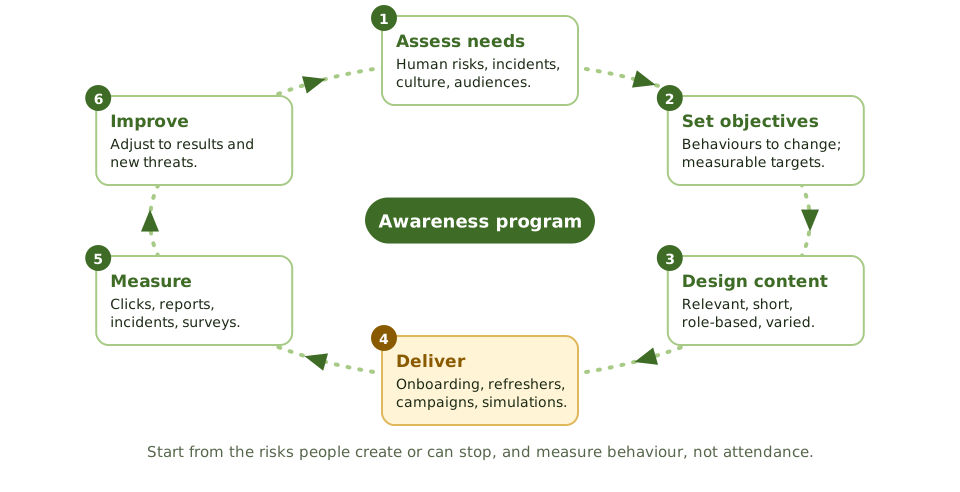
Measuring what matters
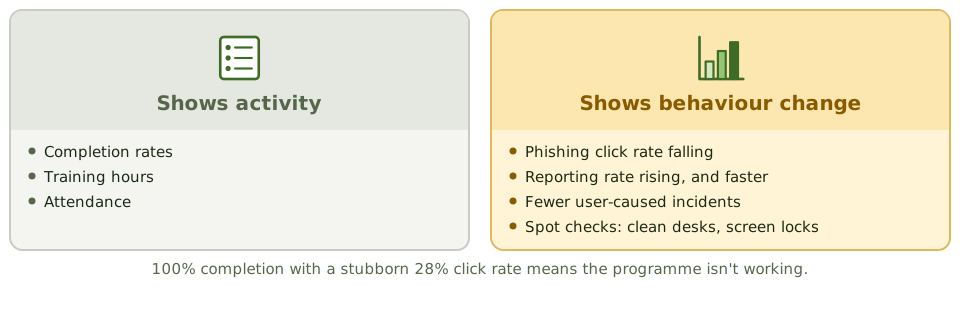
Targeting high-risk roles
- 1Finance: payment fraud and supplier impersonation.
- 2Administrators: privileged access and social engineering.
- 3Executives: whaling and confidentiality.
- 4Developers: secure coding.
How the exam asks about it
| If the question asks… | The answer is usually… |
|---|---|
| BEST measure of awareness effectiveness | Behaviour change, such as fewer phishing clicks |
| Weakness of completion rates | Show activity, not effect |
| Group needing targeted training | High-risk roles such as finance and admins |
| Improve incident reporting | No-blame culture and simple reporting |
Key takeaways
- ✓Many incidents start with human action; awareness reduces the likelihood of people-caused risk events.
- ✓Effective programs are continuous, relevant, role-based and supported by leaders.
- ✓High-risk roles such as finance, administrators and executives need targeted training.
- ✓Measure behaviour (phishing click and report rates, user-caused incidents), not just completion.
- ✓A no-blame reporting culture is as important as training content.
Exam traps
- !Measuring success by training completion rates.
- !One annual session for everyone.
- !Punishing people who report mistakes.
- !Ignoring executives and privileged users.
Privacy Governance and Data Protection Principles
How privacy differs from security, the core data protection principles, and how a privacy program manages the risk of collecting, using and keeping personal data.
Privacy versus security
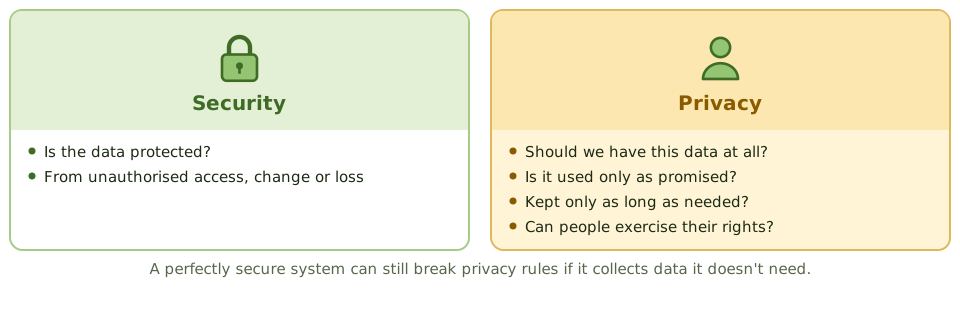
Data protection principles
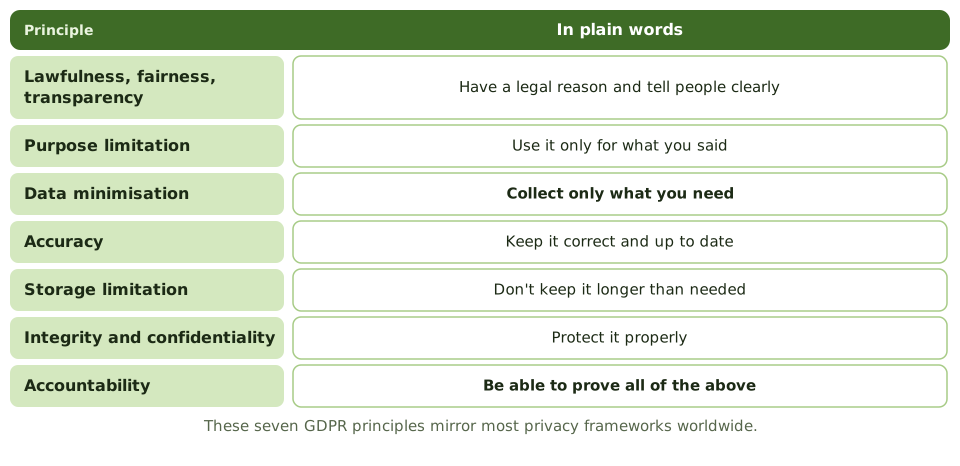
The privacy program
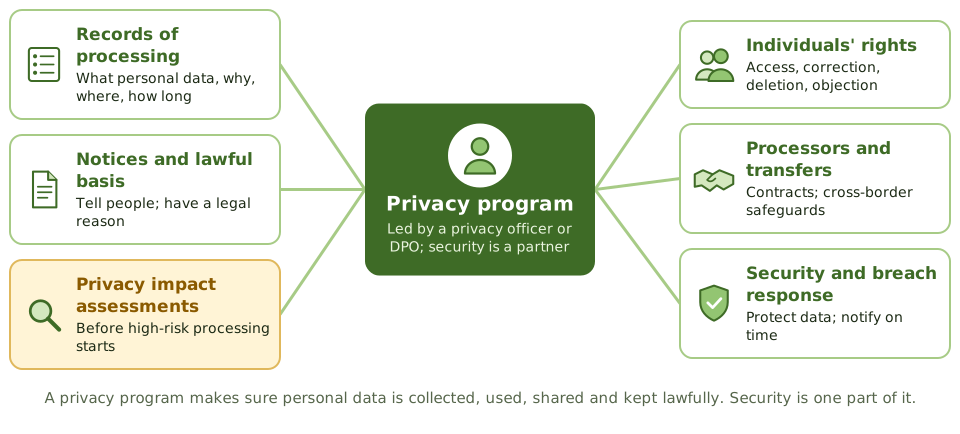
How the exam asks about it
| If the question asks… | The answer is usually… |
|---|---|
| Collecting more data than needed | Breaches data minimisation |
| When to do a privacy impact assessment | During design, before processing starts |
| Relationship between privacy and security | Security is necessary but not sufficient |
| Who is accountable for personal data | The controller (the organisation) |
Key takeaways
- ✓Security protects data; privacy asks whether the organisation should collect and use it at all, and how.
- ✓Core principles include lawfulness, purpose limitation, minimisation, accuracy, storage limitation, security and accountability.
- ✓A privacy program covers records of processing, notices, impact assessments, individuals' rights, processors and breach response.
- ✓Privacy impact assessments are done before high-risk processing starts.
- ✓Privacy risk is a business risk with legal, financial and reputational impact.
Exam traps
- !Assuming strong security means privacy obligations are met.
- !Collecting data 'in case it's useful later'.
- !Doing a privacy impact assessment after launch.
- !Forgetting processors and cross-border transfers.
Developing a Data Protection Control Strategy
How to build a data protection strategy that finds sensitive data wherever it lives, protects it in proportion to its value, and monitors and responds when it's at risk.
The strategy step by step
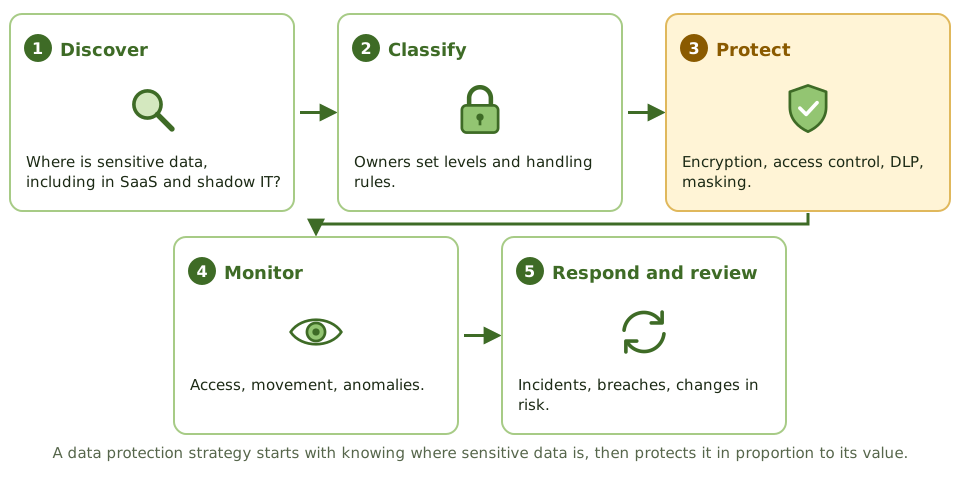
Choosing controls
| Control | Protects against |
|---|---|
| Encryption (at rest, in transit) | Disclosure if media or traffic is intercepted |
| Access control and least privilege | Unauthorised internal access |
| DLP | Sensitive data leaving through email, web, USB |
| Masking and tokenisation | Exposure in test, analytics or payments |
| Backup and immutability | Loss and ransomware |
Don't forget copies
- 1Test and development environments.
- 2Analytics and data lakes.
- 3Suppliers and processors.
- 4Backups and archives.
- 5Personal devices and cloud drives.
How the exam asks about it
| If the question asks… | The answer is usually… |
|---|---|
| FIRST step in a data protection strategy | Discover and classify sensitive data |
| Protect data used in testing | Masking or synthetic data |
| Stop sensitive data leaving by email | DLP |
| Basis for control strength | Data classification |
Key takeaways
- ✓A data protection strategy starts with discovering where sensitive data is, including SaaS and shadow IT.
- ✓Owners classify data; controls are applied in proportion to classification.
- ✓Key controls include encryption, access control, DLP, masking, tokenisation and backup.
- ✓Monitoring detects unusual access and movement; response plans handle breaches.
- ✓The strategy is reviewed as data, regulation and threats change.
Exam traps
- !Buying a DLP tool before knowing where sensitive data is.
- !Encrypting everything equally regardless of value.
- !Ignoring data held by suppliers.
- !Protecting production data while leaving copies in test and analytics environments.