Topics in this domain
- Exam Technique: Thinking Like a Security Manager
- Security Governance vs Security Management
- Organisational Culture and Tone at the Top
- Ethics, Codes of Conduct and Accountability
- Integrating Security into Corporate Governance
- Legal, Regulatory and Contractual Requirements
- Due Diligence, Due Care and Legal Liability
- Privacy and Data Protection Governance
- Governance Roles, the CISO and Reporting Lines
- The Security Steering Committee
- The Three Lines Model and Independent Assurance
- Aligning Security Strategy with Business Objectives
- Developing a Security Strategy and Roadmap
- Gaining and Keeping Executive Commitment
- Governing AI and Emerging Technology
- Security Frameworks Compared: NIST CSF, ISO 27001 and COBIT
- Selecting and Implementing a Framework
- Governance Models: BMIS and the Security Balanced Scorecard
- Resource Planning and Security Budgets
- Building a Business Case for Security Investment
- Demonstrating Value and Return on Security Investment
Gaining and Keeping Executive Commitment
Why it decides everything
Senior management controls the budget, sets priorities and models behaviour for everyone else. Without their visible support, policies have no authority, projects lose funding and business units ignore security requirements. With it, the security manager can achieve far more with the same resources.
That’s why, across all four CISM domains, so many “MOST important” and “FIRST” questions point to senior management commitment and support.
How to earn it
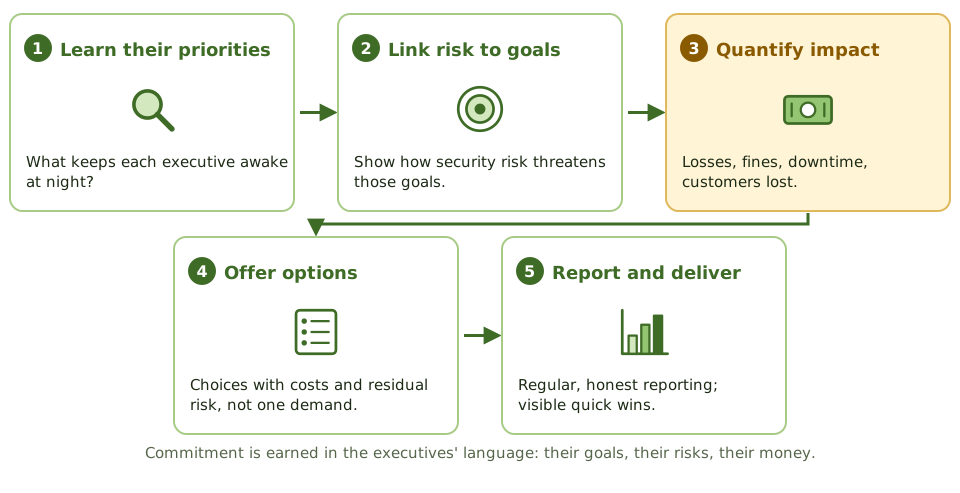
- Learn their priorities. Each executive cares about different things: revenue, cost, compliance, reputation, customers.
- Link risk to their goals. Show how security risk threatens what they’re trying to achieve.
- Quantify impact where you can: losses, fines, downtime, customers lost.
- Offer options, each with its cost and the risk it leaves behind. Executives make better decisions, and feel more ownership, when they choose rather than approve a single demand.
- Report and deliver: regular, honest reporting and visible early results.
Speak their language
| Instead of… | Say… |
|---|---|
| “We have 400 critical vulnerabilities.” | “Our online store could be down for a week; that’s 3 million in sales.” |
| “We need a SIEM.” | “We’d currently take months to notice a breach; this cuts it to hours.” |
| “ISO 27001 requires it.” | “Two of our largest customers require it to renew their contracts.” |
| “Phishing is rising.” | “Fraudulent payment requests cost a peer company 4 million last year.” |
Opportunities to win support
- Incidents, at the organisation or a peer, focus attention. Use them to show the gap calmly, not to frighten. Fear may get a one-off budget, but rarely lasting support.
- Audit findings give independent evidence.
- Regulation makes some actions non-optional.
- Business plans (new markets, products, acquisitions) often depend on security to succeed.
Keeping it
- Report regularly and concisely on risk and progress, using measures the executives care about.
- Deliver what you promised, and show quick wins early.
- Be honest about problems and setbacks; credibility is hard to rebuild.
- Keep executives involved through the steering committee and in strategy reviews.
Commitment should also be visible: the security policy signed by the CEO, executives completing the same training and following the same rules as everyone else.
Example. A CISO gets funding after a peer’s ransomware attack, then reports every quarter with three measures the board chose: time to detect, critical systems backed up offline, and phishing report rate. Two years later, funding continues without a new crisis.
If management decides not to fund something, the security manager’s job is to make sure the decision is informed and documented, with the risk formally accepted by the right person, and then to keep monitoring it.
How the exam asks about it
| If the question asks… | The answer is usually… |
|---|---|
| Most important factor for program success | Senior management commitment |
| Best way to obtain management support | Show how security supports business objectives, in business terms |
| Most effective way to present risk to executives | Business impact, with options and costs |
| Management declines to fund a recommended control | Document the decision and the accepted risk |
| How to maintain support over time | Regular reporting on progress and risk |
In short
- Senior management commitment is the most important success factor for an information security program.
- Executives commit when security is explained in their terms: business goals, risk, money and reputation.
- Offer options with costs and residual risk, so executives make informed decisions rather than approve demands.
- Incidents, audits, regulation and peer benchmarks can create interest, but lasting commitment comes from alignment.
- Keep support through regular, honest reporting, delivered quick wins and a seat on the steering committee.
- Visible commitment (policy signed by the CEO, executives following the rules) tells everyone security matters.
Exam traps
- Fear, uncertainty and doubt may get a one-off budget, but not lasting support.
- Technical detail loses executives; business impact keeps them.
- Commitment isn't a one-time approval; it must be maintained.
- Without senior support, the right answer is rarely 'push ahead anyway'; it's to build the case and get it.
Slides
Click the slide and use the arrow keys. F toggles full screen.
How to earn it