Topics in this domain
- Exam Technique: Thinking Like a Security Manager
- Security Governance vs Security Management
- Organisational Culture and Tone at the Top
- Ethics, Codes of Conduct and Accountability
- Integrating Security into Corporate Governance
- Legal, Regulatory and Contractual Requirements
- Due Diligence, Due Care and Legal Liability
- Privacy and Data Protection Governance
- Governance Roles, the CISO and Reporting Lines
- The Security Steering Committee
- The Three Lines Model and Independent Assurance
- Aligning Security Strategy with Business Objectives
- Developing a Security Strategy and Roadmap
- Gaining and Keeping Executive Commitment
- Governing AI and Emerging Technology
- Security Frameworks Compared: NIST CSF, ISO 27001 and COBIT
- Selecting and Implementing a Framework
- Governance Models: BMIS and the Security Balanced Scorecard
- Resource Planning and Security Budgets
- Building a Business Case for Security Investment
- Demonstrating Value and Return on Security Investment
Integrating Security into Corporate Governance
One organisation, one governance
Boards already govern finance, legal exposure and operations through committees, policies and regular reporting. Information security belongs inside that same structure. When it sits apart, as an IT-only topic with its own vocabulary, the board can’t weigh security against everything else it has to decide, and security loses out.
Integrating security into corporate governance means:
- one risk language: information risk rated the same way as other risks
- board oversight: through existing committees and reporting cycles
- integrated assurance: the functions that protect the organisation work together
- security in business processes: built into decisions, not bolted on afterwards
Speak the language of enterprise risk
Most organisations have an enterprise risk management (ERM) process with a common risk register, standard likelihood and impact scales and a board-approved appetite. Information risks should go into it, not into a separate register with different scales that nobody outside security understands.
Example. The CISO rates “ransomware stops order processing” as High on the company’s own 5x5 scale, with an estimated 2 million impact. The board can now compare it directly with a supply-chain risk of similar size and decide where to spend.
Assurance integration
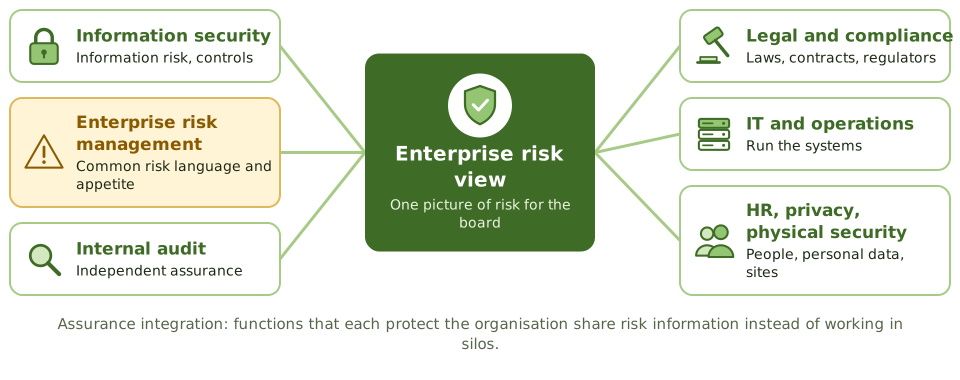
Many functions protect the organisation: information security, risk management, internal audit, legal and compliance, privacy, IT operations, HR and physical security. Working separately, they duplicate effort, ask the business the same questions repeatedly and leave gaps between them. Assurance integration (sometimes called convergence) means they:
- share a common view of risk
- coordinate assessments and testing
- agree who covers what
- report consistently to management and the board
Built into business decisions
Security has the most influence, and costs least, when it’s part of the decision rather than an afterthought:
| Business process | Security’s role |
|---|---|
| Project approval | Security requirements and a risk review are gates in the project life cycle |
| Procurement | Supplier security assessed before contracts are signed |
| Mergers and acquisitions | Security due diligence on the target before the deal closes |
| New products and markets | Legal, privacy and security requirements assessed up front |
| Change management | Security impact considered for significant changes |
Board oversight
- A board committee, usually audit or risk, has information security oversight written into its charter.
- The board approves the risk appetite for information risk.
- The board receives regular reports on top risks, trends, major incidents, program progress and the decisions it needs to make.
- Internal audit provides independent assurance that the security program works.
How the exam asks about it
| If the question asks… | The answer is usually… |
|---|---|
| Best way to integrate security into corporate governance | Through enterprise risk management |
| What should the board receive? | Business-focused risk reporting, not technical detail |
| When should security be involved in projects? | From the start, in approval and requirements |
| Main benefit of assurance integration | Fewer gaps and overlaps; one view of risk |
| How should information risk be expressed? | On the same scales and against the same appetite as other business risks |
In short
- Information security governance is a subset of corporate governance, not a separate IT activity.
- The most effective integration is through enterprise risk management: information risk described in the same language, scales and appetite as other business risks.
- The board oversees security through its committees (audit or risk) and through regular reporting in business terms.
- Assurance integration means security, audit, risk, legal, privacy, HR, physical security and IT share information and avoid gaps and overlaps.
- Security is integrated into business processes such as project approval, procurement, mergers and new products.
- Reporting to the board focuses on risk, trends and decisions needed, not on technical detail.
Exam traps
- Reporting firewall statistics to the board isn't integration; reporting business risk is.
- A separate security risk register with its own scales makes information risk hard to compare with other risks.
- Integration doesn't mean the CISO reports to internal audit; audit must stay independent.
- Security added at the end of a project or deal is too late; it belongs in the approval process.
Slides
Click the slide and use the arrow keys. F toggles full screen.
Assurance integration