Topics in this domain
- Exam Technique: Thinking Like a Risk Practitioner
- Aligning IT Risk Management with Business Strategy
- Organisational Structure, Roles and Decision Rights
- Risk Ownership and Accountability
- Segregation of Duties
- Risk Culture and Tone at the Top
- Ethics and Professional Conduct
- Policies, Standards, Procedures and Guidelines
- Policy Lifecycle, Exceptions and Enforcement
- Business Process Review: Ownership and Criticality
- Identifying and Valuing Organisational Assets
- Embedding Asset Management into Risk Governance
- Enterprise Risk Management: Purpose and Principles
- The Risk Practitioner's Role in ERM
- The Three Lines Model and Risk Oversight
- Risk Management Frameworks: ISO 31000, COSO ERM, NIST and COBIT
- Applying a Framework: the Risk Management Life Cycle
- Risk Appetite, Tolerance and Capacity
- Establishing and Maintaining the IT Risk Profile
- Making Risk-Based Business Decisions
- Legal, Regulatory and Contractual Requirements
- Connecting Governance to Risk Outcomes
Risk Culture and Tone at the Top
What risk culture is
Risk culture is how people actually treat risk when no rule tells them what to do: whether they raise problems, take shortcuts or ask before acting. It decides whether policies work in practice.
Where culture comes from
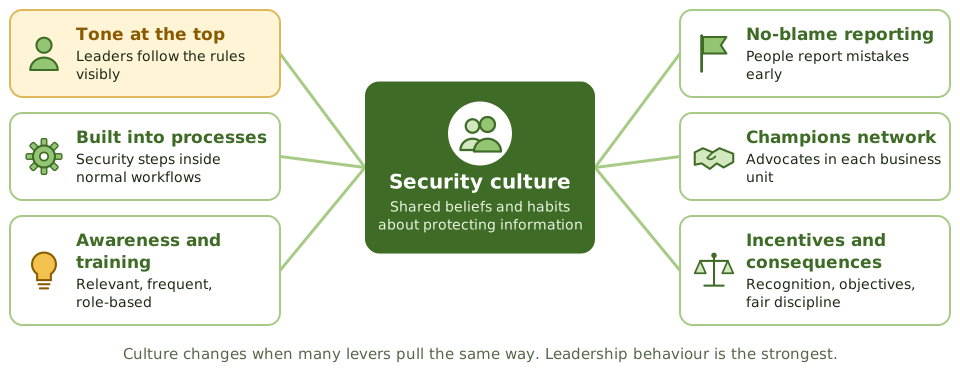
Tone at the top is the strongest lever. People copy what leaders do and reward, not what the policy says.
Healthy versus weak
| Healthy risk culture | Weak risk culture |
|---|---|
| Risks raised early by the business | Risks found only by audit |
| Bad news travels up quickly | Incidents hidden or downplayed |
| Leaders follow the rules | Exceptions for senior staff |
| Mistakes treated as learning | Blame and fear |
Few reported incidents doesn’t prove a healthy culture; it may mean people are hiding them.
Risk awareness program
- Explain what IT risk means in each role.
- Show how to report risks and incidents, simply.
- Use real examples from the organisation and its sector.
- Repeat regularly, and measure behaviour rather than attendance.
Example. After staff who reported phishing clicks were publicly criticised, reports fell by 70%. A new no-blame approach, with thanks for every report, restored reporting within three months.
How the exam asks about it
| If the question asks… | The answer is usually… |
|---|---|
| GREATEST influence on risk culture | Tone at the top: leaders’ behaviour |
| Sign of a healthy culture | Risks raised openly by the business |
| BEST way to improve reporting | No-blame reporting and easy channels |
| Purpose of risk awareness | Everyone recognises and reports risk in their work |
In short
- Risk culture is the shared values, attitudes and behaviours that decide how people treat risk when no rule tells them what to do.
- Tone at the top is the strongest influence: people copy what leaders do and reward, not what policies say.
- Healthy cultures raise risks early, discuss them openly and don't punish honest reporting.
- Signs of a weak culture include hidden incidents, routine workarounds and risks discovered only by audit.
- A risk awareness program helps everyone recognise and report risk in their own work.
Exam traps
- Trying to fix culture with stricter policies or penalties alone.
- Treating awareness as a once-a-year training event.
- Assuming a culture is healthy because few incidents are reported.
- Measuring culture by training completion rather than behaviour.
Slides
Click the slide and use the arrow keys. F toggles full screen.
Where culture comes from
1 / 8