Topics in this domain
- The Security Program: Charter, Scope and Objectives
- Security Team Structure, Roles and Staffing
- Working with Legal, HR, IT, Audit and the Business
- Program Implementation: From Plan to Operating Controls
- Information Asset Identification and Valuation
- Data Classification: Owners, Custodians and Users
- Data Lifecycle: Retention, Archiving and Secure Disposal
- Enterprise Architecture for Security Managers
- Information Security Architecture: Principles and SABSA
- Defence in Depth and Zero Trust
- Cloud Security and Shared Responsibility
- Control Frameworks: NIST SP 800-53, CIS Controls and ISO 27002
- Security Policy Development and Lifecycle
- Security Standards and Baseline Requirements
- Procedures, Guidelines and Acceptable Use
- Policy Enforcement, Exceptions and Review
- Designing Security Metrics: KPIs, KRIs and KCIs
- Collecting, Analysing and Reporting Metrics
- Security Maturity Models and Program Assessment
- Control Types and Categories
- Control Design and Selection Based on Risk and Cost
- Control Testing: Design vs Operating Effectiveness
- Identity and Access Management
- Network and Endpoint Security Controls
- Application Security and the Secure SDLC
- Configuration, Change and Patch Management
- Cryptography for Security Managers
- Security Testing: Scanning, Pen Testing and Tracking Remediation
- Security Awareness Program Design
- Role-Based Security Training
- Phishing Simulations and Social Engineering Defences
- Third-Party Risk Management and Due Diligence
- Vendor Contracts, SLAs and Right to Audit
- Fourth-Party and Supply Chain Risk
- Outsourcing and Managed Security Services
- Security Stakeholder Communication
- Executive Dashboards and Board Reporting
- Continuous Improvement of the Security Program
Security Policy Development and Lifecycle
What policies are for
Policies are management’s instructions to the organisation: what must be protected, who is responsible, and what’s expected of everyone. They give the security program its authority. Everything else (standards, procedures, guidelines) supports them. One CISM task is to establish and maintain information security policies to guide the development of standards, procedures and guidelines.
The documentation hierarchy
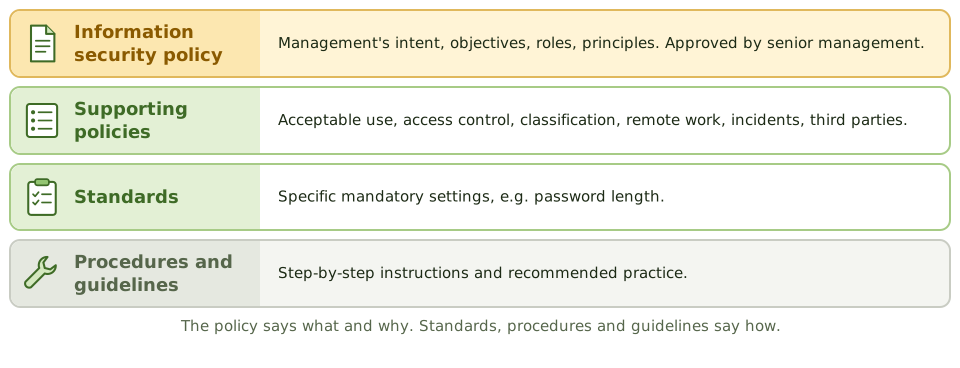
| Document | Purpose | Mandatory? | Example |
|---|---|---|---|
| Policy | Management intent and direction | Yes | “Access is granted on a need-to-know basis.” |
| Standard | Specific, measurable requirements | Yes | “Passwords at least 14 characters; MFA for remote access.” |
| Procedure | Step-by-step instructions | Yes | “How to grant access in the HR system.” |
| Guideline | Recommended practice | No | “Consider using a passphrase.” |
Lower-level documents must support the higher ones, with no contradictions.
The policy life cycle
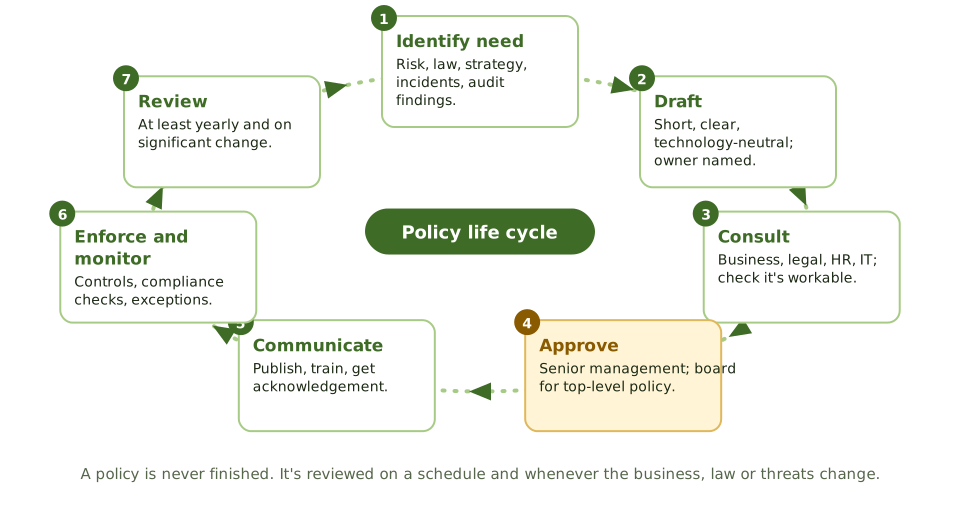
- Identify the need: risks, laws, strategy, incidents, audit findings.
- Draft: short, clear, technology-neutral, with an owner.
- Consult: the business, legal, HR and IT, to make sure it’s workable.
- Approve: senior management; the top-level policy often by the board.
- Communicate: publish, train and get acknowledgement.
- Enforce and monitor: controls, compliance checks, exceptions.
- Review: at least yearly, and whenever the business, laws, technology or threats change significantly.
What makes a good policy
- Aligned with business objectives and the strategy.
- Clear and short, readable by everyone, stating intent rather than detail.
- Technology-neutral, so it survives technology change; specifics go in standards.
- Enforceable: realistic, with consequences and an exception process.
- Owned, with a version, effective date and review date.
- Approved by senior management, visibly.
A common policy set
| Policy | Covers |
|---|---|
| Information security policy | Overall intent, scope, roles, principles |
| Acceptable use | Rules for systems, email, internet and devices |
| Access control | Granting, reviewing and removing access |
| Data classification and handling | Levels and handling rules |
| Incident response | Reporting and handling incidents |
| Third-party security | Supplier requirements and oversight |
Other common topics include remote working, mobile devices, cryptography, backup, change management and AI use.
How the exam asks about it
| If the question asks… | The answer is usually… |
|---|---|
| Who approves the information security policy? | Senior management (or the board) |
| Most important attribute of a policy | Alignment with business objectives and management intent |
| Where do product-specific settings belong? | In standards, not policy |
| When should policies be reviewed? | At least annually, and on significant change |
| First step in developing a policy | Understand the business needs, risks and requirements |
In short
- Policies state management's intent and direction; standards, procedures and guidelines support them.
- The information security policy is approved by senior management (the top-level policy often by the board) and signed or endorsed visibly.
- Good policies are short, clear, technology-neutral, aligned with business objectives and enforceable.
- The life cycle: identify need, draft, consult, approve, communicate, enforce and monitor, review.
- Policies are reviewed at least annually and when the business, laws, technology or threats change significantly.
- Every policy has an owner, a version, an effective date and a review date.
Exam traps
- Policies don't name products or settings; standards do.
- A policy written by security without consulting the business is often unworkable and ignored.
- Approval by the CISO alone lacks authority; senior management approves.
- A policy that isn't communicated or enforced is ineffective.
Slides
Click the slide and use the arrow keys. F toggles full screen.
The documentation hierarchy
The policy life cycle
1 / 9