Topics in this domain
- Risk Management Concepts and Frameworks
- Inherent Risk, Residual Risk, Appetite and Tolerance
- Threat Actors, Motivations and Attack Vectors
- The Evolving Threat Landscape: AI, Cloud and Supply Chain
- Threat Modelling and Cyber Threat Intelligence
- Vulnerability Assessment and Scanning
- Control Deficiencies and Security Gap Analysis
- The Risk Assessment Process
- Qualitative Risk Analysis: Likelihood and Impact
- Quantitative Risk Analysis: SLE, ALE and Loss Estimation
- Risk Scenarios and Prioritisation
- Risk Treatment Options: Mitigate, Transfer, Avoid, Accept
- Risk Acceptance: Approval, Expiry and Review
- Cost-Benefit Analysis for Risk Treatment
- Risk Ownership vs Control Ownership
- RACI and Risk Escalation Paths
- The Risk Register
- Continuous Risk Monitoring and Key Risk Indicators
- Risk Reporting to Executives and the Board
- Integrating Risk Management into Business and IT Processes
Continuous Risk Monitoring and Key Risk Indicators
Risk doesn’t stand still
A risk assessment describes one moment. Threats evolve, systems change, suppliers come and go, and controls quietly degrade. Continuous risk monitoring keeps the picture current, so decisions aren’t based on last year’s facts. One CISM task is to monitor for internal and external factors that may require reassessment of risk.
What triggers reassessment
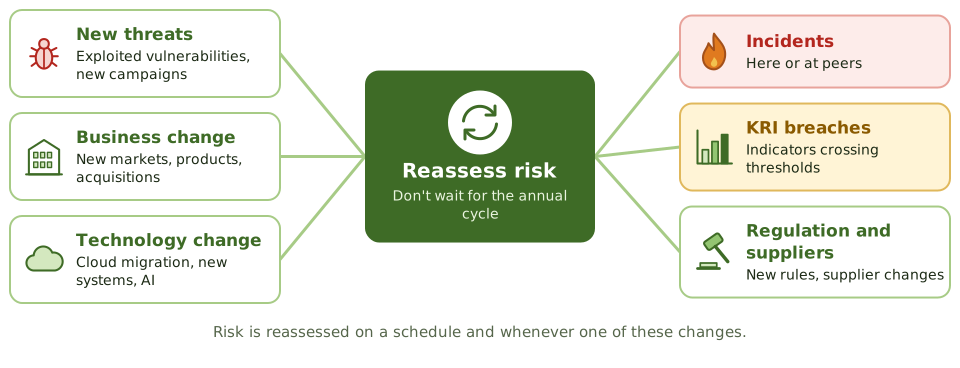
- New threats: exploited vulnerabilities, new attack campaigns
- Business change: new markets, products, acquisitions, reorganisations
- Technology change: cloud migrations, new systems, AI adoption
- Incidents, at the organisation or at peers
- KRI breaches: indicators crossing their thresholds
- Regulation and suppliers: new rules, supplier changes
Key risk indicators
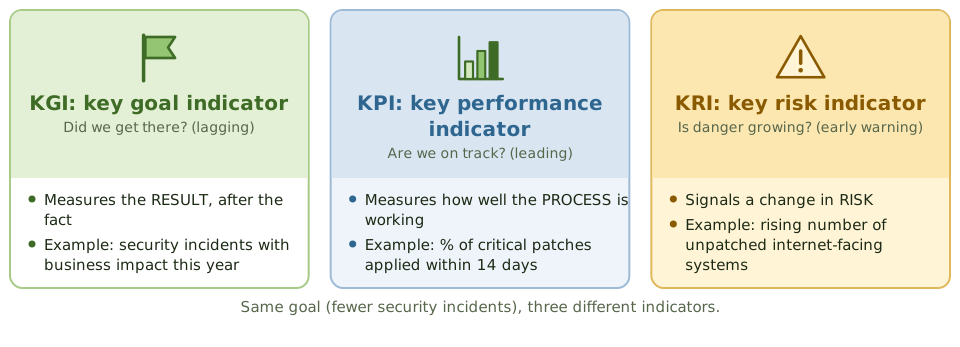
| Indicator | Question | Example |
|---|---|---|
| KRI (key risk indicator) | Is risk exposure changing? | % of privileged accounts without MFA |
| KPI (key performance indicator) | Is the process performing? | % of patches applied within target |
| KGI (key goal indicator) | Did we achieve the goal? | Security incidents with business impact this year |
The best KRIs are leading: they warn before harm occurs. Lagging indicators, such as losses already suffered, confirm the risk but warn too late on their own.
Thresholds make KRIs work
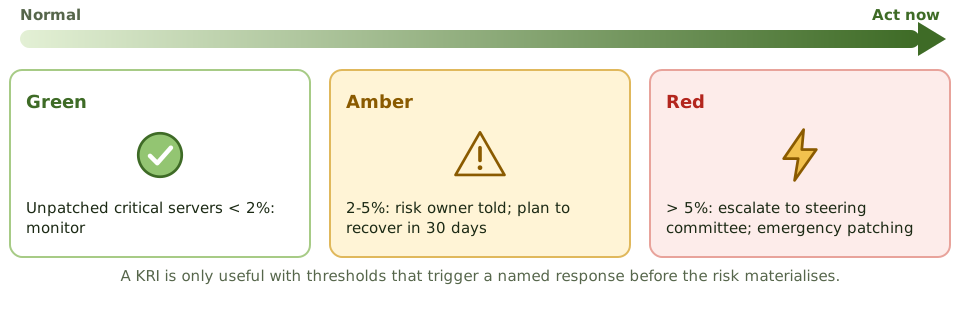
A good KRI is:
- linked to a specific risk in the register
- measurable, preferably automatically
- timely: reported often enough to act on
- owned by a named person
- given thresholds, each triggering an agreed response or escalation
Examples of good KRIs
| Risk | KRI |
|---|---|
| Ransomware | % of critical servers without an offline backup in the last 7 days |
| Account takeover | % of privileged accounts without MFA |
| Insider data loss | Leavers with active accounts more than 24 hours after leaving |
| Supplier breach | Critical suppliers overdue for security review |
| Phishing | Simulation click rate and report rate |
Monitoring also covers controls (are they still operating?) and treatment actions (are they delivered on time?). Pick a few KRIs that track the top risks; dozens of indicators dilute attention.
How the exam asks about it
| If the question asks… | The answer is usually… |
|---|---|
| An indicator that warns risk is rising | A key risk indicator (KRI) |
| What makes a KRI useful | Linked to a risk, with thresholds and an owner |
| When to reassess risk | On a schedule, and when internal or external factors change |
| The best KRIs are… | Leading, giving early warning |
| A KRI crosses its threshold | Trigger the agreed response or escalation |
In short
- Risk changes constantly, so it's monitored continuously, not only at the annual assessment.
- Triggers for reassessment include new threats, business and technology change, incidents, KRI breaches, regulation and supplier changes.
- A key risk indicator (KRI) is a metric that signals a change in risk exposure, ideally before harm occurs (leading).
- Good KRIs are linked to specific risks, measurable, timely, owned and have thresholds that trigger action.
- KRIs differ from KPIs (process performance) and KGIs (goal achievement).
- Monitoring also checks that controls keep working and that treatment actions are delivered.
Exam traps
- A KRI without thresholds and a named response is just a number on a report.
- Lagging indicators (losses already suffered) warn too late on their own.
- Too many KRIs dilute attention; pick the few that track the top risks.
- Monitoring that nobody reviews isn't monitoring.
Slides
Click the slide and use the arrow keys. F toggles full screen.
What triggers reassessment
Key risk indicators
Thresholds make KRIs work