Topics in this domain
- Event vs Incident vs Breach
- Developing the Incident Response Plan
- Incident Response Team Roles and Authority
- Incident Classification and Severity Levels
- Incident Response Playbooks and Decision Trees
- Escalation and Communication Plans
- Business Impact Analysis
- RTO, RPO, MTD and Recovery Prioritisation
- Business Continuity Planning and Strategies
- Crisis Management and Continuity Governance
- Disaster Recovery Planning
- Recovery Sites: Hot, Warm and Cold
- Backup Strategies and Cloud DR
- Incident Response Training
- Testing Plans: Tabletop, Functional and Full Interruption
- Evaluating Exercises and Improving Readiness
- Security Event Detection and Monitoring Methods
- SIEM, the SOC and Event Correlation
- Threat Intelligence and Indicators of Compromise
- Incident Triage and Initial Investigation
- Evidence Preservation, Forensics and Chain of Custody
- Containment Strategies: Short-Term and Long-Term
- Making Containment Decisions
- Breach Notification and Regulatory Reporting
- External Communications: Customers, Media and Law Enforcement
- Eradication, Recovery and Return to Normal Operations
- Post-Incident Review and Root Cause Analysis
- Lessons Learned and Incident Trend Analysis
Incident Response Training
Plans don’t respond, people do
An incident response plan is only as good as the people who carry it out at 3 a.m. under pressure. Incident management training, testing and evaluation is a named CISM topic, and training makes sure everyone, from the receptionist who spots a phishing email to the CEO deciding whether to shut down a factory, knows their part.
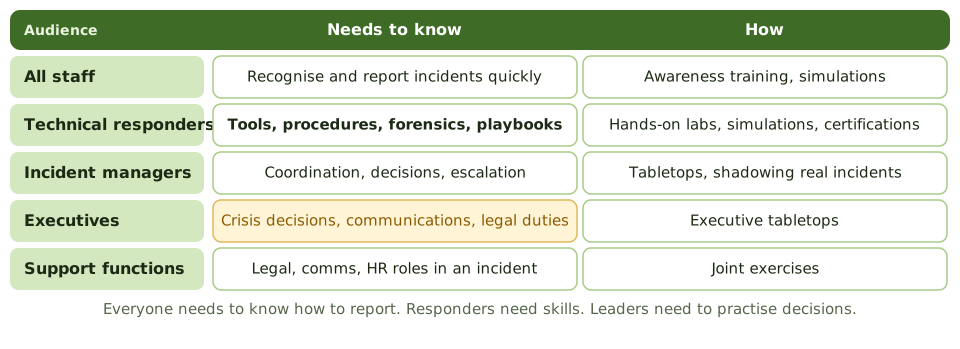
Training by audience
| Audience | Needs to know | How |
|---|---|---|
| All staff | How to recognise and report incidents quickly | Awareness training, simulations |
| Technical responders | Tools, procedures, forensics, playbooks | Hands-on labs, simulations, certifications |
| Incident managers | Coordination, decisions, escalation | Tabletops, shadowing real incidents |
| Executives | Crisis decisions, communications, legal duties | Executive tabletop exercises |
| Support functions | Legal, communications and HR roles in an incident | Joint exercises |
Building responder skills
- Hands-on labs with the real tools: EDR, SIEM, forensic software, cloud consoles.
- Playbook drills: walking through each playbook step by step.
- Certifications, such as incident handling and cloud forensics.
- Threat intelligence, to learn current attacker techniques.
Making training stick
- Base it on the actual plan and playbooks.
- Train deputies as well as primaries.
- Refresh regularly and after plan changes; skills fade and threats change.
- Test through exercises, and feed gaps back into the program.
Example. A post-incident review finds the on-call analyst didn’t know how to isolate a cloud server, because training had covered only on-premises systems. The team adds cloud containment to the playbooks and runs a lab session for everyone on the on-call rota.
How the exam asks about it
| If the question asks… | The answer is usually… |
|---|---|
| Most important IR training for all staff | How to recognise and report incidents |
| Best way to prepare executives | Executive tabletop exercises |
| Who else needs incident response training? | Legal, communications, HR, and deputies |
| Basis for IR training content | The plan and playbooks |
| How to measure training effectiveness | Performance in exercises and real incidents |
In short
- Incident management training is a named CISM topic: plans only work if people know their roles and can perform them under pressure.
- All staff need to recognise and report incidents; responders need technical skills; incident managers need coordination skills; executives need to practise crisis decisions.
- Training is tied to the plan and playbooks, so people learn the procedures they'll actually use.
- Responders keep skills current through hands-on labs, simulations, certifications and threat intelligence.
- New team members are trained before going on call; deputies are trained as well as primaries.
- Training effectiveness is measured in exercises and real incidents, and gaps feed back into the program.
Exam traps
- Training only the security team leaves legal, communications and executives unprepared.
- A plan nobody has been trained on fails on the first real incident.
- Deputies who've never practised can't step in when the primary is unavailable.
- Training once at onboarding isn't enough; skills fade and threats change.
Slides
Click the slide and use the arrow keys. F toggles full screen.
Training by audience
1 / 8