Topics in this domain
- Event vs Incident vs Breach
- Developing the Incident Response Plan
- Incident Response Team Roles and Authority
- Incident Classification and Severity Levels
- Incident Response Playbooks and Decision Trees
- Escalation and Communication Plans
- Business Impact Analysis
- RTO, RPO, MTD and Recovery Prioritisation
- Business Continuity Planning and Strategies
- Crisis Management and Continuity Governance
- Disaster Recovery Planning
- Recovery Sites: Hot, Warm and Cold
- Backup Strategies and Cloud DR
- Incident Response Training
- Testing Plans: Tabletop, Functional and Full Interruption
- Evaluating Exercises and Improving Readiness
- Security Event Detection and Monitoring Methods
- SIEM, the SOC and Event Correlation
- Threat Intelligence and Indicators of Compromise
- Incident Triage and Initial Investigation
- Evidence Preservation, Forensics and Chain of Custody
- Containment Strategies: Short-Term and Long-Term
- Making Containment Decisions
- Breach Notification and Regulatory Reporting
- External Communications: Customers, Media and Law Enforcement
- Eradication, Recovery and Return to Normal Operations
- Post-Incident Review and Root Cause Analysis
- Lessons Learned and Incident Trend Analysis
Lessons Learned and Incident Trend Analysis
From one incident to many
A single incident teaches specific lessons. Looking across dozens of incidents reveals patterns: the same root cause appearing again, one category rising, one business unit always slower to respond. That’s where the biggest improvements come from, and it closes the loop between incident management and the risk and program work in Domains 2 and 3.
Making lessons stick
- Capture: post-incident review reports go into a searchable knowledge base of incidents, causes and fixes.
- Share: briefings for responders, owners and leaders; anonymised case studies for all staff.
- Act: actions are tracked to closure; plans and playbooks are updated.
- Verify: exercises check that the fixes work.
Lessons recorded but never acted on aren’t lessons learned.
Trend metrics
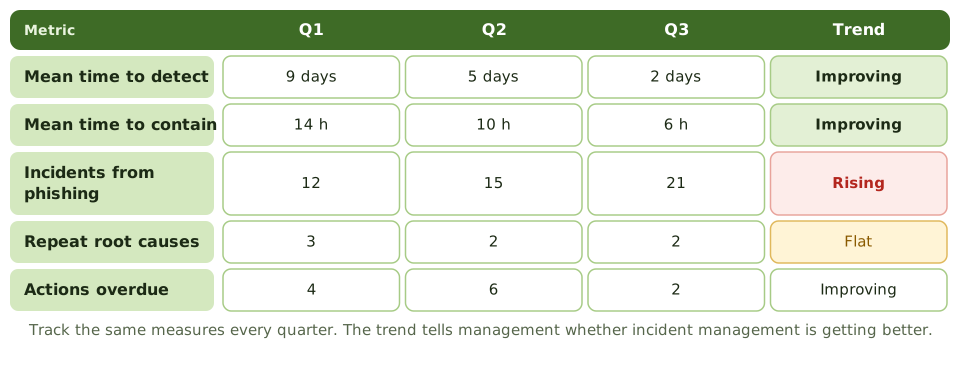
| Metric | What it shows |
|---|---|
| Mean time to detect / contain / recover | Speed of the incident capability |
| Incidents by category and source | Where risk is rising |
| Repeat root causes | Whether fixes address underlying problems |
| Overdue corrective actions | Whether improvement is actually happening |
| % of incidents detected internally | Detection strength |
Consistent categorisation is a prerequisite; without it, trends are unreliable.
Turning trends into action
- A rising category: reassess the risk; adjust controls and training.
- Repeat root causes: fix the underlying process.
- Slow detection or containment: invest in tools, skills or playbooks.
- Overdue actions: escalate through governance.
Example. Quarterly trend analysis shows phishing-led incidents rising for three quarters, mostly through personal email accessed on work laptops. The security manager reassesses the risk, restricts personal webmail on corporate devices and refocuses awareness on the new lures. The next quarter, phishing incidents halve.
Learn from other organisations’ incidents too, through threat intelligence, sector groups and published reports. It’s a far cheaper way to learn.
How the exam asks about it
| If the question asks… | The answer is usually… |
|---|---|
| Main benefit of incident trend analysis | It reveals patterns and systemic weaknesses |
| What trends should feed into | Risk assessment, program priorities, training and plans |
| Prerequisite for trend analysis | Consistent incident categorisation |
| Lessons are recorded but not acted on | They aren’t truly learned; track the actions |
| A proactive source of lessons | Other organisations’ incidents |
In short
- Lessons learned are captured, shared and acted on, not just written in a report nobody reads.
- A knowledge base of incidents, root causes and fixes speeds future response.
- Trend analysis across incidents reveals patterns: rising categories, repeat root causes, weak areas, seasonal peaks.
- Incident metrics (time to detect, contain and recover; incidents by category; repeat causes; overdue actions) show whether incident management is improving.
- Trends feed the risk assessment, program priorities, training and plan updates, closing the loop with Domains 2 and 3.
- Lessons from other organisations' incidents are valuable too, and cheaper.
Exam traps
- Lessons recorded but never acted on aren't lessons learned.
- Looking at incidents one at a time misses patterns.
- Inconsistent categorisation makes trend analysis unreliable.
- Only learning from your own incidents is reactive; learn from peers too.
Slides
Click the slide and use the arrow keys. F toggles full screen.
Trend metrics