Topics in this domain
- IT Risk Events, Loss Types and Business Outcomes
- Threat Sources, Actors and Motivations
- The Changing Threat Landscape and Threat Modelling
- Vulnerabilities, Control Deficiencies and Risk Conditions
- Identifying Internal and External Risk Factors
- Building IT Risk Scenarios
- Evaluating Scenarios for Completeness and Relevance
- Common Risk Scenario Errors
- Risk Assessment Concepts and Standards
- Qualitative, Semi-Quantitative and Quantitative Analysis
- Quantitative Methods: ALE, FAIR and Monte Carlo
- Risk Analysis Techniques: Bow-Tie, Fault Tree, Event Tree and Delphi
- Choosing a Consistent Assessment Methodology
- Translating Technical Events into Business Impact
- Business Impact Analysis for Risk Prioritisation
- Inherent and Residual Risk
- Evaluating Risk Against Business Objectives and Appetite
- Creating and Maintaining the IT Risk Register
- Using the Risk Register to Support Decisions
Risk Analysis Techniques: Bow-Tie, Fault Tree, Event Tree and Delphi
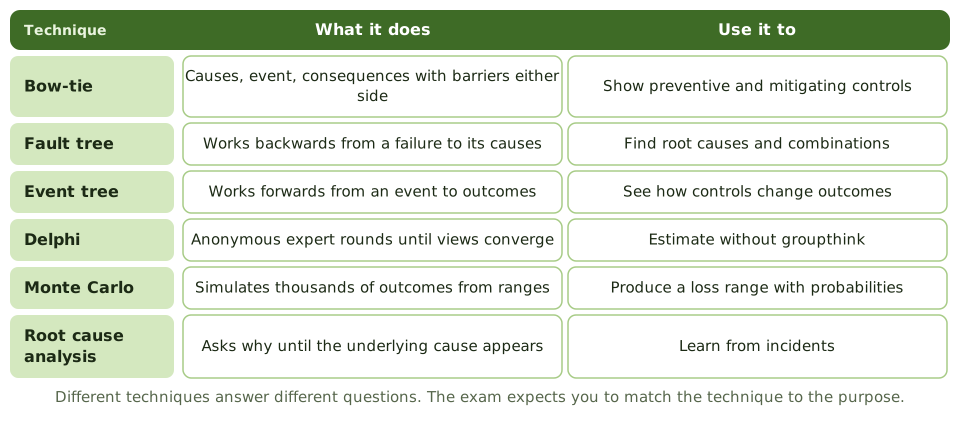
Choosing a technique
The bow-tie
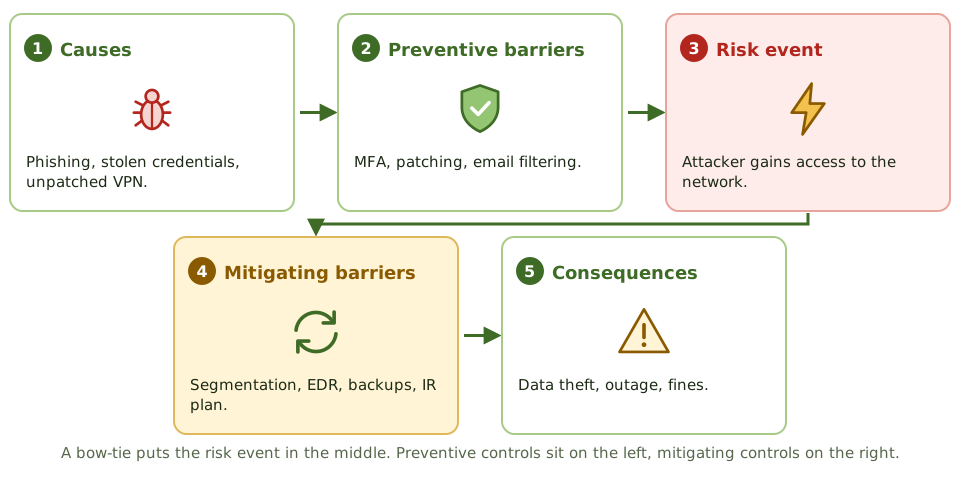
The bow-tie puts the risk event in the middle. Preventive controls sit on the left, between the causes and the event; mitigating controls sit on the right, between the event and the consequences.
Fault tree versus event tree
- Fault tree: start with the failure and work back. Which combinations of causes (AND/OR) lead to it?
- Event tree: start with the event and work forward. If each control works or fails, what outcomes follow?
Getting good estimates
- Delphi: anonymous rounds until the experts converge.
- Structured interviews and workshops with clear scales.
- Calibrating estimates against incident and industry data.
Example. Estimates of a cloud outage’s likelihood swung wildly in an open workshop dominated by one senior engineer. A two-round Delphi exercise produced a tighter, better-supported range.
How the exam asks about it
| If the question asks… | The answer is usually… |
|---|---|
| Technique showing preventive and mitigating controls | Bow-tie |
| Work backwards from a failure to causes | Fault tree analysis |
| Avoid groupthink in expert estimates | Delphi technique |
| Prevent an incident recurring | Root cause analysis |
In short
- Bow-tie analysis shows causes and preventive controls on one side and consequences and mitigating controls on the other.
- Fault tree analysis works backwards from a failure to the combinations of causes that produce it.
- Event tree analysis works forwards from an event through control success or failure to possible outcomes.
- The Delphi technique gathers anonymous expert estimates in rounds to avoid groupthink.
- Root cause analysis finds the underlying cause so that fixes prevent recurrence.
- Match the technique to the question you need to answer.
Exam traps
- Confusing fault tree (backwards to causes) with event tree (forwards to outcomes).
- Using open group discussion where Delphi's anonymity is needed to avoid dominant voices.
- Treating symptoms because root cause analysis wasn't done.
- Choosing a complex technique where a simple workshop would do.
Slides
Click the slide and use the arrow keys. F toggles full screen.
Choosing a technique
The bow-tie
1 / 8