Topics in this domain
- IT Risk Events, Loss Types and Business Outcomes
- Threat Sources, Actors and Motivations
- The Changing Threat Landscape and Threat Modelling
- Vulnerabilities, Control Deficiencies and Risk Conditions
- Identifying Internal and External Risk Factors
- Building IT Risk Scenarios
- Evaluating Scenarios for Completeness and Relevance
- Common Risk Scenario Errors
- Risk Assessment Concepts and Standards
- Qualitative, Semi-Quantitative and Quantitative Analysis
- Quantitative Methods: ALE, FAIR and Monte Carlo
- Risk Analysis Techniques: Bow-Tie, Fault Tree, Event Tree and Delphi
- Choosing a Consistent Assessment Methodology
- Translating Technical Events into Business Impact
- Business Impact Analysis for Risk Prioritisation
- Inherent and Residual Risk
- Evaluating Risk Against Business Objectives and Appetite
- Creating and Maintaining the IT Risk Register
- Using the Risk Register to Support Decisions
Threat Sources, Actors and Motivations
Four sources of threat
- Adversarial: people with intent, such as criminals, insiders and nation-states.
- Accidental: mistakes, such as a misdirected email or a wrong configuration.
- Structural: failures of hardware, software or capacity.
- Environmental: fire, flood, power loss or pandemic.
Accidental and structural threats cause many incidents and are often underweighted.
Who attacks, and why
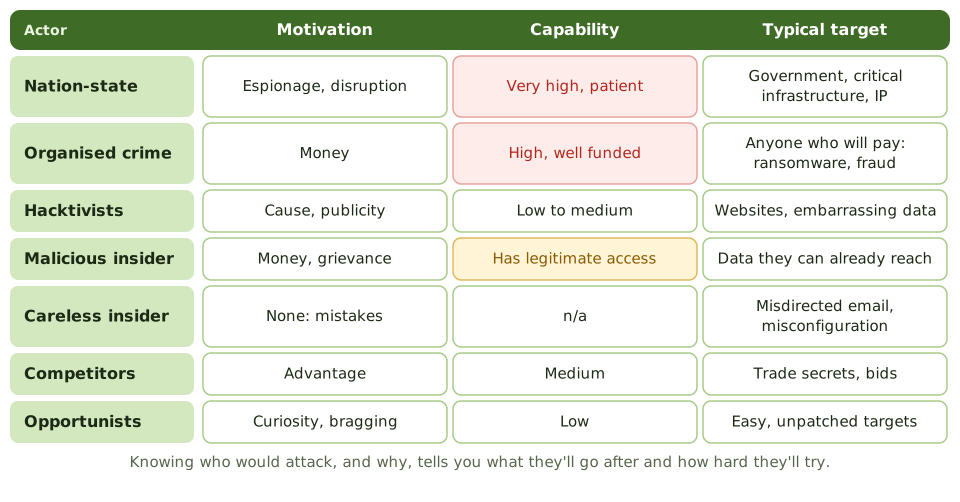
Motivation drives likelihood
A threat is more likely when an actor has both the motive and the capability. A hospital is attractive to ransomware gangs because it can’t tolerate downtime; a defence contractor attracts nation-states because of its secrets.
Example. A small accounting firm assumed it was too small to target. Organised criminals didn’t care: the firm held hundreds of clients’ tax records and paid a ransom faster than a large company would.
Don’t forget the insider
- Already has access and knowledge.
- Bypasses perimeter controls.
- Can be malicious or simply careless.
- Controls: least privilege, segregation of duties, monitoring and a prompt leaver process.
How the exam asks about it
| If the question asks… | The answer is usually… |
|---|---|
| Why consider threat actor motivation | It affects likelihood and targets |
| Threat that bypasses perimeter controls | Insider |
| MOST common cause of many incidents | Human error and failures, not only attacks |
| Small organisation thinks it’s not a target | Opportunistic and criminal actors still target it |
In short
- Threat sources are adversarial (people with intent), accidental (mistakes), structural (failures) and environmental (natural and physical events).
- Adversarial actors include nation-states, organised crime, hacktivists, insiders, competitors and opportunists.
- Motivation and capability decide what an actor targets and how hard they try.
- Insiders matter because they already have legitimate access.
- Accidental and structural threats cause many incidents and are often underweighted.
Exam traps
- Focusing only on external hackers and ignoring errors, failures and insiders.
- Rating likelihood without considering who would want to attack and why.
- Assuming the organisation is too small to be targeted.
- Treating every actor as equally capable.
Slides
Click the slide and use the arrow keys. F toggles full screen.
Who attacks, and why
1 / 8