Topics in this domain
- IT Risk Events, Loss Types and Business Outcomes
- Threat Sources, Actors and Motivations
- The Changing Threat Landscape and Threat Modelling
- Vulnerabilities, Control Deficiencies and Risk Conditions
- Identifying Internal and External Risk Factors
- Building IT Risk Scenarios
- Evaluating Scenarios for Completeness and Relevance
- Common Risk Scenario Errors
- Risk Assessment Concepts and Standards
- Qualitative, Semi-Quantitative and Quantitative Analysis
- Quantitative Methods: ALE, FAIR and Monte Carlo
- Risk Analysis Techniques: Bow-Tie, Fault Tree, Event Tree and Delphi
- Choosing a Consistent Assessment Methodology
- Translating Technical Events into Business Impact
- Business Impact Analysis for Risk Prioritisation
- Inherent and Residual Risk
- Evaluating Risk Against Business Objectives and Appetite
- Creating and Maintaining the IT Risk Register
- Using the Risk Register to Support Decisions
Inherent and Residual Risk
Before and after controls
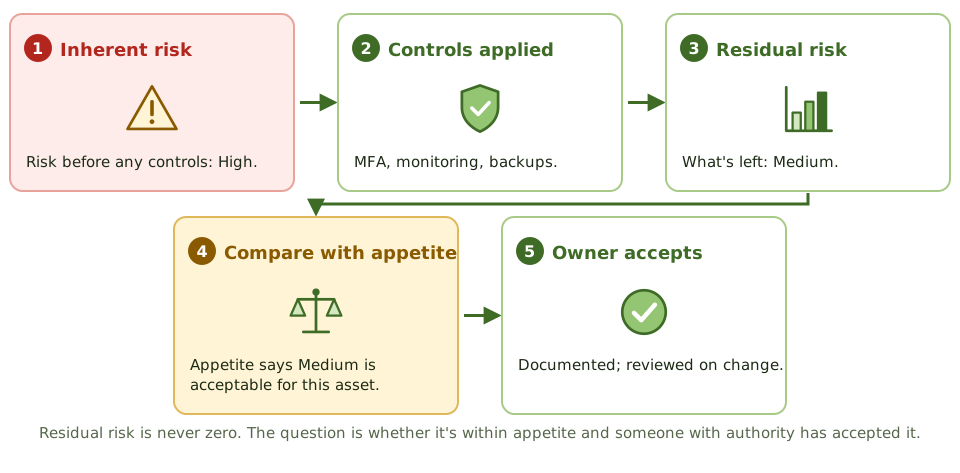
- Inherent risk is the level of risk before considering controls.
- Residual risk is what remains after them. It’s never zero, and must be within appetite or formally accepted.
Why both matter
- Inherent risk shows the exposure if controls fail, and identifies the key controls that must be tested.
- Residual risk shows the risk actually carried, and is compared with appetite to make decisions.
Estimating residual risk honestly
- Base it on how controls actually operate, using test results.
- Discount controls that are untested or have failed.
- Consider how controls could be bypassed.
- Re-estimate after control changes or failures.
Example. A team rated residual fraud risk low because a dual-approval control existed. Testing found approvers routinely approved their own requests through delegated accounts. Residual risk was re-rated high, close to inherent.
How the exam asks about it
| If the question asks… | The answer is usually… |
|---|---|
| Risk before controls | Inherent risk |
| Risk after controls | Residual risk |
| Residual risk exceeds appetite | Further response or formal acceptance |
| BEST basis for a residual estimate | The controls’ tested effectiveness |
In short
- Inherent risk is the level of risk before considering controls; residual risk is what remains after them.
- Residual risk should reflect controls as they actually operate, not as designed on paper.
- Comparing inherent and residual risk shows how much controls reduce risk, and which controls matter most.
- Residual risk is never zero; it must be within appetite or formally accepted.
- If key controls fail, risk returns towards its inherent level.
Exam traps
- Estimating residual risk assuming every control works perfectly.
- Believing residual risk can be eliminated.
- Closing a risk because controls exist, without checking residual risk against appetite.
- Ignoring inherent risk, which shows the exposure if controls fail.
Slides
Click the slide and use the arrow keys. F toggles full screen.
Before and after controls
1 / 7