Topics in this domain
- Enterprise Architecture and IT Risk
- Change Management Risk
- Assets, Configuration and Dependencies
- Incident and Problem Management Oversight
- Project Governance and IT Risk
- Governing the Secure SDLC
- DevOps, CI/CD and Agile Delivery Risk
- Testing, Release and Deployment Risk
- Data Classification, Ownership and Handling
- Data Lifecycle: Integrity, Retention and Disposal
- Business Continuity Planning and Governance
- Disaster Recovery and Testing Recovery Capability
- Emerging Technology Risk: Cloud, IoT and OT
- AI and Machine Learning Risk
- Setting Risk Boundaries for Innovation
- Core Security Concepts: CIA, IAM, Cryptography and Network Security
- Security Frameworks and Control Standards
- Security Awareness Culture and Measuring Training
- Privacy Governance and Data Protection Principles
- Developing a Data Protection Control Strategy
Enterprise Architecture and IT Risk
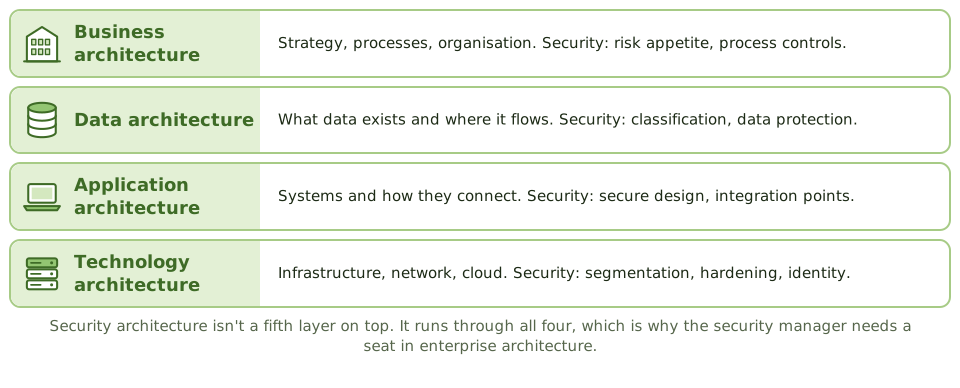
The architecture layers
Why it matters for risk
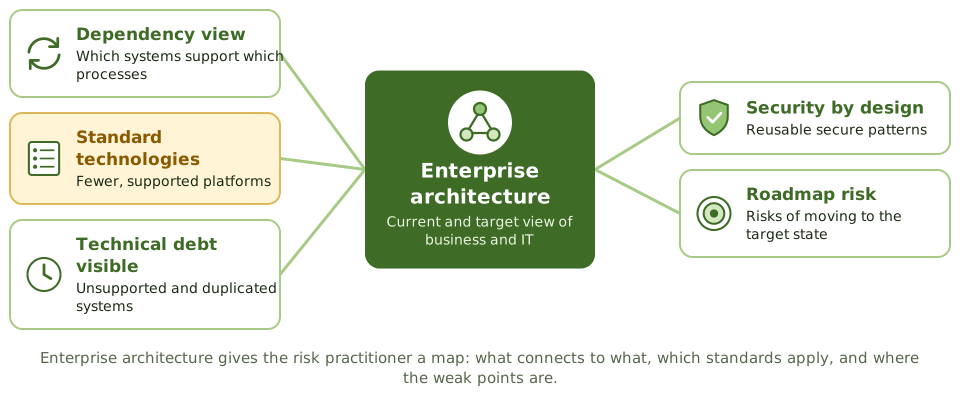
Standard, supported technologies reduce complexity and risk; sprawl and unsupported systems increase it.
Roadmaps and transition risk
A technology roadmap moves the organisation from its current architecture to a target state. The destination may be lower risk, but the journey isn’t: migrations, parallel systems and skills gaps all create risk along the way.
Example. A bank’s roadmap retired a 20-year-old core system. Architecture mapping found 40 undocumented interfaces depending on it. Each became a migration risk with an owner before cutover planning began.
Architecture governance
- Architecture standards are approved and maintained.
- Projects are reviewed against standards at design.
- Exceptions are risk-assessed and time-limited.
- Unsupported systems are tracked in the risk register.
How the exam asks about it
| If the question asks… | The answer is usually… |
|---|---|
| Benefit of EA to risk management | Shows dependencies and supports risk-aware decisions |
| Project wants a non-standard technology | A risk-assessed architecture exception |
| Risk of moving to a target architecture | Transition risk must be assessed |
| Unsupported legacy system | Record and manage the risk; plan replacement |
In short
- Enterprise architecture describes the business, data, application and technology layers and how they connect.
- It shows dependencies, technical debt and single points of failure that drive IT risk.
- Standard, supported technologies reduce complexity and risk; sprawl and unsupported systems increase it.
- Technology roadmaps move from current to target state; the transition itself carries risk.
- Security and risk should be built into architecture decisions, not reviewed afterwards.
Exam traps
- Treating architecture as an IT-only concern with no business input.
- Ignoring the risk of the transition between current and target states.
- Allowing projects to bypass architecture standards without exceptions.
- Leaving unsupported legacy systems off the risk register.
Slides
Click the slide and use the arrow keys. F toggles full screen.
The architecture layers
Why it matters for risk
1 / 8