Topics in this domain
- Enterprise Architecture and IT Risk
- Change Management Risk
- Assets, Configuration and Dependencies
- Incident and Problem Management Oversight
- Project Governance and IT Risk
- Governing the Secure SDLC
- DevOps, CI/CD and Agile Delivery Risk
- Testing, Release and Deployment Risk
- Data Classification, Ownership and Handling
- Data Lifecycle: Integrity, Retention and Disposal
- Business Continuity Planning and Governance
- Disaster Recovery and Testing Recovery Capability
- Emerging Technology Risk: Cloud, IoT and OT
- AI and Machine Learning Risk
- Setting Risk Boundaries for Innovation
- Core Security Concepts: CIA, IAM, Cryptography and Network Security
- Security Frameworks and Control Standards
- Security Awareness Culture and Measuring Training
- Privacy Governance and Data Protection Principles
- Developing a Data Protection Control Strategy
Setting Risk Boundaries for Innovation
Enable, don’t block
Organisations that refuse all new technology lose ground to competitors; those that adopt it blindly suffer avoidable losses. The risk practitioner’s job is to make safe experimentation possible within the appetite the board has set.
Guardrails in practice
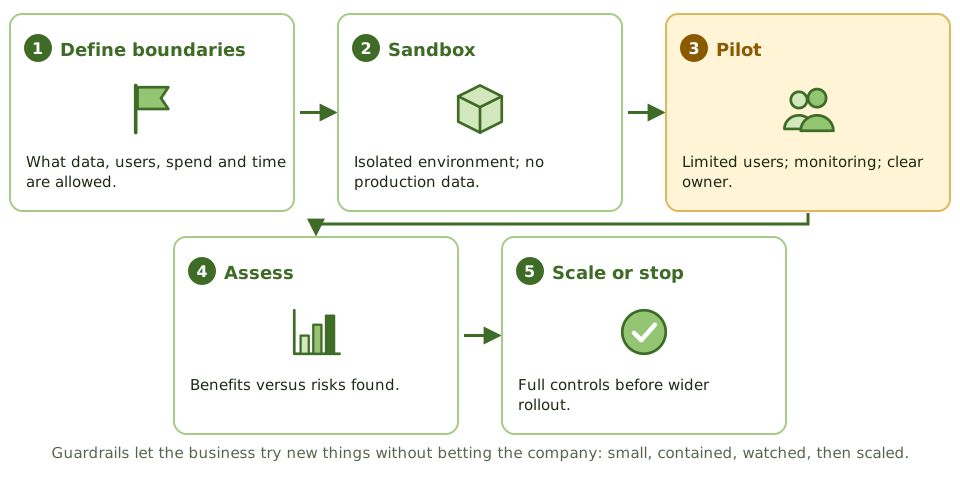
Typical boundaries
| Boundary | Example |
|---|---|
| Data | No customer or personal data in the pilot |
| Users | 50 internal users only |
| Time | 90-day trial, then decide |
| Spend | Capped budget |
| Integration | No connection to production systems |
Example. A retailer wanted to test an AI chatbot for customer service. Guardrails limited it to answering product questions with no access to orders or accounts. After a successful pilot, full controls were added before it handled customer data.
How the exam asks about it
| If the question asks… | The answer is usually… |
|---|---|
| BEST approach to a promising but risky technology | Pilot with defined guardrails |
| Pilot becomes production | Apply full controls first |
| Data in a sandbox | No production or sensitive data |
| Role of risk management in innovation | Enable it within appetite |
In short
- Risk management should enable innovation within appetite, not block it.
- Guardrails define what data, users, spend and time a new initiative may use.
- Sandboxes and pilots let the business learn while limiting the impact of failure.
- Full controls are required before an innovation scales to production.
- Each innovation needs an owner who accepts its risk.
Exam traps
- Banning new technology because its risks aren't fully known.
- Letting pilots quietly become production systems without controls.
- Using production data in sandboxes.
- Innovation projects with no risk owner.
Slides
Click the slide and use the arrow keys. F toggles full screen.
Guardrails in practice
1 / 7