Topics in this domain
- Enterprise Architecture and IT Risk
- Change Management Risk
- Assets, Configuration and Dependencies
- Incident and Problem Management Oversight
- Vulnerability and Patch Management Risk
- Security Monitoring, Logging and Detection
- Project Governance and IT Risk
- Governing the Secure SDLC
- DevOps, CI/CD and Agile Delivery Risk
- Testing, Release and Deployment Risk
- Data Classification, Ownership and Handling
- Data Lifecycle: Integrity, Retention and Disposal
- Business Continuity Planning and Governance
- Disaster Recovery and Testing Recovery Capability
- Emerging Technology Risk: Cloud, IoT and OT
- AI and Machine Learning Risk
- Setting Risk Boundaries for Innovation
- Core Security Concepts: CIA, IAM, Cryptography and Network Security
- Security Frameworks and Control Standards
- Security Awareness Culture and Measuring Training
- Privacy Governance and Data Protection Principles
- Developing a Data Protection Control Strategy
- Identity and Access Management Risk
Security Monitoring, Logging and Detection
Assume something gets through
Preventive controls reduce risk but never remove it. Detection limits the damage: the sooner an attack is spotted, the less an attacker can do.
Example. An attacker used stolen credentials for four months before anyone noticed. The logs had recorded every step. Nobody was looking at them.
From logs to alerts
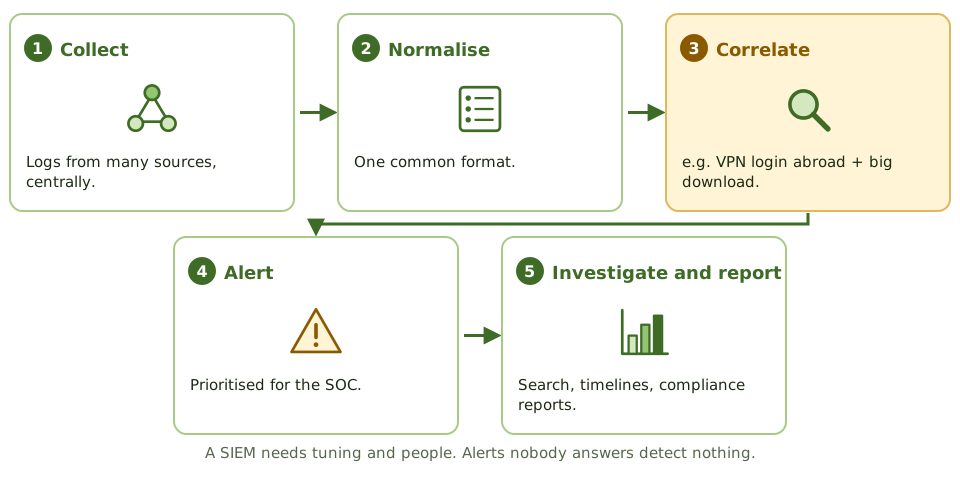
A security information and event management (SIEM) system collects logs from many sources, puts them in a common format and correlates them to spot patterns no single log shows. A security operations centre (SOC), in-house or outsourced, triages the alerts, investigates and escalates real incidents to incident response.
Protecting the evidence
Logs are only useful if they can be trusted:
- central and separate: sent off the source system as they’re created
- tamper-proof: administrators can’t delete or edit records of their own activity
- kept long enough: retention set by investigation needs and regulation
- time-synchronised: all systems on one time source, so events line up
Is monitoring effective?
The diagram shows three questions for judging whether monitoring works. Coverage: can we see it? Critical systems, cloud, endpoints and identity should send logs, with any gaps known and accepted. Detection: will we notice? Detection use cases should map to the top risk scenarios, rules should be tuned to cut false alarms, and detection should be tested, for example with simulated attacks. Response: will we act in time? Alerts need triage around the clock, clear escalation to incident response, and tracking of mean time to detect and respond.
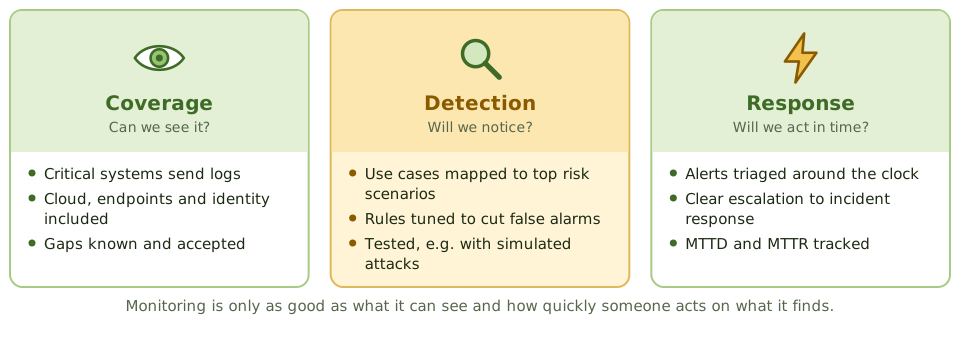
The risk practitioner’s question is whether detection matches the top risk scenarios. If the biggest risk is ransomware through stolen remote access, there should be detection for unusual logins, privilege changes and mass file encryption, and someone ready to act on it at any hour.
Metrics for detection
| Metric | What it tells you |
|---|---|
| Mean time to detect (MTTD) | How long attackers go unnoticed |
| Mean time to respond (MTTR) | How quickly incidents are contained |
| Critical systems without logging | Blind spots |
| False positive rate | Whether analysts can keep up |
How the exam asks about it
| If the question asks… | The answer is usually… |
|---|---|
| Logs exist but attacks went unnoticed | Logs aren’t reviewed; a monitoring process is needed |
| Protecting admin activity logs | Central logging that admins can’t alter |
| BEST indicator of detection capability | Mean time to detect |
| Linking monitoring to risk | Detection use cases based on top risk scenarios |
| Too many alerts to handle | Tune the rules and prioritise by risk |
In short
- Preventive controls eventually fail, so the organisation needs to detect attacks and respond quickly.
- Logs must be collected centrally, protected from tampering, kept long enough and actually reviewed.
- A SIEM collects and correlates logs; a security operations centre (SOC) triages and investigates alerts.
- Effective monitoring needs coverage, detection use cases linked to risk scenarios, and timely response.
- Mean time to detect (MTTD) and respond (MTTR) are key indicators of detection capability.
Exam traps
- Collecting logs that nobody reviews.
- Letting administrators delete or edit logs of their own activity.
- Measuring the number of alerts instead of how quickly real incidents are found.
- Detection rules that don't reflect the organisation's top risk scenarios.
Slides
Click the slide and use the arrow keys. F toggles full screen.
Turn your phone sideways for a bigger view. Tap any diagram to enlarge it.
From logs to alerts
Is monitoring effective?